Hearing that you have a cavity can make your stomach drop a little. Most patients aren't worried only about the tooth. They're also wondering if the visit will hurt, how long it will take, and whether the filling will show when they smile.
The good news is that a modern composite tooth filling procedure is designed to repair the tooth in a way that looks natural and feels comfortable. For many patients in Pico Rivera, this treatment is a straightforward way to stop decay early, protect the tooth, and get back to normal without a dramatic change to their smile.
Restore Your Smile with Tooth-Colored Fillings in Pico Rivera
You come in expecting a routine checkup, and the intraoral camera shows a small dark area on the screen before the tooth ever has a chance to turn into a bigger problem. That moment is often a relief for patients in our Pico Rivera office. They can see what I'm seeing, ask questions, and understand why a small filling now is easier than waiting.
Composite fillings let us repair that tooth in a way that looks natural and preserves your smile. The American Dental Association notes in its guidance on composite fillings from MouthHealthy that composite resin is commonly used on both front and back teeth for small-to-mid-size restorations. In plain terms, it is often a good choice when a tooth needs support, but you do not want the repair to stand out.

Why many patients choose tooth-colored fillings
In practice, patients usually want three things. They want the cavity treated early, the visit to feel manageable, and the final result to blend in when they talk or smile.
At Cali Family Dental, the technology helps with each part of that experience.
- Natural appearance because we can compare the tooth closely with intraoral images and match the shade more precisely
- Accurate treatment planning with digital imaging that helps us spot smaller areas before they require a larger repair
- Conservative repair because composite can be placed and shaped carefully to rebuild the part of the tooth that is damaged
- A more comfortable visit because modern tools, including lasers in selected cases, can make treatment more efficient and less stressful for anxious patients
Patients looking for a dentist in Pico Rivera, CA or a cosmetic dentist near me are usually asking for that balance. They want the tooth fixed properly, but they also want their smile to keep looking like their own.
A good filling should repair the tooth, match the smile, and feel comfortable when you bite.
A practical way to think about treatment
Many patients still picture a filling as a noticeable silver spot. That is not how modern composite treatment feels in most cases. I place the material in layers, shape it to fit your bite, and polish it so the surface feels smooth and natural.
The trade-off is simple. Composite is highly aesthetic and very useful for many cavities, but the tooth still has to be evaluated carefully. Some areas handle biting pressure better than others, and larger damage may call for a different restoration. For the right tooth, though, a tooth-colored filling is often the most comfortable and natural-looking way to restore function without making the repair obvious.
Understanding Why You Might Need a Dental Filling
You may come in with a quick complaint. Cold water stings one side. A sweet snack catches on a tooth. Sometimes there is no warning at all, and we find the problem during a routine exam.
That is how many cavities start. The outer tooth structure weakens, a small area breaks down, and the tooth cannot rebuild that spot on its own. Once bacteria get into that softened area, the damage usually keeps progressing until we remove it and seal the tooth.
In our Pico Rivera office, early diagnosis is much easier on patients than it used to be. We use low-radiation digital X-rays to spot decay sooner and view the images right away, without waiting on film development. Intraoral cameras also let me show you the exact area on a screen, so you can see what I see instead of guessing why a filling is being recommended. That usually makes the decision feel clearer and less stressful.
What happens if you wait too long
A small cavity is often a straightforward repair. A deeper one can irritate the nerve, weaken the tooth, and limit your treatment options.
Possible consequences of delaying treatment include:
- More tooth structure lost as decay spreads deeper
- More sensitivity to cold, sweets, or biting pressure
- A higher risk of infection if bacteria move closer to the nerve
- More involved treatment, such as a crown, root canal, or extraction if the tooth becomes badly damaged
Patients are often surprised by how often a painful dental emergency starts as a quiet cavity that did not seem urgent a few months earlier. I would rather treat a small problem while the visit is shorter, the repair is simpler, and we can preserve more natural tooth.
Why composite is often the right middle ground
Composite resin is a practical choice for many cavities because it repairs the tooth and keeps the result natural-looking. It also allows a conservative approach. I can remove the damaged area, rebuild the missing part of the tooth carefully, and shape the filling to fit your bite instead of preparing the tooth for a larger restoration than it needs.
That said, material choice is never one-size-fits-all.
Practical rule: The best filling is the one that matches the tooth's location, the size of the cavity, your bite, and how much healthy tooth is left.
Real trade-offs to know before you decide
Composite fillings do require careful technique. The tooth has to stay clean and dry during placement, which can make the procedure a little more detailed than older metal fillings. The upside for patients is clear. The filling blends with the tooth, bonds directly to it, and often lets us keep more healthy structure.
Cost and durability are part of the conversation too. Some insurance plans cover tooth-colored fillings differently depending on the tooth and the plan. Very large cavities or teeth under heavy biting force may do better with a crown or another type of restoration.
That is the kind of judgment I make chairside every day. If a composite filling is the right option, I will tell you why. If another restoration will protect the tooth better over time, I will tell you that too.
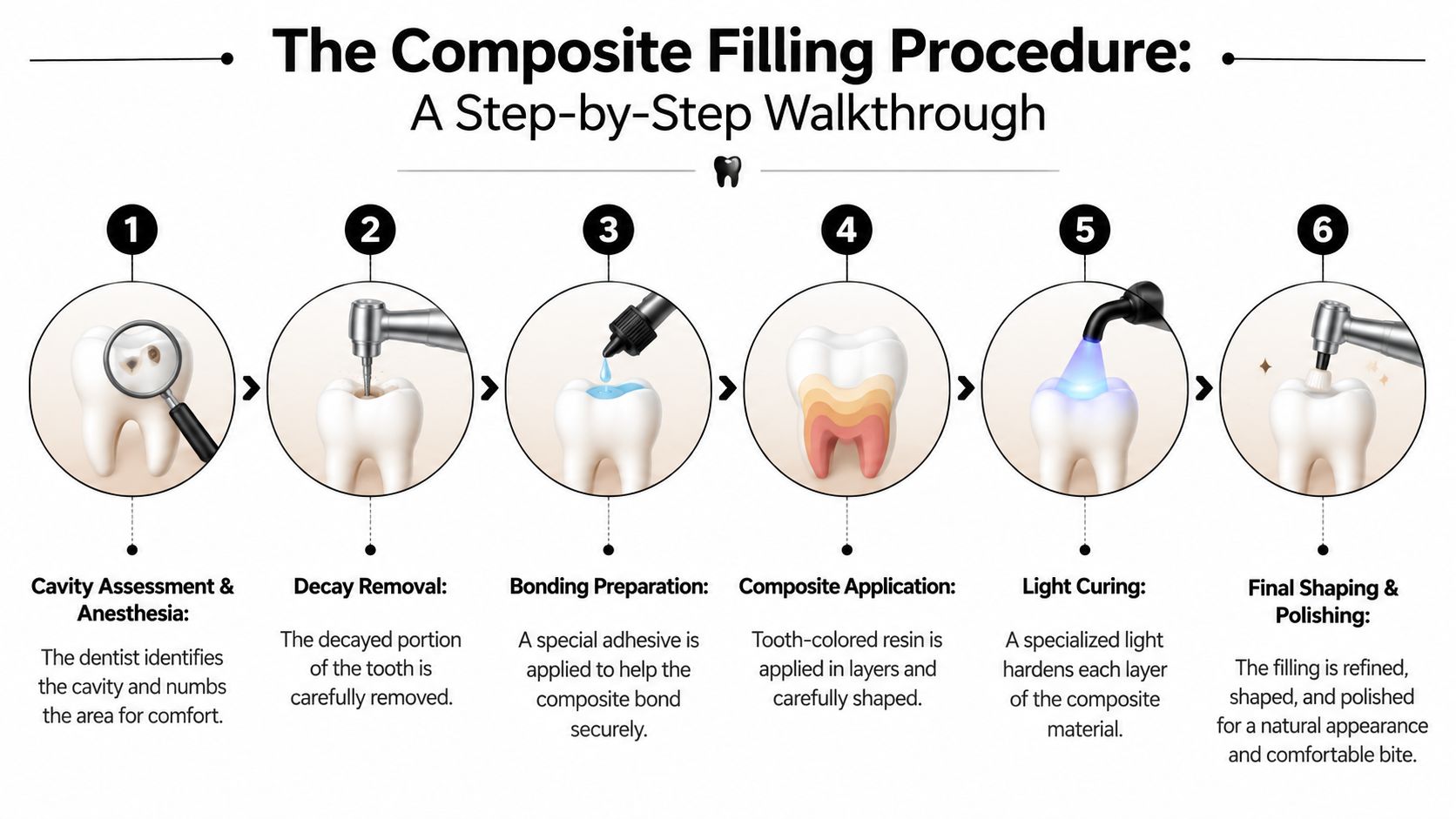
The Composite Filling Procedure A Step-by-Step Walkthrough
You sit down, we numb the tooth, and within a few minutes the sharp sensitivity that brought you in is no longer the main story. What patients usually notice next is how organized and comfortable the process feels when each step is planned well.
Numbing and removing the decay
At our Pico Rivera office, the visit starts with local anesthesia so the tooth and nearby gum tissue are fully numb before I begin. During this stage, you may notice pressure or water, but you should not feel a sharp pinch from the tooth itself.
Modern tools can make this part easier. For some areas, a dental laser can help remove decay or manage soft tissue with less noise and vibration than a traditional drill. Not every cavity is a laser case, and I do not force the technology when a conventional handpiece will do the cleaner, faster job. The goal is comfort and precision, not using a gadget for its own sake.
I also work conservatively. Composite lets me remove the damaged part of the tooth while preserving as much healthy structure as possible.
Keeping the tooth clean and dry for a strong bond
Once the decay is gone, the tooth has to stay isolated from saliva. Patients do not always expect this step to matter so much, but bonding depends on it. If moisture gets onto the tooth at the wrong moment, the filling can become less reliable.
At Cali Family Dental, I use suction, cotton isolation, and other moisture-control methods based on the tooth's location and how easy it is to access. For some patients, knowing why we are pausing to keep the area dry makes the visit feel less mysterious. If I can show the area with an intraoral camera before or after cleanup, that often helps patients understand what I am protecting and why the details matter.
Here's a close look at the layering and shaping approach used in composite restorations.
Building the filling layer by layer
After the tooth is prepared, I apply the bonding steps and place the composite in small layers. Each layer is shaped and cured before the next one goes in. That takes a little more time than packing material into the space, but it gives better control over fit, strength, and appearance.
Technology helps here too. Good lighting and magnified views improve accuracy, and intraoral imaging can confirm that the shape is developing the way I want it to. On front teeth or visible areas, that detail matters even more because the filling has to blend in, not just fill a hole.
This step is technique-sensitive. A larger cavity, a hard-to-reach back tooth, or a patient who has trouble staying open for long can make the work more demanding. Careful layering is still worth it because it reduces the chance of weak spots and helps the final result feel more natural.
Shaping, polishing, and checking your bite
The last part is refining the filling so it feels like your own tooth when you close, chew, and run your tongue across it. I shape the surface, smooth rough edges, polish the restoration, and check your bite carefully.
If a filling is even slightly high, you will usually notice it right away when you bite down. I would rather adjust that in the chair than ask you to wait and hope it settles. Intraoral cameras can also be useful here because patients can see the final result and understand what changed.
A well-done composite filling should look natural, feel smooth, and let you leave the office without wondering whether something was missed.
Your Comfortable Filling Experience at Cali Family Dental
A filling visit feels very different when the office uses modern tools well. Comfort doesn't come from one gadget. It comes from a smoother process from diagnosis to final polish.
At Cali Family Dental, that often starts before any treatment begins. Digital X-rays help identify decay with less guesswork, intraoral cameras let patients see the area on a screen instead of relying on a verbal description, and digital scanners can replace the messy impression material many people dislike. When a laser is appropriate, it can also support more comfortable soft tissue care and precise treatment.
What a patient usually notices first
Most patients don't walk in comparing curing protocols or adhesive systems. They notice whether the visit feels organized, whether someone explains what they're seeing, and whether the process feels rushed.
In practical terms, technology helps in a few specific ways:
- Digital imaging makes it easier to spot the size and location of the cavity clearly
- Intraoral cameras show the crack, stain, or decayed area directly, which helps patients understand why treatment is recommended
- Digital scanners improve comfort when a scan is needed and avoid the mess of traditional impressions
- Laser-assisted care can support gentler treatment in selected situations
Why patient preference matters
Composite fillings have become more common largely because patients want restorations that look natural. The ADA notes they're used more often than amalgam, and patient satisfaction has been reported as higher for composite restorations, with aesthetic value playing a major role, according to Cleveland Clinic's overview of dental fillings.
That lines up with what patients say in the chair. They want the tooth fixed, but they also want to leave without feeling like everyone can see where the work was done.
A calmer visit usually comes down to two things. Clear explanations and fewer unpleasant surprises.
A more efficient visit for busy families
Technology also helps with timing and flow. If the team can diagnose accurately, show you the problem clearly, and move smoothly into treatment, the visit feels shorter and more manageable. That matters for parents, working adults, and anyone looking for a dentist near me who can handle care without making the day harder than it has to be.
Same-day care can be especially helpful when a cavity becomes painful or a chipped tooth needs prompt attention. For some patients, one efficient appointment is the difference between treating the issue early and putting it off until it worsens.
Aftercare and Recovery for Your New Filling
Recovery after a composite filling is usually simple. The most common thing patients notice first is lingering numbness from the local anesthetic. Until that wears off, be careful with chewing so you don't accidentally bite your cheek, lip, or tongue.
Some teeth also feel mildly sensitive to cold, heat, or pressure for a short time after treatment. That can happen because the tooth has been cleaned, bonded, and adjusted. In many cases, it settles as the tooth calms down.
What to do the rest of the day
A few practical habits make the first day easier:
- Wait until numbness fades before eating anything chewy or hot
- Choose softer foods if the tooth feels tender when you bite
- Brush and floss gently but normally, unless your dentist gives you different instructions
- Pay attention to your bite when the numbness is gone
If the tooth feels “high” when you close, don't ignore it. A small adjustment can make a big difference in comfort.
What helps your filling last
The filling repairs one area. It doesn't make the rest of the tooth immune to future decay. Long-term success still depends on daily home care and regular visits.
Focus on:
- Consistent brushing
- Daily flossing
- Routine cleanings and exams
- Addressing clenching or grinding if your dentist thinks it's affecting your teeth
If a new filling feels rough, catches floss repeatedly, or hurts when you bite after the numbness is gone, call the office. Those aren't problems to “wait out” for weeks.
When to call sooner
Some symptoms deserve a prompt call rather than watchful waiting.
Contact your dental office if:
- Your bite feels uneven
- Pain is sharp when chewing
- Sensitivity seems to worsen instead of improve
- A corner feels chipped or the filling feels loose
Patients sometimes assume they should just live with those issues. Usually, a quick follow-up is the right move. Early adjustment is much easier than letting irritation continue.
Comparing Your Tooth Restoration Options
Composite fillings are common, but they aren't the only restorative option. The right material depends on where the cavity is, how large it is, how much tooth remains, and whether appearance is a top priority.
The ADA notes that composites cost more than amalgam and can take longer to place because bonding requires a clean, dry field. That's part of the trade-off. You're often gaining appearance and conservative repair, while accepting a more technique-sensitive procedure.
Dental Filling Material Comparison
| Material | Appearance | Durability | Cost |
|---|---|---|---|
| Composite resin | Tooth-colored and designed to blend with natural enamel | Durable for many small-to-mid-size restorations | Generally costs more than amalgam |
| Amalgam | Silver-colored and more visible | Commonly chosen where appearance matters less | Often lower cost than composite |
| Porcelain inlay or onlay | Very natural-looking | Used when damage is more extensive than a routine filling | Typically higher cost than a direct filling |
| Dental crown | Covers the full visible portion of the tooth | Often used when the tooth is heavily weakened or broken down | More involved and typically higher cost than a filling |
How dentists usually choose among them
A small visible cavity often points toward composite. A very large cavity may push the decision toward an inlay, onlay, or crown because the tooth needs more reinforcement than a filling can provide.
For patients balancing restorative dentistry, cosmetic dentistry, and budget, composite is often the middle ground. It preserves appearance better than metal and is less extensive than a crown when the tooth still has enough healthy structure left.
If a tooth can't be predictably restored with a filling, the better choice is to step up to a stronger option rather than forcing a filling into a situation it wasn't meant to handle.
Frequently Asked Questions About Composite Fillings
How long do composite fillings last
In practice, composite fillings can hold up for many years, but their lifespan depends on the tooth and the job the filling has to do. A small filling on a front tooth usually has a different outlook than a larger filling on a back molar that handles heavy chewing.
I tell patients in Pico Rivera to focus less on a fixed number and more on fit, bite, and maintenance. At Cali Family Dental, intraoral cameras let me show you the filling and the surrounding tooth clearly at follow-up visits, so we can spot early wear before it turns into a bigger repair.
Is the procedure painful
For most patients, this is easier than they expect. Once the area is numb, you should feel movement, water, or vibration, but not sharp pain.
What helps anxiety is knowing what is happening as we go. I often use intraoral camera images to show the cavity before we start, so nothing feels mysterious. If the decay is small and the situation allows, modern tools such as lasers can also make treatment feel more conservative and efficient. That combination of numbing, clear communication, and precise technology usually makes the visit much more comfortable.
Can a composite filling stain or be whitened later
Yes, composite can stain over time, especially with coffee, tea, red wine, or smoking. The material can also lose some surface polish with wear, which makes it easier for stains to cling to it.
Composite does not whiten the way natural enamel does. If you are thinking about whitening your teeth, say that before we place the filling. I can plan the shade more accurately that way. Digital scanning and close-up imaging also help us match the restoration more precisely to the surrounding teeth at the time of treatment.
Will insurance help cover a tooth-colored filling
That depends on your plan and on which tooth needs treatment. Some plans cover composite fillings routinely. Others cover them differently for back teeth than for front teeth.
My advice is simple. Ask for the breakdown before we start. Our team helps patients check benefits and understand out-of-pocket costs ahead of time, and we accept Denti-Cal, Medi-Cal, and most PPO plans. That gives many families a clearer path to getting the tooth treated without surprises.
If you need a filling, have tooth sensitivity, or want a clear second look at a cavity, Cali Family Dental serves patients in Pico Rivera, California with family, restorative, cosmetic, and same-day dental care. Dr. Rafaat and the team can evaluate the tooth, explain whether a composite filling makes sense, and help you schedule treatment that fits your needs.