If you're seeing pink in the sink when you brush, noticing a sour taste that won't go away, or feeling like your gums look puffy no matter how carefully you clean, it's easy to wonder whether you just need a better toothpaste or a routine cleaning. In many cases, the issue sits deeper than the visible part of the tooth.
That's where a scaling and root planing procedure comes in. Patients often hear the phrase “deep cleaning” and immediately feel nervous. The good news is that this is a common, nonsurgical treatment used to control gum disease, reduce bacterial buildup below the gumline, and give your gums a healthier surface to heal against.
In Pico Rivera, many people searching for a dentist near me, an emergency dentist, or a dentist in Pico Rivera, CA are really trying to solve the same problem. Their mouth doesn't feel healthy, and they want clear answers without judgment. The right dental team should explain what's happening, what the treatment involves, what recovery looks like, and how to keep the problem from coming back.
Your Local Pico Rivera Dentist for Lasting Gum Health
A common story goes like this. Someone books a visit because their gums bleed when flossing, their breath seems off even after brushing, or a regular cleaning elsewhere didn't seem to fix the problem. They're not always in severe pain. Often, they're just unsettled because something feels wrong.
That concern is valid. Gum problems don't always announce themselves with dramatic symptoms. They often build slowly, then start showing up in small ways that are easy to dismiss until they become harder to ignore.
The signs patients often notice first
Some of the most frequent warning signs include:
- Bleeding during brushing or flossing that happens repeatedly, not just once in a while
- Bad breath that lingers even when home care is consistent
- Tender or swollen gums that look irritated along the toothline
- A feeling that teeth look longer because the gums seem to be pulling away
- Sensitivity around the gumline when eating or drinking
When these signs appear together, a routine cleaning may not be enough. The issue may be bacteria and hardened deposits below the gumline, where a toothbrush and floss can't fully reach.
Healthy gums are the foundation of a healthy smile. If that foundation is inflamed or infected, cosmetic goals and restorative goals both become harder to protect.
Why local, timely care matters
For patients in Pico Rivera, it helps to have a nearby office that can evaluate gum concerns without making the process feel complicated. If you've been looking for a dentist in Pico Rivera, CA who can handle preventive care, cleaning and exams, dental X-rays, and treatment planning in one place, gum care should be part of that conversation.
A thorough evaluation can also reveal whether the problem is limited to gum inflammation or whether it's affecting the support around the teeth. That distinction matters. It shapes whether you need a standard cleaning, a scaling and root planing procedure, or a broader restorative plan that may eventually involve services like crowns, tooth replacement, or other forms of restorative dentistry.
The earlier you get answers, the simpler the path usually is.
Understanding Gum Disease and the Need for Deep Cleaning
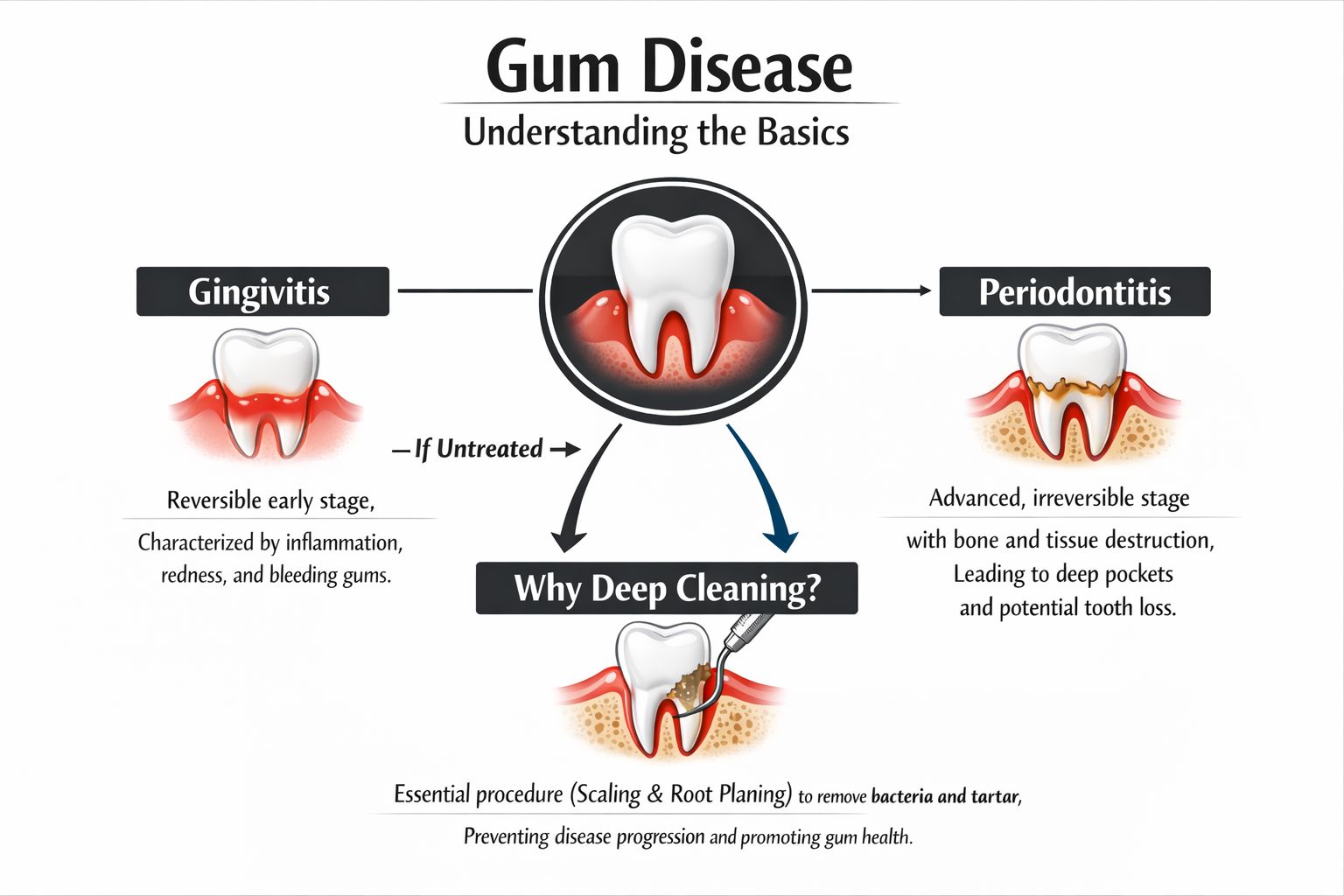
Gum disease usually starts subtly. Early inflammation, called gingivitis, can cause redness, tenderness, and bleeding during brushing or flossing. At that stage, the condition is often reversible with better plaque control and professional care.
Periodontitis is different. The infection extends deeper around the teeth, and the gums begin to separate from the root surface. That creates pockets where bacteria and tartar collect in places a toothbrush and floss cannot reach well.
Once buildup hardens below the gumline, home care alone cannot remove it. The tissue stays irritated, the pockets can deepen, and the support around the teeth can weaken over time.
Why this is so common
This is a routine part of dental care, not a rare diagnosis and not a personal failure. According to the NCBI overview on periodontal disease, roughly 42% of dentate U.S. adults, about 144 million people, have some form of periodontitis, and about 60.5 million are estimated to have moderate to severe disease.
For patients, that matters in two practical ways:
| Concern | What it means for patients |
|---|---|
| It's widespread | Many adults need treatment beyond a routine cleaning at some point |
| It affects health | Gum disease can threaten the support around teeth if it is left untreated |
Bleeding gums are common, but they should not be ignored.
Why a regular cleaning isn't always enough
A standard cleaning is designed for routine maintenance above the gumline and in shallow, healthy gum spaces. A deep cleaning is recommended when infection and tartar have settled farther down along the roots, where the gums need help healing back toward the tooth.
That recommendation is based on what is happening biologically, not on whether someone wants a cleaner-feeling smile. In practice, this is one of the clearest trade-offs I explain to patients in Pico Rivera. Treating gum disease early usually means simpler care, lower long-term costs, and a better chance of keeping natural teeth stable.
For patients also exploring related care, getting the gums healthy first is the right order. At a local office like Cali Family Dental, that often means confirming the diagnosis, reviewing insurance coverage, explaining what deep cleaning involves, and giving patients a realistic plan for treatment and maintenance so the process feels manageable from the first visit onward.
What Is a Scaling and Root Planing Procedure
The term sounds technical, but the process is straightforward when it's explained clearly. A scaling and root planing procedure has two parts, and each one has a specific purpose.
Scaling removes the harmful buildup
Scaling means removing plaque and tartar from the teeth, including the areas below the gumline. Those deposits can't be brushed away once they've hardened. They need to be carefully removed with dental instruments.
Root planing smooths the root surface
Root planing means smoothing the root surfaces so bacteria are less likely to cling to rough spots and the gum tissue has a cleaner surface to heal against. The American Dental Association's patient guidance explains that scaling and root planing is a nonsurgical first-line treatment for mild to moderate periodontal disease that combines scaling with root planing to reduce bacterial reattachment and promote soft-tissue reattachment.
A simple analogy helps. Imagine weeding a garden bed and then smoothing the soil so healthy growth has a better chance to take hold. First, the harmful material is removed. Then the area is made more favorable for healing.
What dentists use during treatment
Depending on the case, providers may use:
- Hand instruments to reach and refine specific areas
- Ultrasonic instruments that help break up buildup efficiently
- Local anesthesia so the treated area stays comfortable
- More than one visit when several areas need attention
That combination is practical. Deep gum pockets and widespread buildup usually aren't treated as casually as a routine polish. Careful, methodical cleaning gets better results than rushing.
The goal isn't to “scrub harder.” The goal is to remove the material causing inflammation and create conditions that let the gums settle and heal.
What this treatment does and doesn't do
A scaling and root planing procedure can lower the bacterial burden under the gums and support healthier tissue attachment. What it doesn't do is act like a one-appointment reset button that lets gum disease be ignored afterward.
That's why the procedure works best when it's part of a full care plan. If your mouth also needs fillings, crowns, tooth extraction, or planning for dental implants near me, your dentist will usually want the gum condition stabilized first. Healthy gums support almost every other part of dentistry.
Your Step by Step Journey at Our Pico Rivera Office
You come in because your gums bleed when you brush, or because a routine visit turned up pocketing that should not be ignored. Before any treatment starts, the first job at our Pico Rivera office is to show you what we see, explain what needs attention, and make the visit feel predictable.
How the appointment usually begins
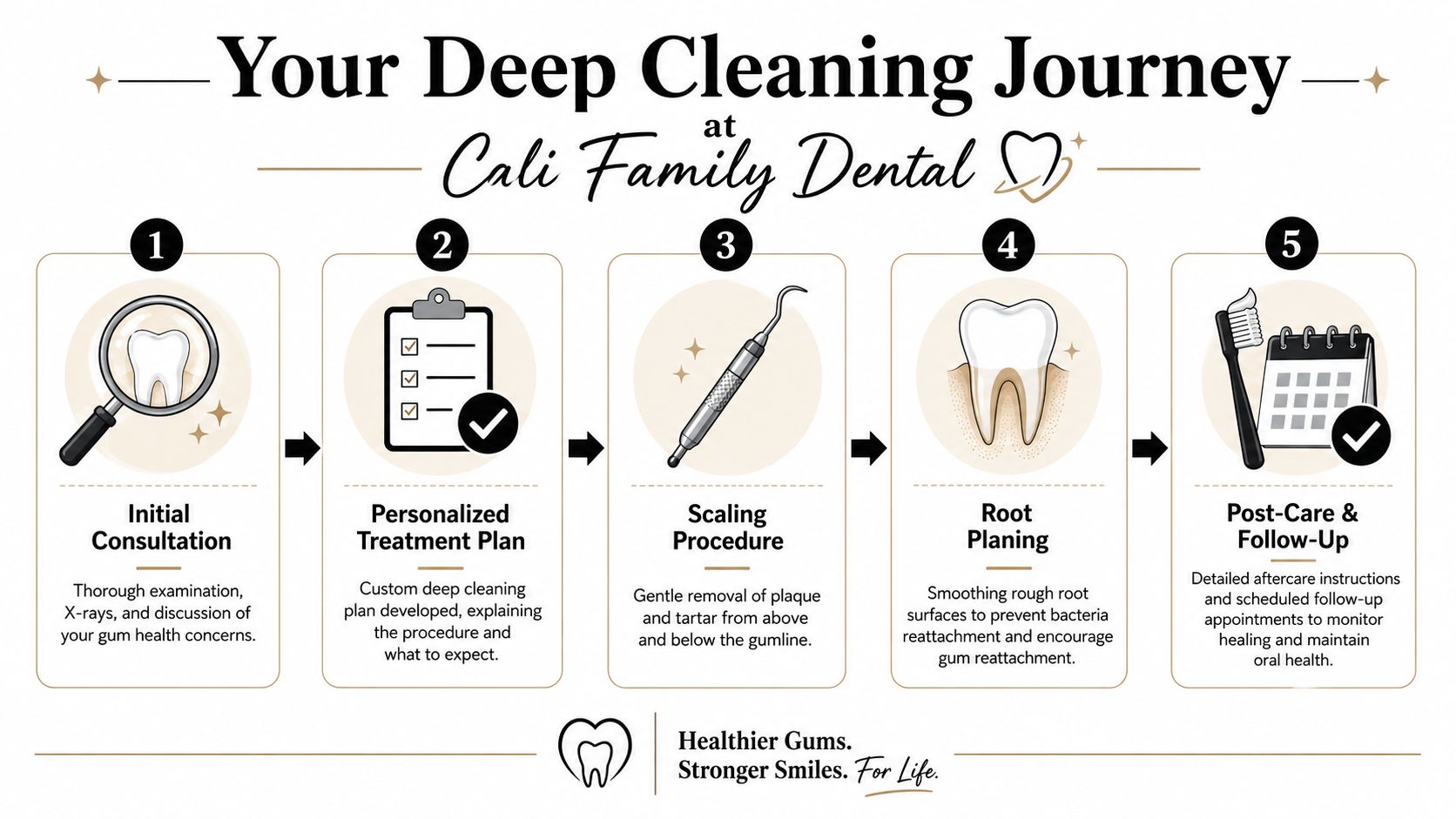
A scaling and root planing visit starts with a close look at your gums and the bone support around your teeth. That may include an exam, updated imaging, and pocket measurements. Those measurements help identify where inflammation and buildup have moved below the gumline and where a regular cleaning would fall short.
At Cali Family Dental, digital X-rays and intraoral photos help make the conversation clearer. Patients are often less anxious once they can see the areas we are treating and understand why we are recommending deep cleaning instead of a routine polish.
Here's a short look at the procedure in motion:
What happens during the procedure
Once we identify the areas that need treatment, we focus on comfort first. Local anesthesia is used as needed so the gums and roots can be cleaned thoroughly without making the appointment harder than it needs to be. In my experience, patients do better when they are comfortable enough to stay relaxed and let us work carefully.
Treatment is often done one section at a time. That approach gives each area the attention it needs and makes the visit easier to tolerate, especially if several parts of the mouth are involved.
A typical visit includes:
Evaluation and diagnosis
We review the gums, pocket depths, and imaging to confirm where deeper cleaning is needed.Numbing the area
Local anesthesia is placed when necessary to keep treatment more comfortable.Scaling below the gumline
Plaque and hardened calculus are removed from the tooth surfaces and root areas.Root planing
The root surfaces are smoothed so the gums have a healthier surface to heal against.Home care and follow-up instructions
You leave with clear guidance on cleaning, sensitivity, and when we want to see you back.
Why the visit may be split
Some patients can be treated in one longer appointment. Others do better if we divide the mouth into two visits. The right choice depends on how much buildup is present, how inflamed the gums are, how comfortably you stay numb, and how much time each area needs.
There is a real trade-off here. A single visit can be more convenient. Two shorter visits can be easier on sore gums, easier to numb well, and easier for us to complete with the level of detail the procedure requires.
What patients should expect emotionally
Uncertainty is usually the hardest part. Once patients know why we are measuring the gums, what the anesthetic feels like, and why treatment may be completed in sections, the appointment tends to feel far less intimidating.
Modern tools and clear communication help reduce stress. Patients benefit from seeing their images, getting direct answers, and understanding the plan before we begin. This approach is helpful for patients who came in for gum concerns, a routine exam, or an emergency visit that uncovered a deeper periodontal problem.
Aftercare Recovery and Long Term Periodontal Health
After a scaling and root planing procedure, most patients notice that the mouth feels different before it feels fully settled. Gums can feel tender. Teeth may feel cleaner but also a bit more sensitive near the roots. That doesn't mean anything went wrong. It usually means inflamed tissue has been treated and now needs time to calm down.
The key is to be gentle without becoming inconsistent. Stopping home care completely is one of the worst responses after deep cleaning.
What to do in the first days after treatment
A few practical habits make recovery smoother:
- Brush carefully using a soft toothbrush and steady pressure, not aggressive scrubbing
- Keep the mouth clean because bacteria return quickly when brushing and flossing stop
- Choose gentler foods at first if the gums feel sore or teeth seem sensitive
- Follow any personalized instructions your dental team gives you for rinses, brushing technique, or timing
What doesn't work is pretending the appointment “fixed everything” and then slipping back into rushed brushing or irregular flossing. Gum disease responds best to consistency.
If the gums have been inflamed for a while, healing is a process. Patients usually do best when they think in terms of maintenance, not a one-time rescue.
Why follow-up matters so much
This is the part many basic explainers leave out. A scaling and root planing procedure is often the beginning of periodontal care, not the end of it. The gums need to be re-evaluated to see how they responded.
The ADA's patient guidance notes that many patients require ongoing periodontal maintenance visits every 3 to 4 months after initial SRP to re-evaluate healing and help prevent disease recurrence. That schedule is one of the most important parts of long-term success.
What long-term control usually looks like
Long-term gum care often includes a mix of:
| Ongoing need | Why it matters |
|---|---|
| Periodontal maintenance | Removes new buildup before it triggers another flare-up |
| Home care coaching | Small technique changes can make daily brushing and flossing more effective |
| Monitoring pockets and tissue response | Helps your dentist see whether the gums are staying stable |
| Planning other dental work at the right time | Restorative or cosmetic treatment tends to do better in a healthier gum environment |
Patients often ask whether they can go back to “normal cleanings.” Sometimes the answer is yes later on, but many patients with established periodontal disease need a maintenance rhythm that's more protective.
A better way to think about success
Success isn't just getting through the appointment. Success means the gums bleed less, feel firmer, stay cleaner between visits, and support the teeth more reliably over time.
If you're also considering other services, from cosmetic dentistry to implant treatment, this step protects those future investments. A healthier gum foundation gives every other treatment a better chance to last.
Cost Insurance and Alternatives to Deep Cleaning
For many patients in Pico Rivera, the hardest part of saying yes to treatment is not the procedure itself. It is wondering what the bill will look like, what insurance will cover, and whether there is a cheaper option that still protects their teeth.
Cost deserves a clear answer. So does context.
What affects the cost
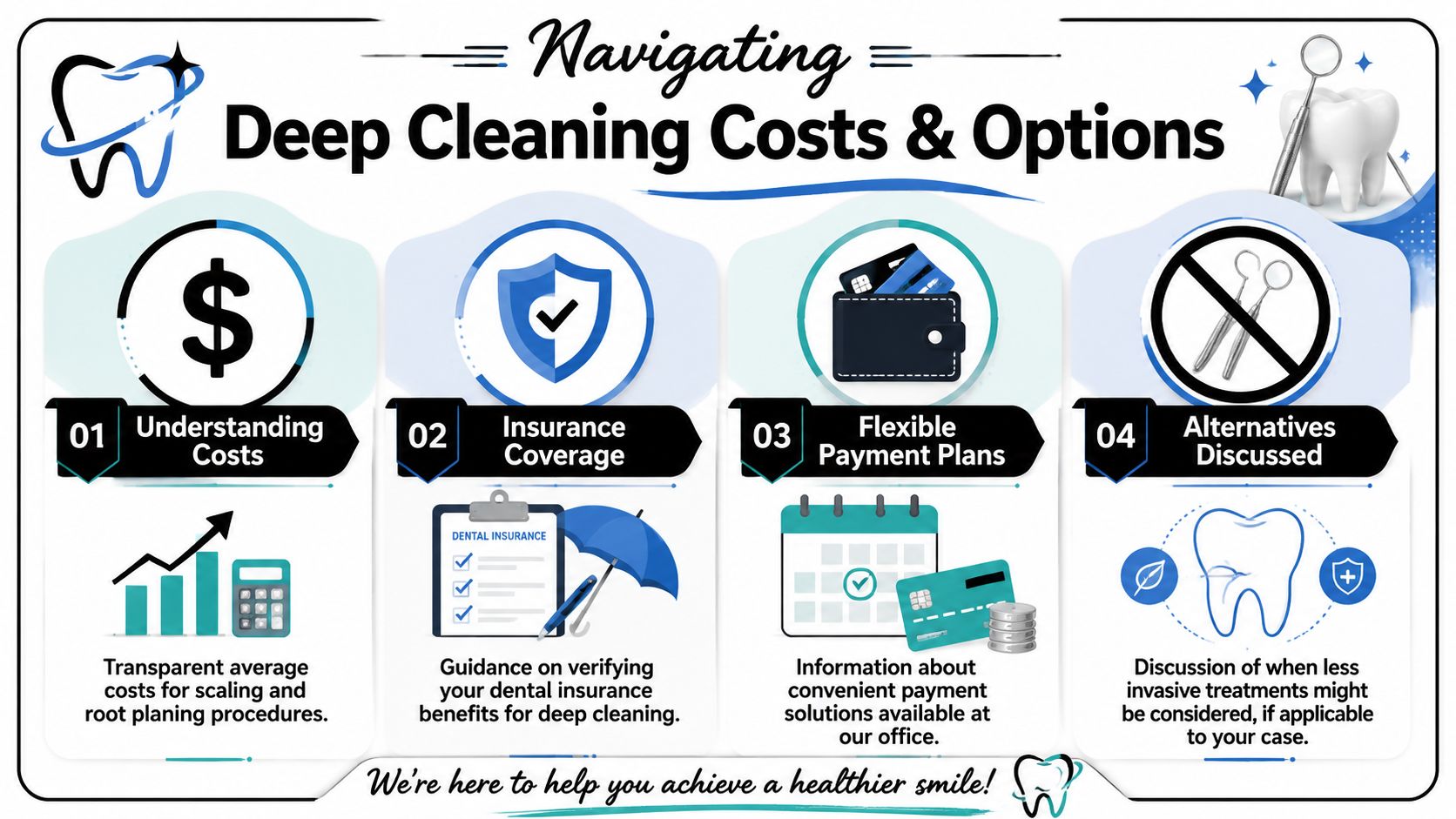
Scaling and root planing is often priced by quadrant, not as one flat fee for every patient. The total depends on how much of the mouth shows active disease, whether treatment is completed in one visit or split into stages, and what kind of follow-up is needed once the gums start to heal.
That is why a personalized estimate matters more than a generic online price.
In practice, I tell patients to look at three numbers. The office fee. The insurance contribution. The amount left after benefits are applied. That gives a much more useful picture than a national average that may not reflect a Pico Rivera office, your plan, or the condition of your gums.
Insurance and payment questions worth asking
A good financial conversation should be as clear as the clinical one. Before treatment, patients should ask:
- Which quadrants need scaling and root planing
- How is this being coded for insurance
- Does my plan require proof that the treatment is medically necessary
- Will visits be separated over time
- What payment or financing options are available if there is a remaining balance
Many local patients want to know about Denti-Cal, Medi-Cal, and PPO coverage. Cali Family Dental is one Pico Rivera office that works with those plan types and helps patients review benefits before care, which can make the process easier and reduce surprises.
What your alternatives really are
The main alternative depends on the stage of the disease.
| Option | When it makes sense |
|---|---|
| Routine cleaning | For healthy gums or mild buildup above the gumline |
| Scaling and root planing | For gum infection and tartar below the gumline |
| Periodontal surgery or specialist care | For deeper pockets, tissue damage, or cases that do not respond well enough to nonsurgical treatment |
Patients sometimes ask if they can skip deep cleaning and just get a regular cleaning instead. If the infection is below the gumline, a routine cleaning usually does not reach the area that needs treatment. It may make the teeth feel cleaner for a short time, but it does not solve the underlying problem.
Waiting has a cost too. Bleeding, bone loss, bad breath, gum tenderness, and tooth mobility are harder and more expensive to manage once the disease progresses. In many cases, scaling and root planing is the more conservative option because it addresses the problem before surgery or tooth replacement enters the discussion.
The goal is not to sell a bigger procedure. The goal is to treat the level of disease that is present, keep you comfortable, and help you keep your teeth for the long term.
Your Trusted Pico Rivera Dentist for Gum Health
Choosing a dentist for gum treatment isn't just about finding the closest office when you search dentist near me. It's about finding a team that explains things clearly, uses modern diagnostic tools, respects your budget, and helps you think beyond the next appointment.
That matters with periodontal care because fear and confusion delay treatment. Patients need to understand what the problem is, why a scaling and root planing procedure is being recommended, what recovery will feel like, and how maintenance protects their results. A good experience is built on that clarity.
What patients should look for in a gum care provider
When you're deciding where to go in Pico Rivera, a few things make a real difference:
- Clear diagnosis with gum measurements, imaging, and direct explanations
- Comfort-focused treatment including local anesthesia when needed
- Modern technology such as digital X-rays, intraoral imaging, scanners, and tools that improve precision
- Access to broader care if your needs include fillings, crowns, implant planning, cosmetic treatment, or urgent care
- Support with insurance and payment questions so financial uncertainty doesn't stop needed treatment
For families and individuals trying to balance routine care with larger treatment goals, it also helps when one office can coordinate preventive, restorative, surgical, and cosmetic needs in a way that makes sense over time.
Why confidence in the process matters
Gum treatment can feel intimidating before the first visit. It usually feels far more manageable once you've had a proper exam and a straightforward conversation. The right office doesn't pressure patients or bury them in jargon. It gives them a clear path.
Dr. Rafaat brings more than 24 years of experience to patient care, and that kind of experience shows up in practical ways. It shows up in treatment planning, in how calmly concerns are addressed, and in how efficiently care can move from diagnosis to action when timing matters.
If your gums bleed, your breath hasn't felt fresh, or you've been told you need a deep cleaning and haven't moved forward yet, getting answers now can protect your teeth and make future treatment simpler. It can also give you a more comfortable, confident starting point for everything from routine preventive care to dental implants near me, tooth extraction, and cosmetic smile goals.
If you're ready to stop guessing about your gum health, schedule a visit with Cali Family Dental. New patients can also ask about the $69 special that includes an exam, digital X-rays, and a routine cleaning, making it easier to get evaluated and take the next step toward a healthier smile in Pico Rivera.