If you're missing a tooth in Pico Rivera, the first concern is usually function. You want to chew comfortably, speak clearly, and stop thinking about the gap every time you smile. Then the second concern hits fast: the price.
That reaction is normal. Many people search for a dentist near me, dental implants near me, or a dentist in Pico Rivera, CA, find an implant quote, and immediately wonder why it costs so much. The short answer is that an implant isn't just a replacement tooth. It's a carefully planned medical and restorative treatment designed to protect your jawbone, restore bite strength, and support long-term oral health.
A well-done implant is an investment in stability, safety, and daily quality of life. When patients understand what they're paying for, the cost starts to make more sense.
Your Guide to Understanding Dental Implant Costs in Pico Rivera
A missing tooth can affect more than appearance. Patients often come in saying food gets stuck in the area, the opposite teeth don't feel right when they bite, or they avoid smiling in photos. Some are also dealing with a cracked tooth after a tooth extraction, or they're trying to decide between a bridge, a denture, or an implant.
The surprise usually comes when they see that implants cost more upfront than other options. That doesn't mean the fee is arbitrary. It reflects the fact that an implant replaces the tooth from the root up, not just the visible part above the gums.
Why implants keep gaining attention
Dental implants have become much more common in the United States. Use among U.S. adults with missing teeth has grown over 12-fold in the last two decades, and projections in the same research suggest that by 2026, nearly one in four adults needing tooth replacement could choose implants, according to this NHANES-based study on dental implant prevalence.
That trend matters because it shows something patients already sense in real life. Even with the higher initial cost, more people are choosing implants for their long-term benefits.
The question usually isn't only "What does it cost?" It's also "What do I get back from that investment over time?"
What patients are really paying for
When someone asks why do dental implants cost so much, I explain it in practical terms. You're paying for more than a screw and a crown. You're paying for:
- A true tooth replacement that sits in bone instead of resting on top of the gums
- Detailed diagnosis so placement is safe and precise
- A staged healing process that your body has to complete successfully
- A custom restoration made to fit your bite and smile
That combination is why implants are often considered the gold standard in restorative dentistry.
For many patients in Pico Rivera, cost becomes easier to evaluate once they compare it to the day-to-day burden of a missing tooth. Trouble chewing, shifting teeth, uneven bite pressure, and self-consciousness all carry a cost too. If you're also looking for a cosmetic dentist near me, implants often help with both appearance and function in a way simpler options can't fully match.
The Anatomy of a Dental Implant What You Are Paying For
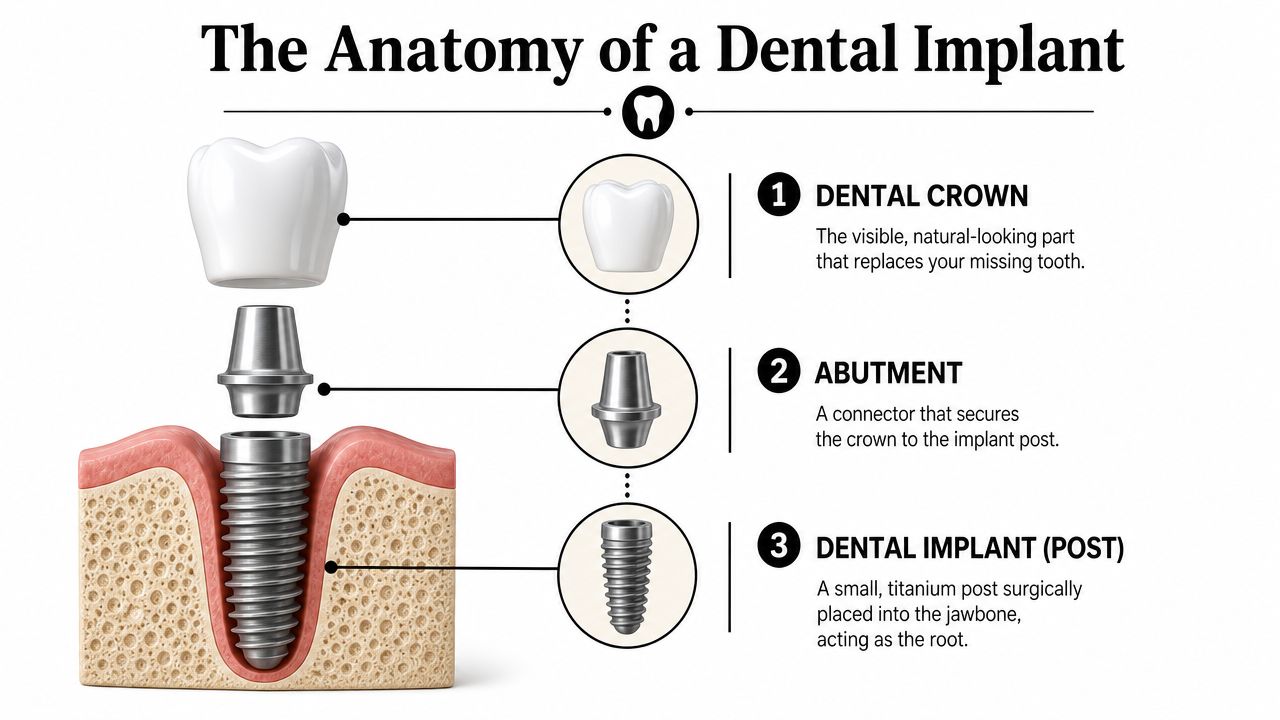
A dental implant isn't one piece. It's a system. The easiest way to think about it is like building a house. You need a foundation, a connector, and the finished exterior you see.
The implant post
The implant post is the part placed into the jawbone. It acts like an artificial root. This part needs to be strong, biocompatible, and manufactured with tight tolerances because it has to integrate with living bone.
The abutment
The abutment is the connector. It joins the implant post below the gums to the crown above the gums. It may look small, but it has to fit precisely. A poor fit can affect the gumline, the bite, and the long-term stability of the final tooth.
The crown
The crown is the visible part of the restoration. It isn't an off-the-shelf tooth. It's made to match neighboring teeth in shape, shade, contour, and bite contact so it feels natural when you chew and smile.
According to this breakdown of dental implant materials and fabrication costs, the implant body is commonly made from implant-grade titanium alloy (Ti-6Al-4V ELI) or zirconia, and the custom-milled crown can add $800–$2,500 depending on the fabrication process and materials.
Practical rule: If a treatment is replacing both the root and the visible tooth, expect the materials and lab work to be more complex than a standard filling or crown.
Why the parts matter to patients
Each part connects to a specific benefit:
| Component | What it does | Why it affects cost |
|---|---|---|
| Implant post | Replaces the root | Requires surgical-grade material and precise placement |
| Abutment | Connects implant to crown | Must fit accurately at the gumline |
| Crown | Restores appearance and chewing | Custom lab work affects esthetics and bite |
This is why implant fees don't behave like simple retail pricing. You're not buying a single object. You're investing in a coordinated restorative system designed to function under daily bite pressure.
Key Factors That Determine Your Final Implant Cost
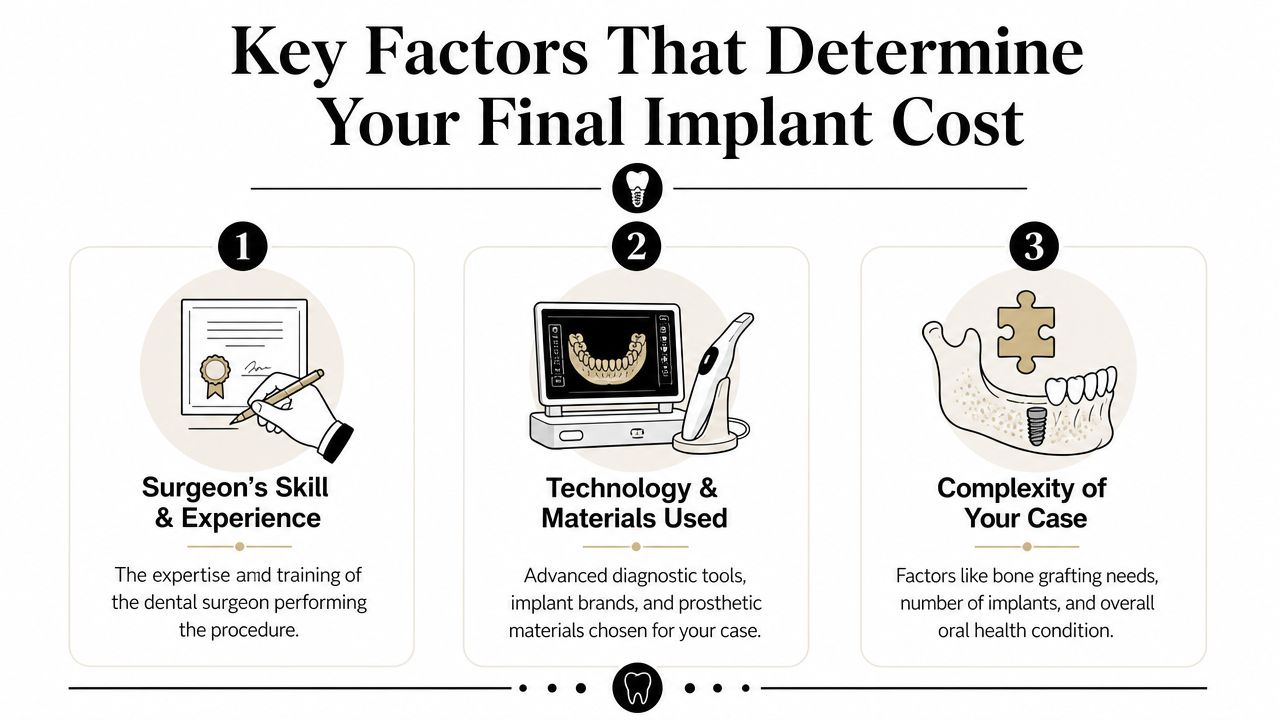
Two patients can both need a single implant in Pico Rivera and receive very different estimates. The reason is simple. The fee reflects the condition of the bone, the bite, the gum tissue, the timing of treatment, and the amount of planning needed to place the implant safely and restore it so it lasts.
Your mouth determines the level of treatment
A straightforward case usually costs less because it needs fewer steps. A more involved case costs more because more work is required to protect the final result.
Several factors commonly change the final fee:
- Bone quality and volume: If the jawbone has shrunk after a tooth has been missing for a while, grafting may be needed to create stable support for the implant.
- Timing of tooth loss: A fresh extraction site can present different options than an area that has been empty for years.
- Gum condition: Healthy gum tissue helps support a cleaner, more natural-looking result, especially in visible areas.
- Bite pressure: Clenching and grinding can require changes in implant position, materials, or crown design.
- Tooth location: A front tooth often requires more cosmetic detail. A back tooth must handle heavier chewing force.
Each of these adds cost for a reason. The goal is not to make treatment more elaborate. The goal is to reduce risk and build a tooth replacement that functions well over time.
Planning and precision affect value
Implants depend on careful diagnosis before any treatment begins. Digital imaging, measurements, and surgical planning help identify the safest position for the implant and help avoid problems with nearby teeth, nerves, and sinus spaces.
That planning has real value for patients. It improves fit, supports long-term stability, and lowers the chance of costly surprises later.
At Cali Family Dental, Dr. Rafaat uses digital imaging and individualized treatment planning to determine whether a patient needs a simple implant placement or preparatory treatment first. That is why honest implant pricing is personalized. A flat number without a proper exam usually leaves out important details.
Healing time is part of the investment
An implant is placed in living bone. The body needs time to heal and bond to it before the final tooth is completed. In some cases, treatment also includes grafting or other preparatory care before placement.
This part of the process can feel slow, but it protects the outcome. Rushing implant treatment can increase the chance of failure, poor esthetics, or bite problems that are expensive to correct.
A lower quote may only cover placement of the implant. A complete quote often includes diagnosis, imaging, surgical planning, the implant procedure, healing checks, the custom restoration, and follow-up care.
Patients who also need an emergency dentist, restorative dentistry, or dental x-rays in Pico Rivera often see the difference right away. Temporary relief and full reconstruction are priced differently because they solve different problems. Implant fees reflect the work required to restore health, chewing function, comfort, and long-term confidence.
Dental Implants vs Bridges and Dentures A Cost Comparison
The right comparison isn't just implant versus bridge versus denture on day one. The better question is how each option affects your teeth, comfort, maintenance, and long-term oral health.
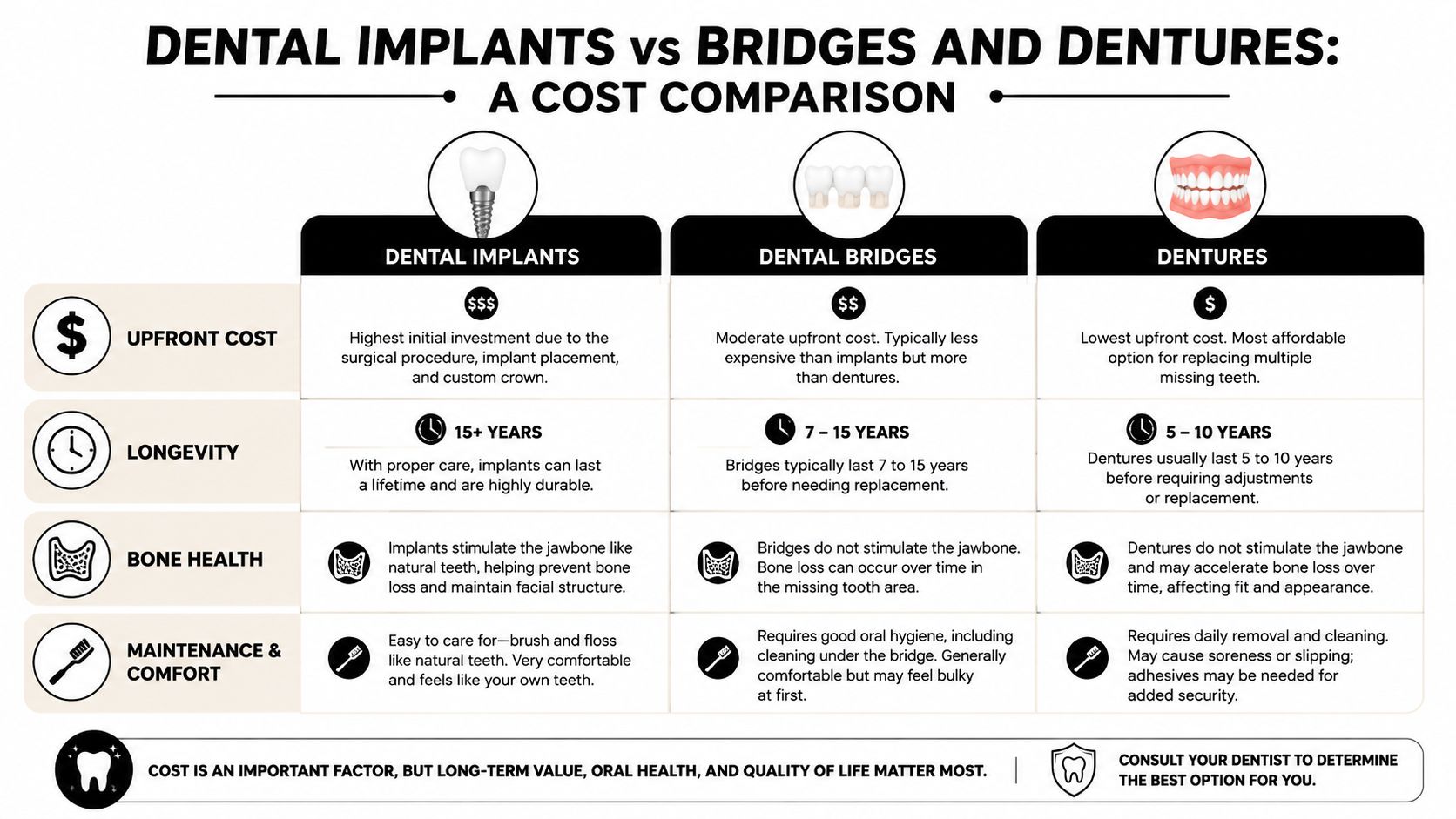
A quick visual overview can help clarify the trade-offs.
How implants differ from bridges
A traditional bridge can be a useful solution in the right case. But it usually depends on the teeth next to the gap. Those neighboring teeth often need to be reshaped to hold the bridge.
That means a bridge replaces the missing tooth by leaning on other teeth. An implant replaces the missing tooth independently.
How implants differ from dentures
A removable denture can restore appearance and basic function, but it sits on top of the gums. It doesn't replace the tooth root. Over time, patients often notice changes in fit, stability, and confidence while eating certain foods.
An implant-supported restoration feels more anchored because it is anchored.
Side-by-side value comparison
| Option | Upfront cost | Bone health | Daily feel |
|---|---|---|---|
| Implant | Higher upfront | Helps preserve jawbone | Fixed, stable, natural-feeling |
| Bridge | Often lower upfront | Doesn't replace the root | Fixed, but depends on nearby teeth |
| Denture | Usually lowest upfront | Doesn't stimulate bone | Removable, can shift over time |
If your main goal is the lowest starting price, implants may not be the first choice. If your main goal is a stable tooth replacement that protects the jaw and doesn't depend on neighboring teeth, implants often make the most sense.
Patients looking for restorative dentistry, cosmetic dentistry, or dental implants near me often choose implants because they want a solution that feels close to a natural tooth in everyday life. Bridges and dentures still have a place. They just solve a different problem in a different way.
Navigating Insurance and Financing for Implants in Pico Rivera
The core issue isn't whether implants have value. It's whether the treatment fits the budget right now.

What a typical single implant may include
A typical U.S. cost for a single dental implant, including the implant fixture, abutment, and prosthetic crown, ranges from $3,000 to $7,000 per tooth, according to this GoodRx overview of dental implant costs.
That kind of range is one reason patients feel overwhelmed. The exact total depends on what's included, whether the site needs preparatory treatment, and how your benefits apply.
Ways patients make treatment more manageable
Insurance coverage for implants varies. Some plans may help with parts of treatment rather than the entire case. In many real-world situations, patients need a combination of benefits and payment planning.
Common ways people handle implant costs include:
- Insurance coordination: Some plans may contribute to parts of the surgical or restorative work.
- Financing: Monthly payments can spread the cost into a more manageable schedule.
- Health spending accounts: Depending on your plan, these may help with qualified dental expenses.
- Phased treatment: In some cases, treatment can be sequenced based on health priorities and budget.
Affordability is part of treatment planning
Good financial guidance is part of good dental care. Patients shouldn't have to guess what they're paying for or what options they have.
For families in Pico Rivera who are also comparing cleaning and exams, new patient exams, teeth whitening, or more urgent needs like tooth extraction, it helps to view implants as one part of a larger oral health plan. The best next step is usually a consultation with a written estimate, benefit review, and a clear explanation of what can be done now versus later.
Your Dental Implant Journey at Cali Family Dental
The implant process feels much easier when you know the sequence. Most patients do well once the plan is broken into simple steps and each visit has a clear purpose.
Your first visit
The first appointment focuses on the reason you're there. Maybe you've lost a tooth, maybe you've been told you need an extraction, or maybe an older bridge or denture isn't working well anymore. This visit includes an exam, imaging, and a discussion about whether an implant is the right fit for your mouth and goals.
For new patients, the office also offers a $69 New Patient Special that includes an exam, digital X-rays, and a routine cleaning.
Planning and placement
If you're a candidate, the next step is a personalized treatment plan. That includes reviewing the site, your bite, the condition of surrounding teeth, and whether any preparatory care is needed first.
The implant placement itself is done carefully and with local anesthesia. Patients are often relieved to learn that the procedure is typically more manageable than they expected.
Most of the success of an implant case comes from proper planning, proper healing, and a restoration that fits the bite correctly.
Healing and the final crown
After placement, the body needs time to heal and integrate with the implant. Once that stage is complete, the final crown is attached and adjusted so it looks natural and functions comfortably.
Patients often say the biggest change isn't just cosmetic. It's the return of normal daily habits. Chewing feels steadier. Smiling feels easier. The missing-tooth space stops controlling attention.
If you've been searching for a dentist in Pico Rivera, CA, a dentist near me, or help with restorative care that doesn't feel rushed, a clear treatment roadmap makes a big difference.
Frequently Asked Questions About Dental Implants
Are dental implants painful
The procedure itself shouldn't be painful because it's performed with local anesthesia. Most patients describe the recovery as manageable. In many cases, the soreness after treatment is less than people expect, especially when compared with the anxiety they felt beforehand.
How long do dental implants last
With proper care, the implant post can last a lifetime. The crown on top may need replacement after years of normal use, but the underlying implant is designed as a long-term solution. That's one reason many patients see the treatment as an investment rather than a short-term fix.
Am I a good candidate for dental implants
Many adults with missing teeth are candidates. The main issue is whether there is enough healthy bone to support the implant and whether the gums and surrounding teeth are in stable condition. Even if bone loss has occurred, preparatory procedures may still make treatment possible.
How do I care for a dental implant
You care for it much like a natural tooth. Good brushing, flossing, and routine professional visits matter. Regular dental care, cleaning and exams, and follow-up checks protect both the implant and the rest of your mouth.
A dental implant doesn't get cavities, but the gum and bone around it still need consistent care.
Is an implant always better than a bridge or denture
Not always. It depends on your oral health, budget, timeline, and goals. Some patients are better served by a bridge or denture, especially when medical, financial, or anatomical limits are part of the picture. The right choice is the one that solves the problem safely and realistically.
If you're weighing your options and want clear answers without pressure, schedule a consultation with Cali Family Dental. Dr. Rafaat and the team help patients in Pico Rivera understand whether a dental implant, bridge, denture, or another restorative plan makes the most sense, then review the costs, insurance questions, and financing options in plain language.