If you're searching for dental implant cost in San Diego, the typical 2026 price for a single implant is $3,000 to $6,500. That range is a useful starting point, but your final cost depends on your bone health, the restoration needed, and whether any preparatory treatment is required.
A lot of people start the same way. They've lost a tooth, they're tired of avoiding one side when they chew, or they're comparing options after being told they may need restorative dentistry instead of a bridge or tooth extraction. They type in a cost search, see a wide range, and still don't know what they would pay.
That confusion is understandable. A dental implant isn't one simple line item. It's a treatment process. The fee can reflect diagnostics, surgical placement, healing, and the final visible tooth. What matters most is whether the plan is complete, clearly explained, and built around long-term success rather than the lowest advertised number.
Dr. Rafaat approaches implant care with that kind of clarity. Patients in Pico Rivera and nearby communities often look at larger-market searches first, including San Diego, because those searches seem likely to give a benchmark. The better next step is understanding why the numbers vary and what kind of care gives you the best value close to home.
Your Guide to Dental Implant Costs in Southern California
Southern California patients often begin with a broad search because they want an honest ballpark before scheduling anything. That makes sense. Implant care is a significant decision, and patients often want to know whether they're looking at something manageable before they come in for a new patient exam.
According to San Diego implant pricing in 2026, the average cost for a single dental implant ranges from $3,000 to $6,500. That price typically includes the initial consultation, X-rays, surgical placement, and standard follow-ups, although bone grafting can add $500 to $2,000 when the jaw needs more support.
What that starting range usually means
A single implant fee is often discussed as if it's one product. It isn't. You're replacing a missing tooth with a system designed to function like a natural root and tooth structure. If a quoted price leaves out key parts of treatment, it can look attractive at first and become frustrating later.
For many patients, the primary question isn't just “What does an implant cost?” It's “What is included?” That's the difference between a useful estimate and a number that creates more uncertainty.
Practical rule: Ask whether the quote includes the consultation, imaging, surgery, restoration, and follow-up visits. If those details aren't spelled out, the price isn't complete.
Why a San Diego search still matters in Pico Rivera
Searches for dentist near me, dental implants near me, or dentist in Pico Rivera, CA often happen after someone first checks bigger-market pricing. San Diego numbers can help set expectations, but they don't tell you what your mouth needs. Two patients missing one tooth can receive very different treatment plans based on gum health, bite forces, and available bone.
That's why a local, personalized evaluation matters more than a generic list online. In real practice, implant cost reflects clinical reality. Someone with stable bone and no infection may move forward more straightforwardly. Another patient may need extraction, site preservation, or additional restorative dentistry first.
Cost matters, but value matters more
A lower fee doesn't always mean lower total spending over time. If the planning is rushed, if imaging is limited, or if the implant is placed without addressing the foundation, the patient may end up paying in repairs, delays, or compromised comfort.
When people come in worried about cost, the most helpful thing is a direct conversation. Good implant planning should feel clear, not mysterious. That same transparent approach also helps patients compare implants with alternatives like bridges, dentures, cosmetic dentistry, or emergency dentist visits after a broken tooth changes the plan entirely.
What Factors Influence Your Total Implant Cost
The wide range in implant pricing comes from the fact that treatment is customized. One patient needs a straightforward single-tooth replacement. Another needs extra support before the implant can be placed safely. The final fee reflects those differences.
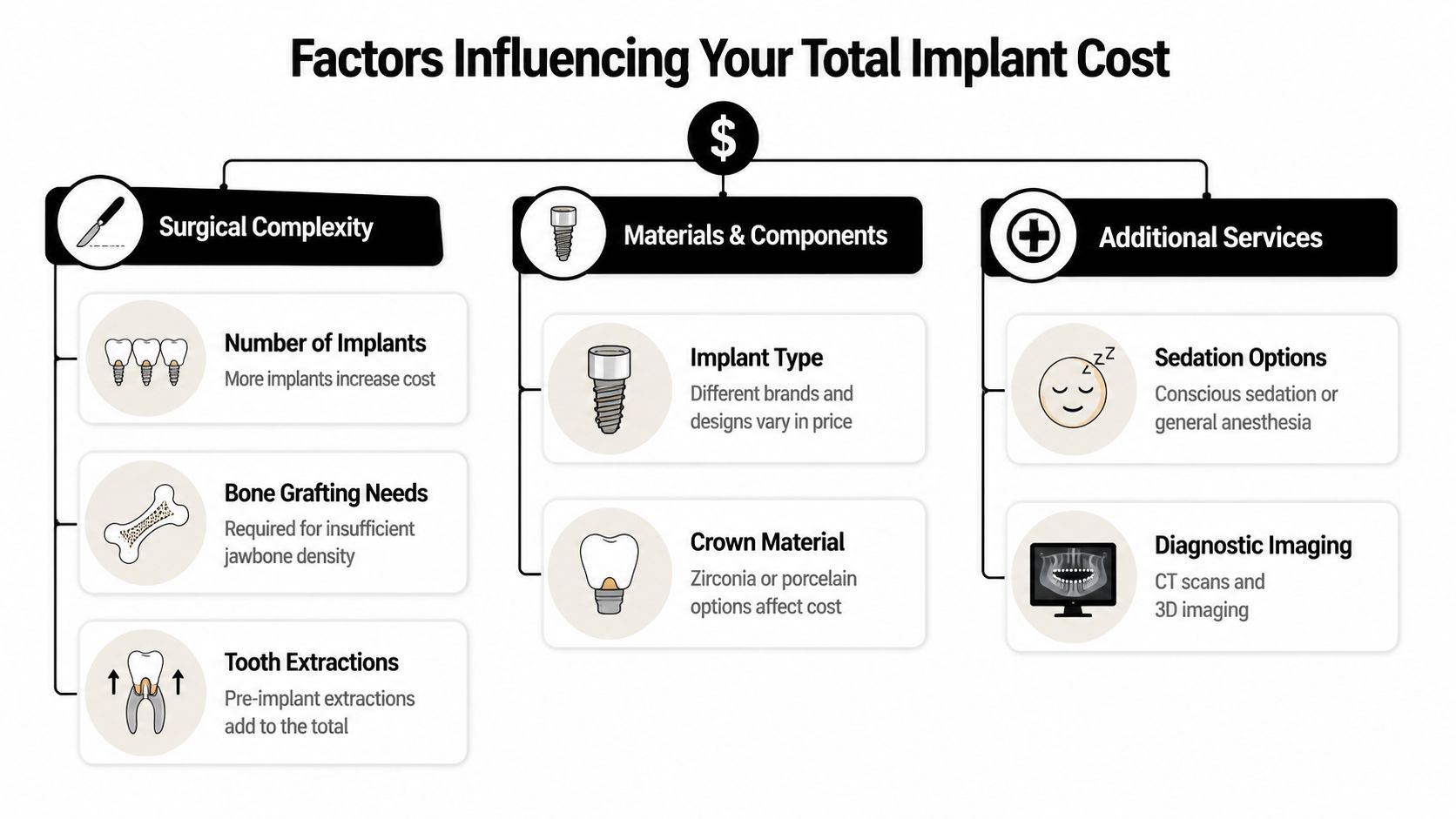
The three cost drivers patients should understand
A simple way to look at implant pricing is to separate it into clinical complexity, materials, and supporting services.
| Cost area | What changes the fee | Why it matters |
|---|---|---|
| Surgical complexity | Bone quality, site condition, number of teeth involved | More complex cases require more planning and precision |
| Materials and components | Implant system, abutment, final crown material | These affect function, esthetics, and long-term wear |
| Additional services | Imaging, sedation, extractions, follow-up needs | These support safety, comfort, and treatment predictability |
Surgical complexity changes everything
The condition of the implant site matters more than many patients expect. If the tooth has been missing for a while, the jaw may have changed shape. If infection or trauma is involved, treatment may need to slow down and rebuild the area first.
That's also why a quick price over the phone usually isn't enough. A responsible evaluation looks at the bone, the gums, the neighboring teeth, and your bite. A patient who's also considering restorative dentistry, crowns and bridges, or even an emergency dentist visit after sudden tooth damage may need a phased plan instead of a single appointment solution.
Materials affect function, not just appearance
Patients sometimes assume the visible crown is the only material choice that matters. It isn't. The implant system and restoration components influence fit, strength, and how the final tooth feels in daily use.
Some cases call for a different restorative approach based on where the tooth is located. Front teeth place a premium on esthetics. Back teeth handle more chewing force. A treatment plan should account for both.
The best implant choice isn't the one with the shortest quote. It's the one that fits your bite, your bone, and your long-term goals.
Technology and planning are part of the value
Modern implant care depends on good diagnostics. Digital imaging, careful measurements, and precise planning help reduce surprises. Patients also appreciate tools that make the process easier, such as digital scans instead of traditional impressions when appropriate.
This is one area where “cheaper” can be misleading. If planning is minimal, the fee may look lower while the risk of complications or revisions becomes higher. In implant dentistry, careful preparation is part of what patients are paying for.
Understanding Necessary Preparatory Procedures
Many unexpected implant costs come from treatment that has to happen before the implant itself. Patients don't always hear that clearly at the beginning, which is why they feel blindsided later. The most common example is bone grafting.
An implant needs a stable foundation. If the jawbone has thinned after tooth loss, placing an implant into weak support is like building on loose ground. The implant may not have the environment it needs for long-term stability.
Why bone support matters
Bone changes after a tooth is lost. The body no longer receives the same stimulation in that area, and the ridge can shrink over time. If that change is mild, treatment may still be straightforward. If it's more advanced, the site may need to be rebuilt before the implant can be placed properly.
That can be frustrating to hear, especially when a patient is ready to move forward. Still, it's far better to identify the issue early than to place an implant in a site that can't support it well.
A practical way to think about it is this:
- Healthy foundation: The implant has the support it needs to integrate well.
- Compromised foundation: The implant may face added stress or poor positioning.
- Rebuilt foundation: The site is prepared for a more stable, predictable result.
When a graft may be part of the plan
In some cases, the jaw has enough width and height for implant placement without any extra treatment. In others, grafting is recommended because the bone has receded or the area was damaged by infection.
Based on San Diego implant cost guidance, a complete single-tooth implant including post, abutment, and porcelain crown ranges from $3,000 to $5,500, with the total influenced by case complexity, bone condition, and preparatory work like grafting.
That's an important distinction. Preparatory treatment isn't an upsell when it's clinically necessary. It protects the final outcome.
What doesn't work well
What usually doesn't work is choosing a treatment plan based only on speed. If a site needs support and that step is skipped, the patient may save time initially but increase the chance of disappointment later.
People looking for dental implants near me or cosmetic dentist near me are often trying to solve both function and appearance at once. That's reasonable. But function comes first. If the foundation is weak, the cosmetic result won't have the support it needs.
A stable implant starts before the implant is placed. It starts with the condition of the bone and the honesty of the plan.
Navigating Insurance and Financing for Implants
Insurance is where many implant conversations become confusing. Patients hear that a practice “works with insurance,” assume that means the full treatment is covered, and only later learn that coverage may apply to one part of the case and not another.
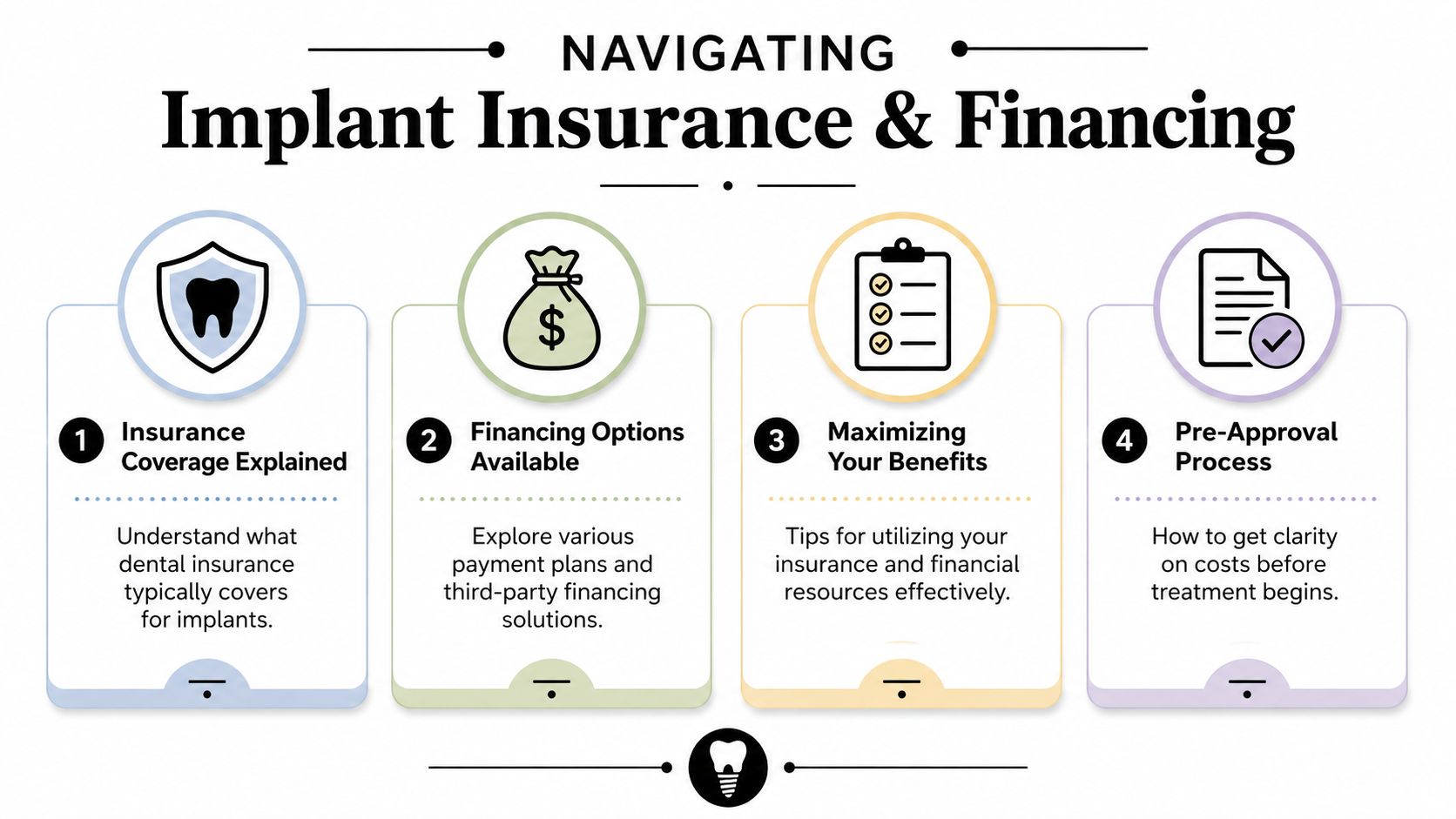
According to implant insurance details for San Diego patients, many patients are surprised to learn that insurance may only cover the crown portion of an implant, not the surgical placement, and that annual benefit caps are often limited to $1,000 to $1,500. The same source notes that transparent financing matters because patients often discover these limits only after a consultation.
The part patients miss most often
The confusion usually comes from how implant treatment is divided. The surgical phase and the restorative phase may be treated differently by a dental plan. That means a patient may receive some help with the visible crown while the implant surgery itself remains non-covered.
This video gives a helpful overview of how patients can think through cost and payment planning before treatment begins.
That disconnect is why broad promises aren't enough. “We take your insurance” isn't the same as “Here is exactly what your plan is likely to apply to, and here is what it probably won't.”
What to ask before you agree to treatment
Patients who want clarity should ask for a written breakdown before treatment starts. That discussion should separate the parts of care clearly.
- Surgical phase: Ask whether the implant placement is considered excluded, limited, or non-covered under your plan.
- Restorative phase: Ask whether the crown receives any reimbursement and whether annual caps apply.
- Related services: Ask how exams, dental X-rays, extractions, or other restorative dentistry steps are categorized.
- Payment support: Ask whether financing can bridge the gap between insurance benefits and the full fee.
In the San Diego and Chula Vista implant market overview, local dentists report single-implant fees around $3,000 to $4,500, while most insurers cap implant-related benefits at $1,000 to $1,500 per year, typically toward the crown portion. That's why so many patients find that a typical implant is still largely paid out of pocket.
Denti-Cal and Medi-Cal questions
Patients using Denti-Cal or Medi-Cal often have the same concern. They want to know what applies to implant treatment and what does not. The difficult part is that benefit language can be narrow, component-based, and hard to interpret without help from the office team.
What tends to work best is a consultation that maps treatment line by line. What usually doesn't work is relying on assumptions or verbal estimates without a written financial plan.
A smart financial decision starts with a complete insurance breakdown, not a vague promise of coverage.
Your Dental Implant Journey From Start to Finish
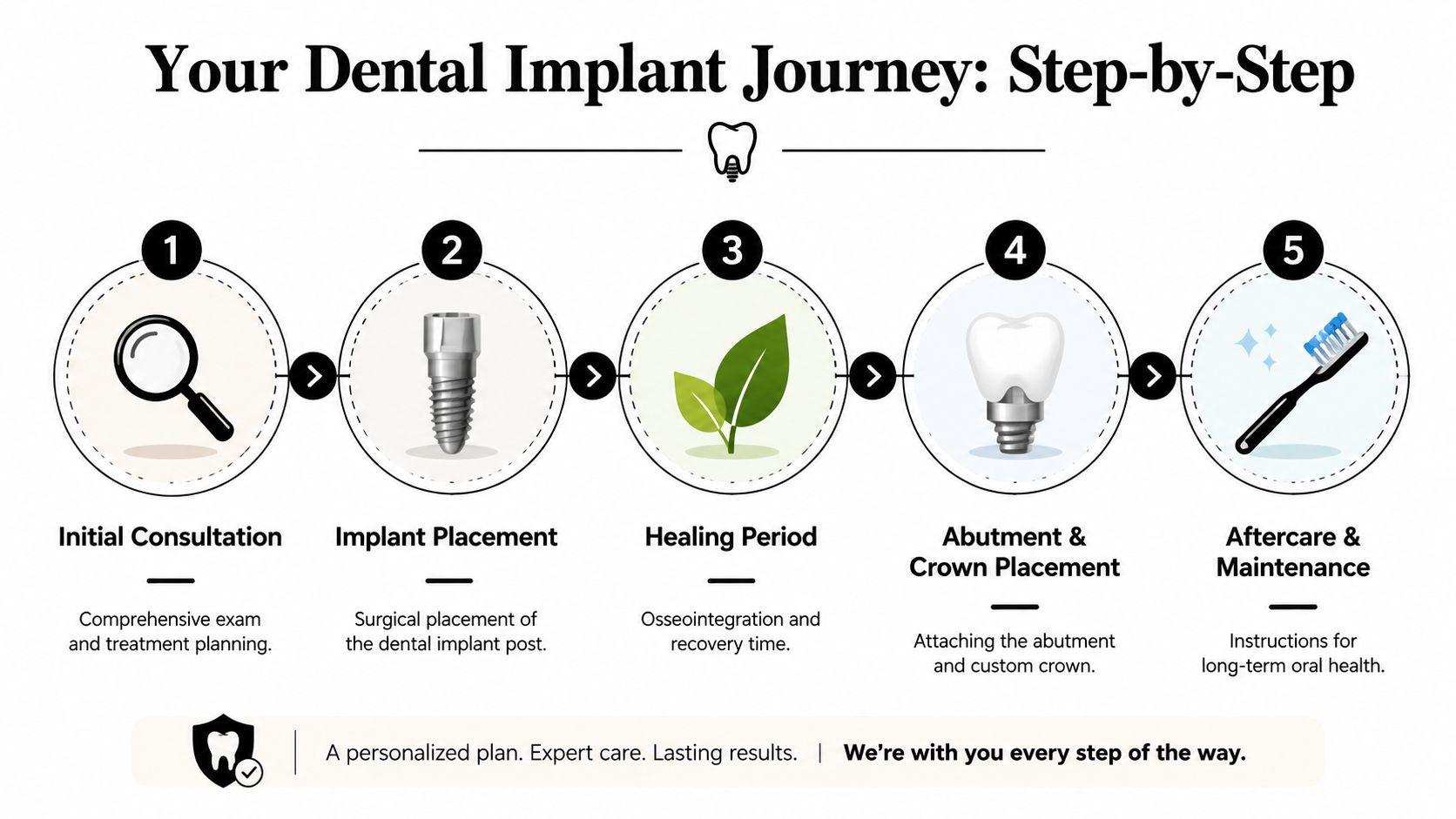
Most patients feel better once they know the sequence. Implant treatment isn't random. It follows a clear path, and each step has a purpose.
Step one is diagnosis, not drilling
The first visit focuses on the problem in front of you. Maybe you lost a tooth years ago. Maybe a cracked tooth led you to search for a dentist near me or emergency dentist and now replacement options are on the table. Maybe you're comparing a bridge with an implant and want to understand the long-term difference.
That appointment typically includes an exam, imaging, and a conversation about goals. Some patients care most about chewing comfort. Others want a natural-looking result that blends with cosmetic dentistry work such as teeth whitening on nearby teeth.
The middle of the process is where healing happens
Once planning is complete, the implant is placed in the jaw. After that, the body needs time to heal and integrate around the implant. This stage is easy to underestimate because it happens subtly, but it's one of the most important parts of success.
Patients often expect the final visible tooth right away. In some cases, temporary solutions are part of the process. In others, the plan is more staged. What matters is that healing is respected rather than rushed.
Here's the typical flow patients experience:
- Consultation and planning with exam, imaging, and treatment review
- Site preparation if extraction or grafting is needed
- Implant placement with detailed post-op instructions
- Healing period while the implant stabilizes
- Final restoration with the abutment and custom crown
- Maintenance visits to protect the implant and surrounding gum tissue
The last step is daily function
When the crown is attached, the goal isn't just to fill a space. The goal is to restore comfort, confidence, and bite balance. The finished tooth should look natural and feel stable in everyday life.
Patients who also need cleaning and exams, bite adjustment, or additional restorative dentistry often do best when implant treatment is part of a complete oral health plan rather than treated in isolation. That broader view helps protect the investment.
Why Pico Rivera Chooses Us for Dental Implants
Patients want more than a number. They want to know who's planning their care, how clearly things will be explained, and whether the office treats them like a person rather than a procedure. That matters even more with implants, where precision and trust go hand in hand.
Experience and communication matter
Dr. Amirreza Rafaat brings more than 24 years of experience to patient care. That experience shows up in practical ways. Treatment planning is careful. Explanations are straightforward. Patients aren't pushed toward a one-size-fits-all solution when a better option may involve phased restorative dentistry, a tooth extraction first, or a more conservative plan.
People searching for dentist in Pico Rivera, CA often want one office that can handle both routine and complex needs. That includes preventive care, dental care for families, same-day concerns, and long-term smile restoration under one roof.
Technology should improve comfort
Modern tools aren't there to impress patients. They should make care easier to understand and easier to tolerate. Digital scanners can replace messy impressions in many situations. Digital X-rays reduce radiation and improve diagnostic communication. Intraoral cameras help patients see what the doctor sees instead of trying to follow a verbal description alone.
That's especially useful in implant consultations. When patients can see the tooth, bone, and surrounding area, decisions become clearer. The treatment doesn't feel abstract anymore.
Accessibility also matters
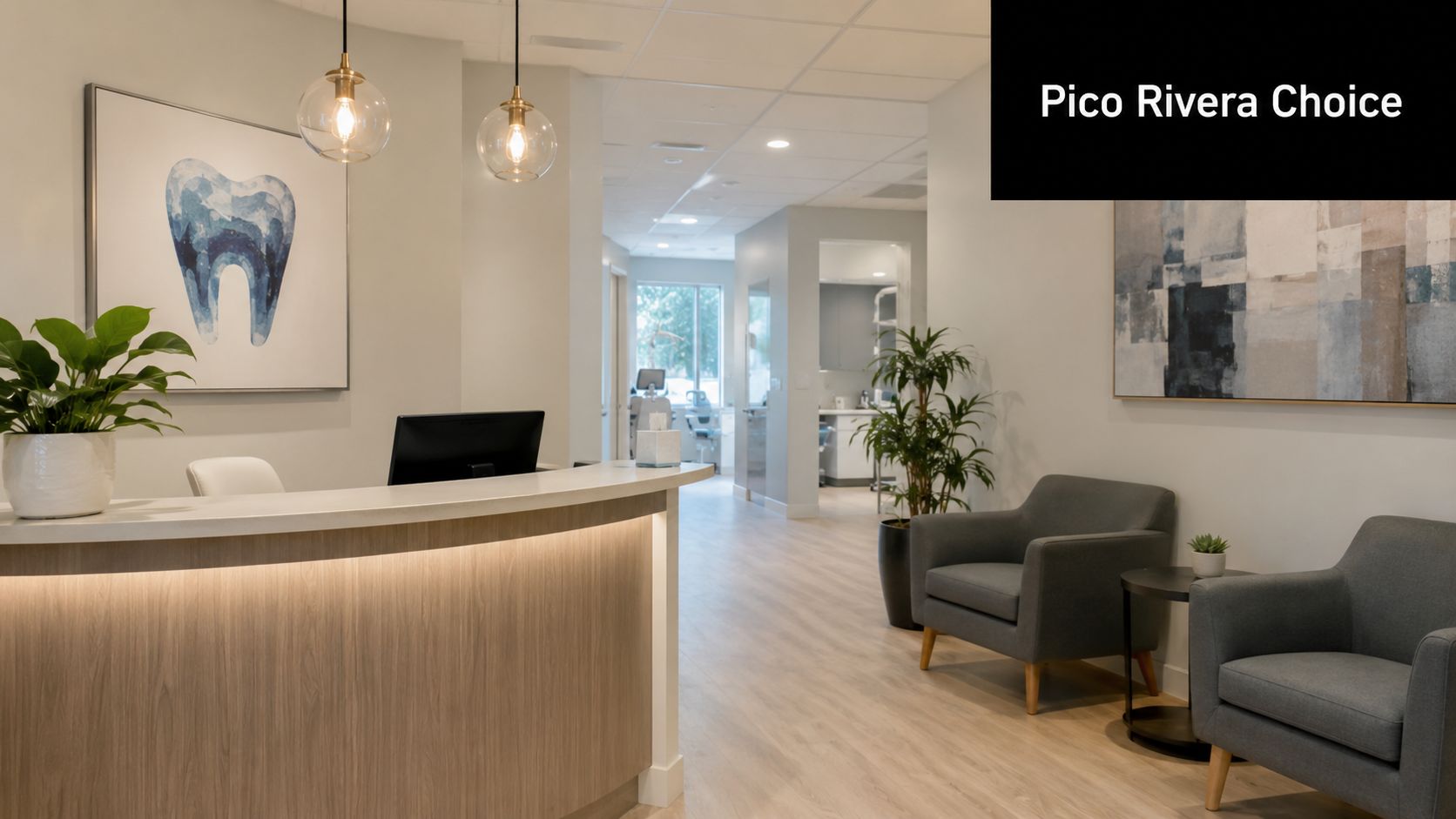
A good implant office should be strong in surgical and restorative care, but it should also be accessible. That includes insurance friendliness, financing options, and a welcoming setting for patients who may already be anxious. Acceptance of Denti-Cal, Medi-Cal, and most PPO plans matters to cost-conscious families in Pico Rivera.
The same office should also support everyday needs such as new patient exams, dental X-rays, cleaning and exams, cosmetic dentistry, and emergency dental services. For many patients, that continuity is a major advantage. They don't want to start over with a new team every time their needs change.
Patients usually feel most confident when the office is clear about both the clinical plan and the financial plan from the beginning.
Your Next Step to a Confident Smile
Online research is useful, but it only gets you so far. A San Diego price range can give you a reference point. It can't tell you whether your implant site is ready, whether you'd benefit from grafting, or how your insurance may apply to different parts of care.
That's why the most useful next step is a personalized consultation. A real exam allows Dr. Rafaat to evaluate the tooth, the gums, the bone, and your bite. It also gives you a chance to ask practical questions about timeline, comfort, alternatives, and how implants compare with other restorative dentistry options.
What patients can expect at the visit
A consultation should feel calm and specific. You should leave knowing what problem is being treated, what the recommended steps are, and what questions still need to be answered before moving forward.
Patients commonly come in for concerns such as:
- A missing tooth: You want a fixed replacement that feels more natural than a removable option.
- A failing tooth: You may be deciding between saving the tooth or planning for extraction and replacement.
- A cosmetic concern: You want the restored tooth to blend with your smile and existing dental work.
- A broader dental need: You may also be overdue for cleaning and exams, dental X-rays, or general dental care.
A low-friction first step
For many families in Pico Rivera, the easiest way to begin is with the $69 new patient special, which includes an exam, digital X-rays, and a routine cleaning. That's a practical entry point if you're still gathering information or want to establish care before deciding on implant treatment.
The right implant plan should leave you informed, not pressured. If you've been comparing dental implants near me, cosmetic dentist near me, or dentist near me, the best choice is usually the office that explains your options clearly and gives you a treatment plan that makes sense medically and financially.
If you're ready to get clear answers about missing teeth, restorative options, or a personalized implant estimate, schedule a visit with Cali Family Dental. Dr. Rafaat and the team provide patient-focused care in Pico Rivera with same-day availability, transparent guidance, and a welcoming approach that helps you move forward with confidence.