When a gap between your teeth starts to bother you, and you're looking for a dentist near me in Pico Rivera, CA, you're not alone. Many adults and teens feel fine about their smile for years, then notice a front gap in photos, during video calls, or when talking face to face. Sometimes the gap has always been there. Sometimes it seems to appear after other dental changes.
That kind of spacing has a name: diastema. In simple terms, it means there is extra space between teeth. For some people it's only a cosmetic concern. For others, the gap can also affect how food traps, how the bite feels, or how confident they are when they smile.
In Pico Rivera, patients looking for a cosmetic dentist near me often ask whether Invisalign can really fix gapped teeth without metal braces. In many cases, it can. Clear aligners can be a comfortable, discreet option for the right kind of spacing, especially in the front teeth. The key is understanding why the gap is there, whether the case is a good fit for aligners, and what kind of long-term retention is needed after treatment.
Your Guide to a Confident Smile in Pico Rivera
A small gap can feel like a big issue when it's your smile. Some people cover their mouth when they laugh. Others crop photos or avoid smiling with teeth at all. If that sounds familiar, it's worth knowing that gapped teeth are common, and many cases are treatable with modern orthodontic care.
The clinical word for a tooth gap is diastema. That term sounds technical, but the idea is simple. Your teeth have spaces between them that you would rather close, usually because of appearance, bite balance, or food getting caught.
Why gaps happen
A gap doesn't come from one single cause. I always encourage patients to think of spacing as a clue, not just a flaw. The cause matters because it affects which treatment makes sense.
Common reasons include:
- Genetics: Your jaw size and tooth size may not match perfectly, which can leave extra space.
- A missing tooth: When one tooth is absent, nearby teeth can drift and leave visible gaps.
- A large frenum: The small band of tissue above the upper front teeth can sometimes keep those teeth apart.
- Childhood habits: Thumb-sucking or long-term pacifier use can influence spacing as teeth develop.
- Gum problems: Bone and gum support can change over time, and spacing may appear as teeth shift.
A local first step that feels manageable
If you're comparing options for a dentist in Pico Rivera, CA, a first visit should help you understand the cause before anyone talks about trays, bonding, or veneers. A good exam looks at your teeth, gums, bite, and any missing or worn areas that may be part of the problem.
For local patients who want a straightforward entry point, Cali Family Dental offers Invisalign consultations along with broader dental care such as cleaning and exams, dental X-rays, restorative dentistry, cosmetic dentistry, emergency dentist visits, tooth extraction, and dental implants near me services for cases where spacing is connected to missing teeth. New patients can also start with a $69 special that includes an exam, digital X-rays, and a routine cleaning.
Practical rule: Before closing a gap, find out why it formed. The best-looking result usually starts with the right diagnosis, not the fastest cosmetic fix.
Understanding Why You Have Gapped Teeth
A gap can look simple from the outside and still have a very specific cause. That's why two people with similar-looking spacing may need very different treatment plans. One person may be a strong candidate for Invisalign alone. Another may need gum treatment, space management for a missing tooth, or a cosmetic finishing step.
The five causes patients see most often
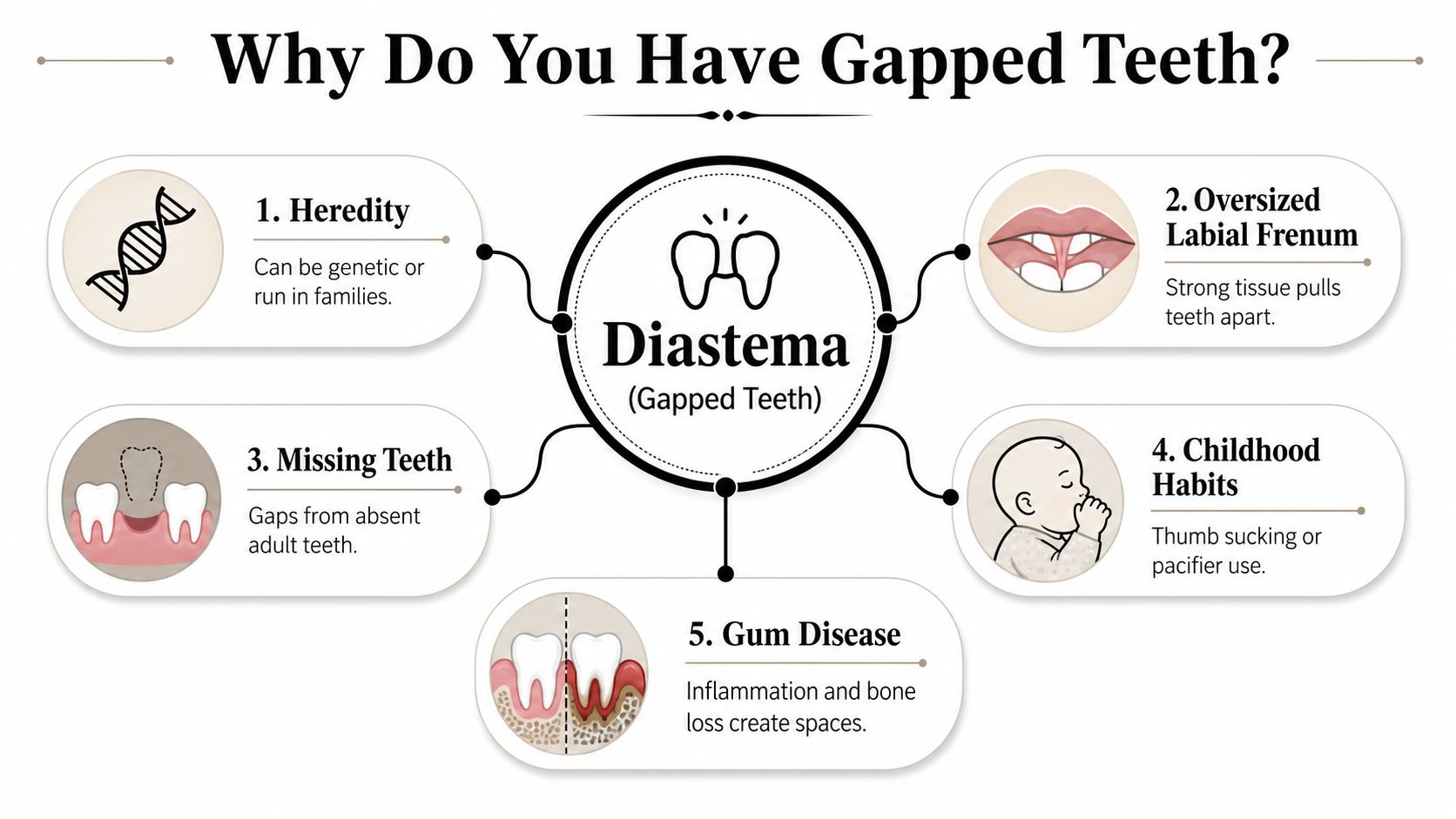
When I explain spacing to patients, I keep it practical. We look for patterns.
- Family traits often show up as small teeth, a wider arch, or spacing that runs in relatives.
- Soft tissue pull can happen when the labial frenum sits low and keeps the front teeth apart.
- Missing teeth change how neighboring teeth sit, and those changes can open or shift spaces.
- Old habits from childhood may leave a lasting effect on tooth position.
- Gum disease can loosen support around teeth, which sometimes causes spreading.
How Invisalign moves teeth into a better position
Braces and aligners both move teeth, but they do it in different ways. A simple way to think about Invisalign is that it uses a sequence of clear trays to apply gentle, planned pressure where it's needed. Instead of wires being adjusted in the mouth, each new tray continues the movement.
A published overview notes that Invisalign effectively closes small to moderate gapped teeth of 2 to 6 mm, especially central front tooth gaps up to 6 mm, using custom SmartTrack thermoplastic aligners changed every 1 to 2 weeks through controlled, gentle pressure (review of Invisalign gap closure effectiveness).
That sounds technical, but here's the plain version. Your teeth aren't being shoved into place. They're being guided in a series of small, controlled steps.
What the process looks like in real life
Most patients are surprised by how digital the process feels now.
- Your teeth are scanned instead of using messy traditional impressions.
- The movements are mapped out in advance.
- A series of aligners is made to match that plan.
- You wear each set, then switch to the next one on schedule.
- The space gradually closes as teeth move into healthier positions.
Moving teeth is a bit like nudging books across a shelf one at a time. Small movements, done in the right order, create a clean final lineup.
Are You a Good Candidate for Invisalign
Some gap cases are almost made for clear aligners. Others need a more layered plan. The question isn't just, "Can Invisalign close a space?" The better question is, "Is Invisalign the right way to close your specific space?"

Signs you may be a strong candidate
Invisalign for gapped teeth is often a good fit when the spacing is mild to moderate, your gums are healthy enough to support movement, and you're willing to wear the aligners as directed. It also helps if your goals are clear. Some patients want to close one visible front gap. Others want full smile alignment and bite improvement.
You may be a stronger candidate if:
- Your gap is natural spacing: This is often easier to treat than space caused by a missing tooth.
- Your oral health is stable: Cavities, active gum problems, or broken restorations may need attention first.
- You want a discreet option: Many working adults and teens like that aligners are removable and less noticeable.
- You can stick to the routine: Invisalign works best when patients are consistent every day.
Natural gap vs missing-tooth gap
Many people encounter mixed messages online. A natural gap between existing teeth is different from a space where a tooth is missing.
A clinical review on Invisalign for missing teeth points out an important distinction: aligners can help manage spacing, but they can't generate bone or replace root structure, which makes Invisalign in missing-tooth cases mainly a preparatory step for an implant rather than a standalone solution (clinical explanation of Invisalign for missing teeth).
That means if you're also searching for dental implants near me, your treatment may involve two phases. First, aligners place teeth where they belong. Then a restorative solution fills the actual missing-tooth space.
Here's a short video that helps patients visualize how clear aligner treatment works:
When a hybrid plan makes more sense
Some front gaps close beautifully with aligners alone. Some don't. Larger visible spaces, unusual tooth shapes, or concerns about final symmetry may call for a hybrid approach. That can mean Invisalign first, followed by small cosmetic refinements such as bonding or veneers.
Sometimes the best result comes from moving the teeth first and perfecting the shape second.
If you're unsure which category you fall into, that's normal. A consultation is what sorts this out. An exam, digital scan, and bite review can tell you whether your smile is best served by Invisalign alone, by restorative dentistry, or by a staged plan that combines both.
Your Invisalign Treatment Timeline and Cost
Two questions come up in almost every consultation. How long will this take, and what will it cost me? The honest answer is that both depend on your case, especially the size of the gap, whether other teeth need movement, and how consistently you wear the aligners.
What affects treatment length
For gap closure, Invisalign treatment commonly falls into a moderate range rather than one fixed schedule. A patient with a small front space and a stable bite usually moves faster than someone who has several spaces, rotation, or bite changes to correct.
Clinical guidance for gap closure notes that treatment typically takes 6 to 18 months, and smaller gaps of 1 to 2 mm may close in as little as 3 to 6 months, depending on complexity and patient compliance (timeline for Invisalign gap treatment).
A simple way to think about it:
| Situation | Typical pattern |
|---|---|
| Small visible gap | Often a shorter plan |
| Multiple gaps or bite changes | Usually a longer plan |
| Inconsistent aligner wear | Can slow progress |
| Missing-tooth planning | May require staged treatment |
What influences cost
Cost depends on how many aligners you need, whether refinements are needed, and whether the treatment is limited to simple spacing or includes broader bite correction. If a missing tooth is part of the picture, the full cost picture may also include restorative treatment such as a bridge or implant after alignment.
For many Pico Rivera families, affordability matters just as much as aesthetics. Insurance benefits can change what you pay, and flexible payment options often make treatment more realistic than patients expect at first.
Making care accessible in Pico Rivera
If you're looking for a dentist near me or a cosmetic dentist near me and cost is your biggest concern, ask about the practical details early. Coverage, financing, and phased treatment can all matter.
Many local patients need an office that works with everyday insurance realities, including Denti-Cal, Medi-Cal, and most PPO plans, plus financing options when orthodontic or restorative care is part of the plan. That matters not only for Invisalign, but also for related services such as cleaning and exams, dental X-rays, crowns, bridges, tooth extraction, or emergency dentist care when a dental issue needs attention before cosmetic treatment begins.
Invisalign vs Braces and Other Gap Solutions
If you want to close a gap, Invisalign isn't the only option. That's good news. It means treatment can be matched to your goal instead of forcing every smile into the same plan. Some patients do best with aligners. Others need the control of braces. Some just need a cosmetic finishing treatment.
Invisalign and braces side by side
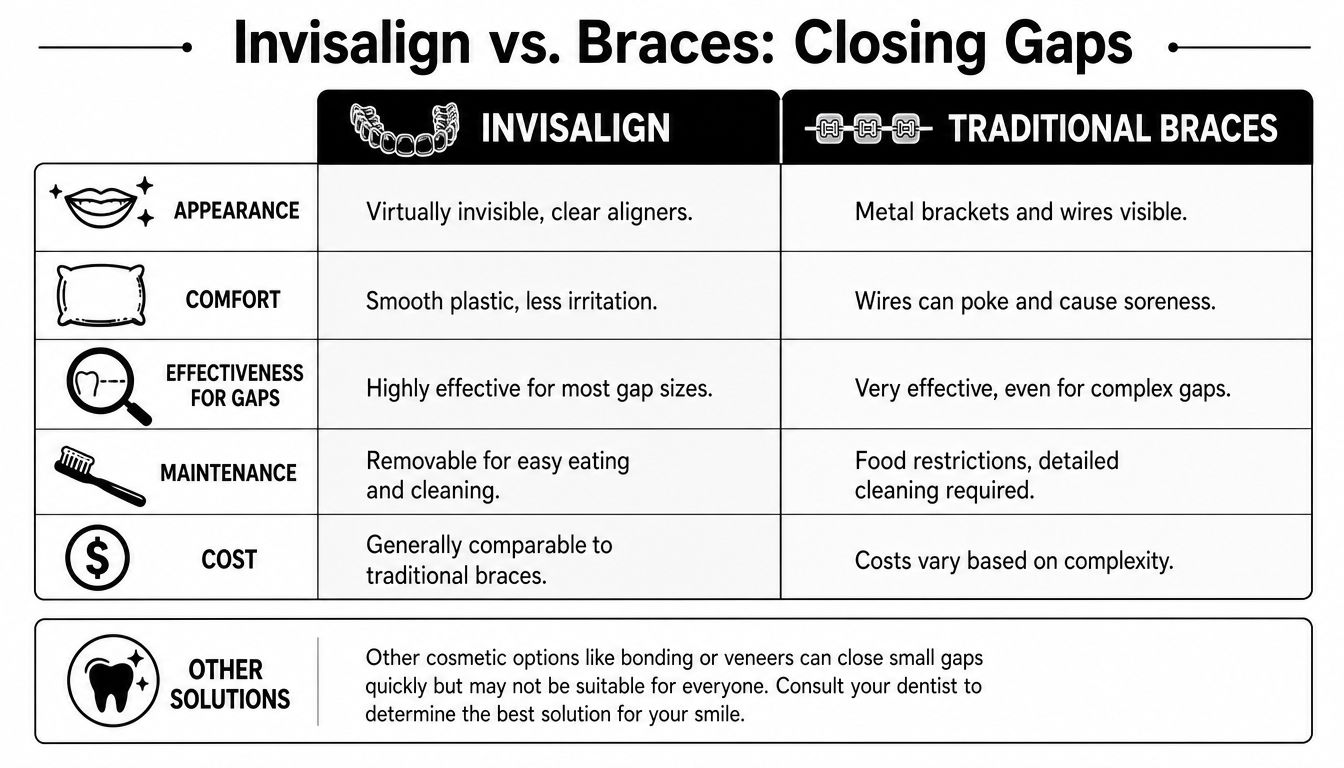
A systematic review found that Invisalign achieves orthodontic outcomes that are statistically equivalent overall to fixed appliances, with a significant reduction in total treatment time. The review reported comparable gap-closure outcomes in roughly 39% less time than traditional braces (systematic review on Invisalign and fixed appliances).
That doesn't mean Invisalign is automatically better for every patient. It means it can be highly effective for the right case.
| Option | Best for | Main advantages | Main tradeoffs |
|---|---|---|---|
| Invisalign | Mild to moderate spacing, patients who want a discreet option | Clear, removable, easier brushing and flossing | Requires discipline |
| Traditional braces | More complex tooth movement or bite correction | Strong control for difficult cases | More visible, harder hygiene routine |
Bonding and veneers
Not every gap needs orthodontics. Cosmetic dentistry can sometimes solve the appearance of spacing faster, especially when the issue is partly tooth shape.
- Dental bonding: A tooth-colored material is added to reshape the teeth and reduce the appearance of small gaps. It's often useful when the space is small and the tooth proportions are the bigger issue.
- Porcelain veneers: Thin custom coverings on the front of teeth can improve shape, size, and spacing together. Veneers are often chosen when patients want a broader smile makeover.
Which option fits which patient
If the teeth are in the wrong positions, moving them first usually creates the healthiest base. If the teeth are well positioned but look too narrow or uneven, bonding or veneers may be the more direct answer. In some smiles, both are appropriate in sequence.
A gap can be an alignment problem, a shape problem, or both. Treatment works better when the plan matches the real cause.
Patients who are also dealing with damaged teeth, old crowns, or missing teeth may need restorative dentistry in the conversation too. That's why a cosmetic concern sometimes overlaps with function, long-term wear, or planning for implants and bridges.
Your Invisalign Journey at Cali Family Dental
Patients typically don't walk into a consultation asking for a full treatment map. They usually start with something simpler. They say they don't like the gap, they want to know if Invisalign could work, and they want a straight answer about what comes next.
The first visit
A typical journey starts with a new patient exam. That appointment gives you a chance to talk about what bothers you, whether it's one front gap, multiple spaces, shifting teeth after a missing tooth, or a smile that doesn't feel balanced anymore.

The visit usually includes digital X-rays and a close look at your teeth and gums. If spacing is the main concern, digital scanning can map your teeth without messy impressions. That scan helps show not only where the gap is, but also whether other teeth need to move so the final result looks natural and functions well.
Building the treatment plan
Once the records are complete, the next step is planning. During this stage, patients often feel relief because the problem starts to look solvable. You can see the teeth as they are and discuss where they need to go.
The aligners are then created as a sequence. Each set is designed to continue the movement started by the one before it. Some patients need a shorter series focused mainly on spacing. Others need a broader alignment plan that includes rotations or bite refinement.
A peer-reviewed review on clear aligner compliance notes that successful gap closure depends heavily on wearing aligners for 22 hours a day, switching them weekly or biweekly, and staying consistent because without that adherence, the 80% to 90% success rate seen for mild to moderate spacing issues drops significantly (clinical review of compliance and clear aligner success).
Check-ins and long-term retention
Check-ins are usually straightforward. The goal is to confirm that the teeth are tracking as planned, answer questions, and keep treatment moving without surprises. If an attachment, wear pattern, or refinement is needed, it's easier to catch early.
The final stage matters just as much as the first. Once the gap is closed, the teeth need help staying there. That's where retainers come in. Without retention, teeth can drift, especially in the area that was originally spaced.
Here's the mindset I want patients to have: aligners close the gap, but retainers protect the result.
The smile reveal isn't the end of treatment. Retention is what keeps the smile looking the way you worked for it to look.
Common Questions About Closing Gaps with Invisalign
Does closing a tooth gap with Invisalign hurt
Most patients describe it as pressure, not sharp pain. You may notice soreness for a few days when you start a new aligner, especially early in treatment. That's a sign the teeth are moving. The feeling is usually manageable and tends to fade.
What happens after Invisalign is finished
You wear a retainer. That's the short answer, and it's an important one. Teeth can shift back if they aren't held in their new positions. Your retainer schedule depends on your case, but long-term retention is part of protecting the result.
Can I still get Invisalign if I have crowns or fillings
In many cases, yes. Existing dental work doesn't automatically rule out Invisalign. The key is making sure your restorations are in good condition and that your treatment plan accounts for them. An exam helps determine whether any dental care should happen before aligner treatment starts.
What if my gap is caused by a missing tooth
That usually means you need a broader plan. Invisalign may still help by preparing the space or repositioning nearby teeth, but the missing tooth itself often needs a restorative solution such as a bridge or implant.
Do I need a consultation even if the gap looks small
Yes. Small gaps can be simple, but they can also be signs of bite issues, tooth shape differences, gum changes, or shifting caused by a missing tooth. A consultation helps identify the reason so treatment isn't based on guesswork.
If you're ready to talk about Invisalign for gapped teeth, schedule a visit with Cali Family Dental. If you're looking for a dentist in Pico Rivera, CA for cosmetic dentistry, cleaning and exams, dental X-rays, restorative dentistry, tooth extraction, emergency dentist care, or dental implants near me, an in-person evaluation is the best way to find out which solution fits your smile and your budget.