A chipped tooth at breakfast. A crown that fell off during work. A gap that makes you cover your smile when you laugh. These problems feel urgent because they affect more than appearance. They change how you eat, speak, and carry yourself through the day.
Patients in Pico Rivera often come in with one question that sounds simple but isn't. Should I get a crown, a bridge, or an implant? The right answer depends on what's happening below the surface, how healthy the surrounding teeth are, how quickly you need treatment, and what will serve you well years from now.
Dr. Rafaat approaches this decision the way experienced restorative dentists should. Start with the tooth, the bone, the bite, and the person. Then choose the treatment that solves the underlying problem, not just the visible one. If you've been searching for a dentist near me, dental implants near me, or a dentist in Pico Rivera, CA because something doesn't feel right, this guide will help you understand your options in plain language.
Facing a Missing or Damaged Tooth in Pico Rivera
A damaged or missing tooth rarely stays a small issue for long. A crack can deepen. A weak tooth can break further. A missing tooth can make nearby teeth shift, and that can change the way your bite comes together.
In practice, the first thing many people want is clarity. They don't want a lecture. They want to know what can be saved, what needs to be replaced, and which option will feel the most natural. That's especially true when the problem is in a visible area or when chewing has started to hurt.
What patients usually notice first
Some patients call because they have pain. Others call because they don't. A missing back tooth may not hurt at all, but it can still create long-term wear and bite imbalance. A front tooth may be structurally damaged even if the discomfort is mild.
Common reasons people start comparing Crown vs Bridge vs Implant include:
- A broken tooth that still has a healthy root and may be restorable
- A missing tooth that leaves a visible space or makes chewing awkward
- An old crown or bridge that no longer fits well
- A tooth with a large filling that has become weak over time
- A dental emergency where the immediate goal is to stabilize the tooth first
The best restoration isn't the one that sounds most advanced. It's the one that matches the condition of your tooth, gums, bite, and long-term goals.
Why a careful exam matters
Two teeth can look similar in the mirror and need very different treatment. One may need a crown. Another may be too damaged to save and need extraction followed by a bridge or implant. That's why a proper exam, digital X-rays, and a close bite evaluation matter before making a decision.
If you're looking for restorative dentistry, cosmetic dentistry, or even an emergency dentist in Pico Rivera, the goal is the same. Protect comfort now and make a smart decision for the future.
Understanding Your Three Main Tooth Restoration Options
The easiest way to understand these treatments is to think about what's still there and what's missing.
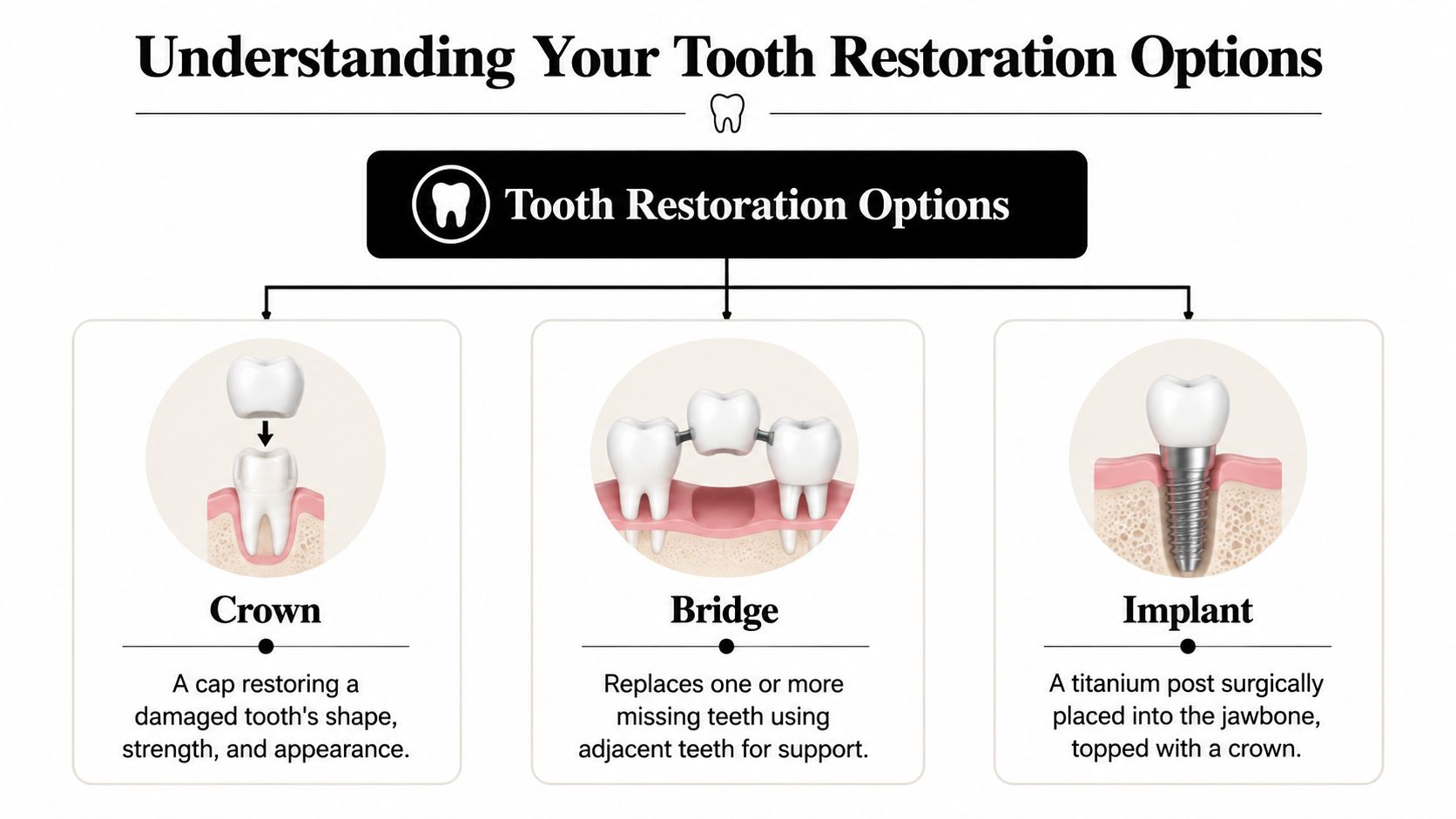
A dental crown protects and rebuilds a tooth that still has a usable root. A dental bridge fills a gap left by a missing tooth by using neighboring teeth for support. A dental implant replaces the missing tooth from the root up.
What a crown does
A crown is like a protective helmet for a damaged tooth. It covers the visible part of the tooth and helps restore shape, strength, and appearance. Crowns are often used when a tooth is cracked, heavily filled, worn down, or weakened after root canal treatment.
If the root and surrounding support are healthy, a crown often lets you keep your natural tooth instead of replacing it.
What a bridge does
A bridge spans an open space. It places a replacement tooth in the gap and anchors that tooth to the neighboring teeth. Those support teeth usually need to be shaped and crowned so they can hold the bridge securely.
This can be a practical option when a tooth is missing and the teeth on either side already need crowns or need added support anyway.
What an implant does
An implant is different because it replaces both the root and crown. The implant post is placed in the bone, and after healing, a custom crown attaches to it. That means the replacement stands on its own rather than depending on the neighboring teeth.
Simple rule: If the tooth is still present and can be saved, a crown may be the answer. If the tooth is missing, the conversation usually shifts to a bridge or an implant.
Why this distinction matters
These aren't interchangeable procedures. A crown saves a tooth. A bridge replaces a missing one by leaning on adjacent teeth. An implant replaces a missing tooth more independently. Once patients understand that, the decision becomes much less confusing.
Crown vs Bridge vs Implant A Side-by-Side Comparison
A patient in Pico Rivera often sits down with one question that sounds simple but usually is not: “Which option will feel right in daily life?” That is the comparison that matters. At Cali Family Dental, the answer comes from the condition of the tooth, the health of the neighboring teeth and bone, and how much time, surgery, and maintenance a patient is comfortable with.
| Feature | Dental Crown | Dental Bridge | Dental Implant |
|---|---|---|---|
| Main purpose | Restores a damaged tooth | Replaces a missing tooth | Replaces a missing tooth |
| What it relies on | Existing tooth and root | Adjacent teeth for support | Bone support with implant post |
| Effect on nearby teeth | Usually limited to the treated tooth | Requires support from neighboring teeth | Functions independently of neighboring teeth |
| Surgery required | No | No | Yes |
| Timeline | Often faster than implant treatment | Usually completed faster than implant treatment | Longer because healing is required before the crown is placed |
| Best fit | Tooth is present but weakened | Missing tooth with support teeth available | Missing tooth where long-term independence is a priority |
Procedure and treatment flow
The treatment experience feels different with each option.
For a crown, the focus stays on one tooth. The tooth is shaped, a digital scan or impression is taken, and the restoration is made to fit that tooth precisely. In some cases, same-day crown technology can shorten the process, which matters to patients who want fewer visits and less time in a temporary.
A bridge is usually more involved than patients expect because the treatment includes the teeth on both sides of the space. Those support teeth are reshaped so the bridge can anchor securely. If those teeth already have large fillings, old crowns, or structural weakness, that step may fit the bigger picture. If they are healthy and untouched, it is a bigger decision.
An implant has the longest path. The implant post is placed in the bone first, then the area heals before the final crown is attached. Digital scanners and 3D planning help make that process more precise, but healing time still cannot be rushed.
What happens to the teeth next door
This is often the deciding factor.
A crown usually leaves neighboring teeth alone. A bridge asks those teeth to do more work and usually requires permanent reshaping. An implant stands on its own, so it does not depend on the teeth beside the gap for support.
In practice, this is one of the clearest trade-offs I discuss with patients. If the adjacent teeth already need crowns, a bridge can be a sensible way to solve multiple problems at once. If those teeth are healthy, many patients prefer an option that preserves them.
Healthy neighboring teeth are worth protecting whenever possible.
Comfort, function, and appearance
All three options can look natural when they are planned well and matched carefully to your bite and smile. The difference is in how they function over time and how the process feels to the patient.
A crown can feel the most straightforward because you keep your own tooth. A bridge restores chewing and appearance well, but some patients notice that cleaning under it takes practice. An implant often feels the most like a separate tooth because the final crown is supported more independently, but it also asks for surgery and patience during healing.
The Core Trade-Off
A bridge is often the faster replacement choice for a missing tooth. An implant usually takes longer but avoids placing that load on neighboring teeth. A crown belongs in a different category because it helps save a tooth that is still present.
That is why the decision is rarely about picking a favorite procedure. It is about choosing the treatment path that fits your mouth, your timeline, and the condition of the teeth around the area.
Who Is the Best Candidate for Each Option
The right treatment becomes clearer when you stop thinking in product terms and start thinking in clinical situations.

When a crown is usually the right choice
A crown is often the best fit when the tooth is still there, the root is stable, and the goal is reinforcement rather than replacement. This is common with cracked teeth, large old fillings, worn teeth, or teeth that have had root canal treatment.
A crown makes sense when saving the natural tooth is realistic. In many cases, that's the most conservative path.
When a bridge may be the practical answer
A bridge can be a reasonable choice when a tooth is already missing and the neighboring teeth aren't pristine. If those adjacent teeth already need crowns because of large fillings, fractures, or prior dental work, using them to support a bridge may be efficient and sensible.
The long-term tradeoff matters, though. Cleveland Clinic's overview of dental bridges notes that bridges typically last about 5 to 15 years, while implants generally last longer and help preserve bone. That tradeoff becomes especially important when the teeth next to the gap are still healthy, because bridge preparation requires crowning those support teeth and can expose them to future decay or retreatment.
Healthy neighboring teeth deserve real consideration before they're committed to supporting a bridge.
When an implant is often the strongest long-term fit
An implant is often the preferred option when a tooth is missing, the patient wants a stand-alone replacement, and the bone and gum conditions support treatment. It's especially appealing when the teeth beside the gap are healthy and you want to leave them untouched.
Implants also fit patients who are thinking beyond the immediate fix. They usually involve more time and a surgical step, but many people choose them because they want a replacement that functions more independently.
Here's a short visual overview of how dentists think through this decision in everyday care:
Questions that help narrow it down
During a consultation, these questions often guide the decision:
- Is the tooth still restorable? If yes, a crown may be the cleanest solution.
- Are the adjacent teeth already compromised? If yes, a bridge may be more reasonable.
- Are the adjacent teeth healthy? If yes, many patients prefer to explore implant treatment first.
- Do you want the fastest path or the most independent replacement? That answer often separates bridge candidates from implant candidates.
No one should have to guess their way through this. A good restorative plan should feel logical once the underlying condition is explained clearly.
The Long-Term View Lifespan Maintenance and Cost
The upfront fee is only one part of the decision. What matters more over time is how long the restoration is likely to serve you, what maintenance it requires, and whether choosing the faster option today creates more treatment later.
What longevity really means in practice
A crown can serve very well when the underlying tooth remains healthy and stable, but the long-term outlook always depends on that natural tooth and root.
For missing-tooth replacement, the durability differences are more established. According to this clinical summary comparing implants and bridges over time, single-tooth implants are commonly reported at about 98.6% success at 5 years and 90% to 95% survival at 10 years, with many cases lasting 30 years or more. Traditional bridges are commonly described as lasting 5 to 15 years, with some reports showing 79% to 94% 10-year survival depending on patient factors and study design.
That doesn't mean every implant outlasts every bridge. It means implants generally have the stronger long-term track record when conditions are favorable.
Maintenance is part of the investment
Implants still require maintenance. They need healthy gums, good home care, and regular professional monitoring. Neglect can shorten the life of any restoration.
Bridges need attention too, but the cleaning routine is different because food and plaque can collect beneath the replacement tooth. Patients often need instruction on how to clean under a bridge effectively. If the support teeth develop problems, the entire bridge can be affected.
Long-term view: The cheapest starting point isn't always the lowest lifetime cost, especially if future retreatment affects multiple teeth.
Insurance and access to care
Coverage varies by plan, and every office handles benefits a little differently. What helps most is a treatment plan that separates what is necessary now from what can be phased later.
For many Pico Rivera families, affordability is part of the clinical conversation, not a separate issue. That's why it helps to ask about PPO benefits, Denti-Cal, Medi-Cal, and financing before treatment begins. A thoughtful plan should address the mouth you have now and the budget you need to work within.
The Cali Family Dental Difference Modern Care in Pico Rivera
You come in with a cracked tooth, a missing front tooth, or a crown that gave out during lunch. In that moment, the right office setup matters. Clear imaging, faster records, and a treatment discussion you can follow can make a stressful visit feel much more manageable.

Why digital workflows matter to patients
Digital scanning improves comfort and helps patients understand what I see. Instead of traditional impression trays, many cases can be planned with a quick intraoral scan. That often means less gagging, fewer retakes, and a clearer view of the tooth, bite, and surrounding area.
It also improves the conversation. Patients can look at the scan on the screen and see why a crown may be enough, why a bridge may involve neighboring teeth, or why an implant may be the better long-term replacement. A practical overview of these newer workflows appears in this review of crown, bridge, and implant technology.
Where same-day care helps and where it doesn't
Same-day treatment can be a real advantage for certain crown cases, especially when the goal is to protect a damaged tooth quickly and reduce time in a temporary. That matters to busy families in Pico Rivera and to patients who do not want multiple visits for a problem that can be handled sooner.
Implants still follow healing timelines. Digital planning helps us place them more precisely and explain each step more clearly, but bone and gum healing still determine when the final tooth can be attached. Good technology makes the process more efficient. It does not rush biology.
Why experience still matters
Technology supports decisions. It does not make them for you.
At Cali Family Dental, Dr. Rafaat uses digital X-rays, intraoral cameras, and digital scanners to examine the problem carefully and explain the trade-offs in plain language. With more than 24 years of experience in restorative and emergency care, he focuses on a question patients care about. What choice will feel comfortable, protect the surrounding teeth, and hold up well for this specific mouth?
That approach provides practical value for patients who need a dentist in Pico Rivera, CA, want to replace a missing tooth, or need prompt help for a broken restoration. The goal is not to push one treatment. The goal is to help you choose the option that fits your health, timeline, and budget.
Good technology should make care clearer and more comfortable. It should support a treatment plan that fits the patient sitting in the chair.
Your Next Step to a Confident Smile
If you're deciding between a crown, bridge, or implant, start with the simplest truth. These treatments are not competitors in every case. A crown saves a damaged tooth. A bridge replaces a missing tooth by using support from nearby teeth. An implant replaces a missing tooth more independently.
The best choice depends on a few things that are unique to you:
- What condition the tooth is in
- Whether the adjacent teeth are healthy or already restored
- How important speed, surgery, and long-term durability are to you
- What fits your budget and treatment timeline
If you've been putting this off because the decision feels overwhelming, that's normal. Most patients don't need more internet advice. They need a real exam, clear images, and a dentist who will explain the trade-offs in plain language.
A consultation is where this gets easier. Once the tooth, bone, gums, and bite are evaluated, the right path usually becomes much more obvious. Whether you need restorative dentistry, dental implants, a replacement for a missing tooth, or same-day attention for a damaged one, getting answers early can prevent a more complicated problem later.
If you're ready to talk through your options with Dr. Rafaat, Cali Family Dental offers a full range of family and restorative dental care in Pico Rivera, including crowns, bridges, implants, emergency visits, and same-day care for many situations. New patients can also ask about the $69 special that includes an exam, digital X-rays, and a routine cleaning. Schedule a visit if you want a clear, low-pressure treatment plan built around your comfort, your goals, and your long-term oral health.