Most dental bonding falls in the $300 to $600 per tooth range, and the national average is $431 per tooth, which makes it one of the most affordable cosmetic dental options for fixing small chips, gaps, and shape concerns. If you're looking in the mirror at a minor flaw and wondering whether it's worth fixing, bonding is often the quickest and most budget-friendly way to improve a smile without committing to a more extensive treatment.
A lot of people in Pico Rivera start the same way. They notice a chipped front tooth after biting something hard, a small space that catches their eye in photos, or one tooth that doesn't quite match the rest of their smile. Then the next search is usually practical: dentist near me, cosmetic dentist near me, and of course, dental bonding cost.
That's a smart place to start. Cost matters, but so do durability, insurance, and whether the treatment makes sense for your specific tooth. A simple cosmetic touch-up and a repair for a cracked edge don't get billed the same way, and they don't always get covered the same way either.
For families and individuals in Pico Rivera, CA, the goal is usually straightforward. You want care that looks natural, feels comfortable, and doesn't force you into a treatment that's bigger than the problem. Bonding fits that need well when the issue is minor and you want a conservative option. It can also be part of a larger plan that includes cleaning and exams, dental X-rays, restorative dentistry, teeth whitening, or even emergency dentist care if the chip happened suddenly.
Your Trusted Pico Rivera Dentist for Affordable Smile Makeovers
When a dentist in Pico Rivera, CA is needed because a front tooth has a chip, stain, or small gap, two concerns often arise simultaneously: a desire for improved appearance and a reasonable cost.
Bonding is often the treatment that checks both boxes. It's a practical cosmetic dentistry option for people who don't need crowns, don't want veneers right away, and want to preserve as much natural tooth structure as possible. In day-to-day practice, bonding is most effective for: small to moderate imperfections that bother you every time you smile.
Why patients ask about bonding first
People usually don't come in asking for the material. They come in with a situation.
- A chipped edge: You ran into a utensil, a sports mishap, or normal wear finally caught up to a front tooth.
- A small gap: The space may be harmless medically, but it changes how your smile looks in photos and conversation.
- A shape concern: One tooth looks shorter, flatter, or uneven next to the others.
- Staining that whitening won't solve: Some spots need coverage, not bleach.
Practical rule: If the tooth is healthy overall and the problem is modest, bonding is often the most conservative cosmetic fix.
That's why this treatment shows up so often in conversations about cosmetic dentist near me. It can improve appearance without the drilling that more involved restorations often require.
Where bonding fits in a full dental plan
Bonding isn't separate from general dental care. A good dentist looks at the whole mouth first. Sometimes the answer is bonding. Sometimes the better next step is a filling, crown, tooth extraction, or another restorative dentistry service. If a chipped tooth happened in an accident or started causing pain, the visit may also overlap with emergency dentist care.
For Pico Rivera families, that wider view matters. A smile improvement should still protect bite function, gum health, and the long-term condition of the tooth. That's the difference between a quick patch and a well-planned result.
What Is Dental Bonding
Dental bonding uses a tooth-colored composite resin to repair or improve the appearance of a tooth. The easiest way to picture it is like sculpting. A dentist places the material onto the tooth, shapes it carefully, then hardens it so it blends into the natural enamel.
It's popular because it solves cosmetic issues with a light touch. In many cases, there's little to no enamel removal, which makes it a conservative option in cosmetic dentistry.
To make the process easier to visualize, this guide helps: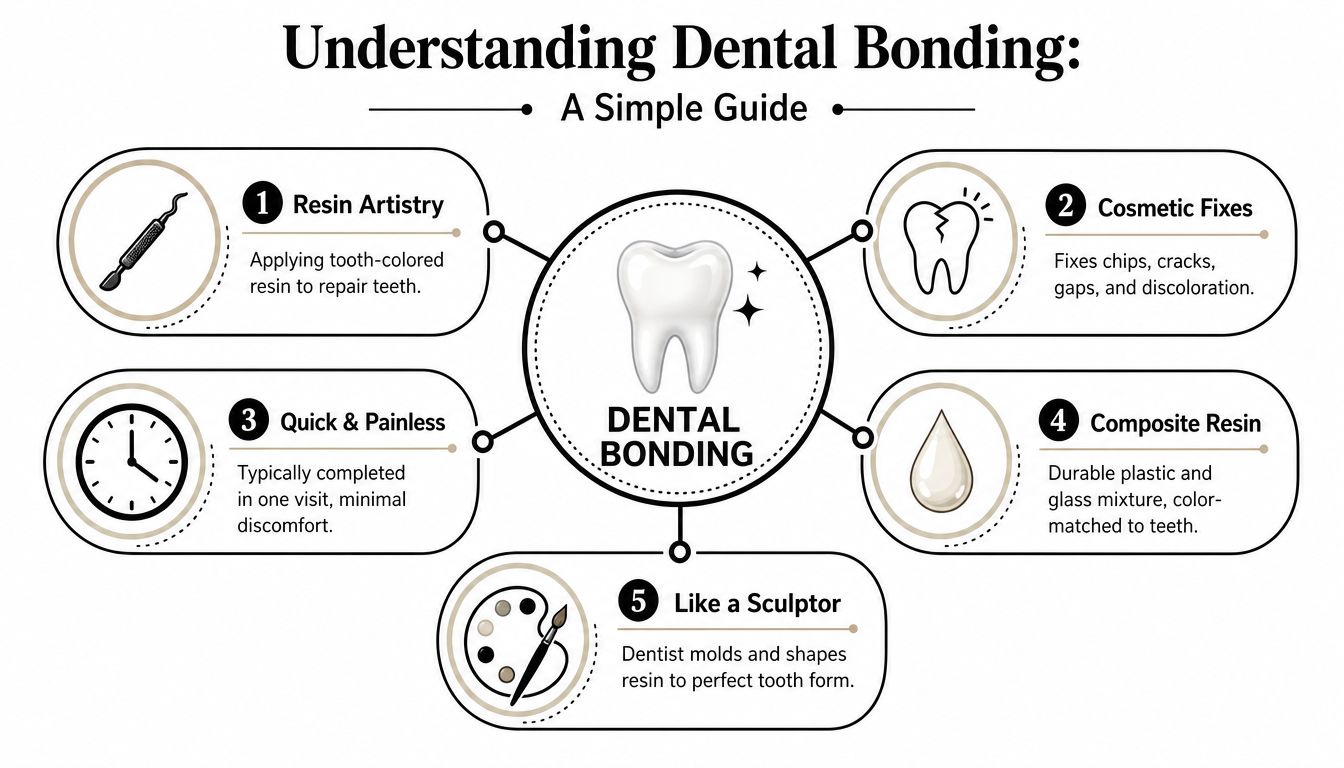
Problems bonding can improve
Bonding is best for visible issues that don't require a full-coverage restoration.
- Chips and small cracks: Especially on front teeth where appearance matters most.
- Gaps between teeth: Including a diastema, or small space between front teeth.
- Discoloration: When a spot doesn't respond well to whitening.
- Misshapen teeth: If one tooth looks uneven, short, or out of proportion.
- Minor contour corrections: To help the smile look more balanced.
What bonding doesn't do is replace major reconstructive care. If a tooth is badly broken, heavily decayed, or structurally weak, a crown or another restorative solution may make more sense.
Why patients like it
One reason bonding stays popular is that it's usually straightforward and comfortable. Many cases can be done in one visit, which appeals to busy parents, students, and working adults trying to fit dental care into a normal week.
This short video gives a useful overview of how the treatment works:
Bonding is often the treatment patients choose when they want a visible improvement without making a permanent jump to veneers.
What the appointment usually involves
The dentist selects a shade that matches your tooth, prepares the surface so the resin adheres well, places the composite, shapes it, hardens it with a curing light, and then polishes it. The final step matters. Good polishing is part of what helps bonding look natural rather than bulky or dull.
For someone comparing options under searches like dentist near me or cosmetic dentist near me, bonding often stands out because it's efficient, minimally invasive, and adaptable to many small smile concerns.
Key Factors That Determine Dental Bonding Cost
In a Pico Rivera office, two bonding cases can look similar at first glance and still carry different fees. A tiny chip on one front tooth is usually a straightforward cosmetic repair. Closing a gap, reshaping a worn edge, or rebuilding a larger portion of a tooth takes more time, more material, and more artistic detail.
That is why online price ranges can feel inconsistent. They often describe different kinds of treatment.
This visual sums up the main cost drivers: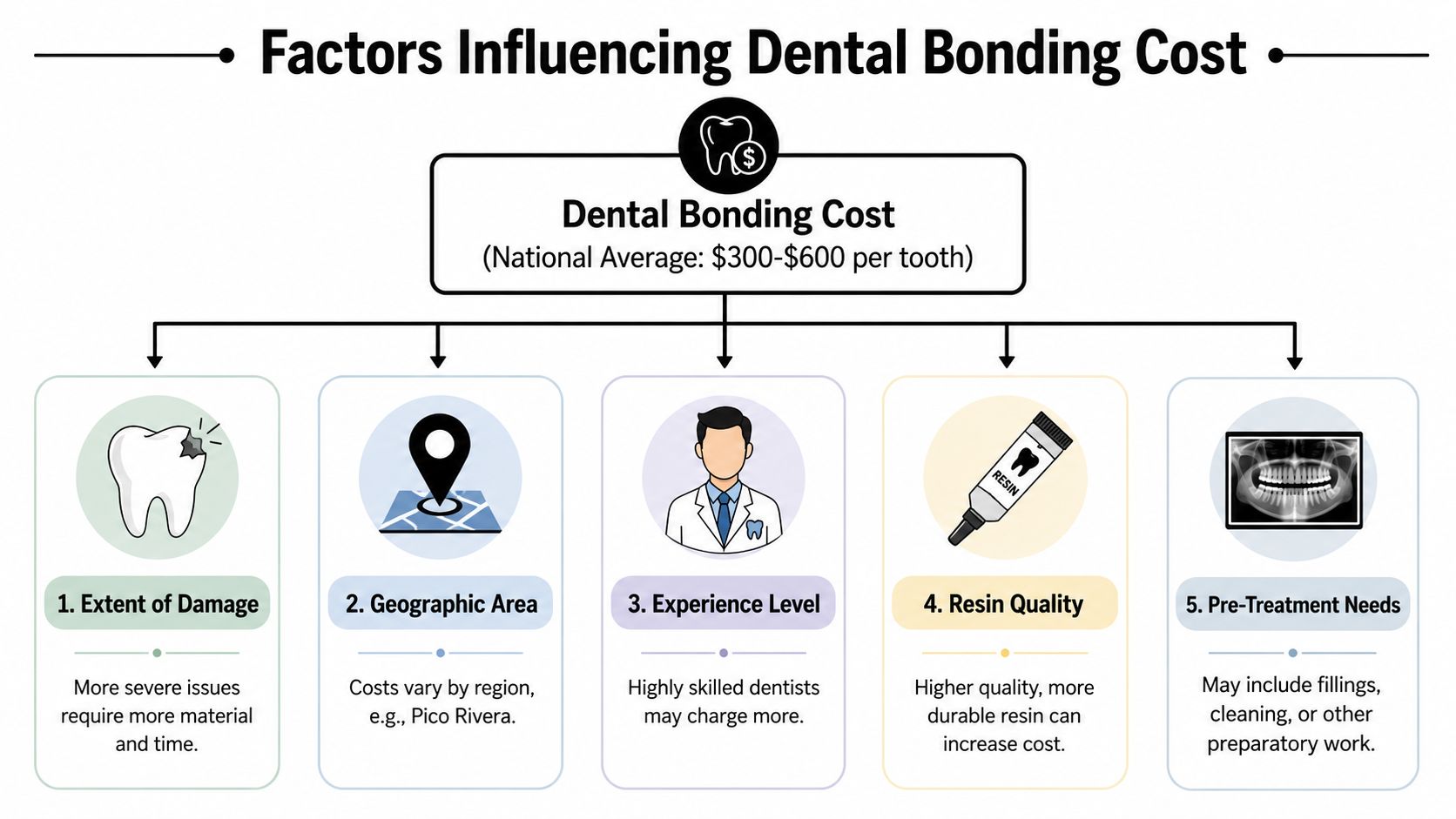
What changes the fee
The size of the repair usually matters first. A small edge chip can often be corrected with less shaping and less resin than a broader repair that wraps across several surfaces of the tooth.
The next factor is location. Front teeth demand careful shade matching, contouring, and polishing because they show every detail when you smile and talk. Back teeth may involve less cosmetic sculpting, but bite forces can add a different kind of technical challenge.
Other variables can also affect the total:
- How many teeth need bonding: Treating one tooth costs less than treating several teeth for balance across the smile.
- How complex the correction is: A simple chip repair differs from closing a gap or rebuilding a tooth that has lost more structure.
- Whether old dental work is present: Existing fillings, wear, or cracks can change the treatment plan.
- How much cosmetic finishing is needed: Precise polishing and shaping take time, and they make a visible difference.
Common price patterns
A common price range for dental bonding is lower for small cosmetic touch-ups and higher for cases that involve multiple surfaces, detailed reshaping, or several teeth. In practical terms, a quick repair on one tooth is usually less expensive than a case where symmetry matters across the front smile line.
That distinction matters for families comparing estimates in Pico Rivera. A fee for one chipped tooth may have little in common with a fee for bonding four front teeth to improve shape and spacing. Both are called bonding, but they are not the same appointment.
| Cost factor | How it affects price |
|---|---|
| Small cosmetic flaw | Usually toward the lower end |
| Multiple surfaces involved | Increases chair time and material |
| Front tooth detail work | May require more cosmetic refinement |
| Several teeth in one smile zone | Raises total cost even if each tooth is modest |
| Cosmetic-only purpose | Often means out-of-pocket payment |
The clearest way to understand a bonding estimate is to ask whether the tooth needs a minor repair, a cosmetic shape change, or a larger rebuild.
Why a local exam matters
A real exam gives the answer that online averages cannot. The tooth may only need bonding, or it may have decay, a bite issue, or older dental work that changes what will hold up well. If I see a case that looks cosmetic on the surface but has deeper structural concerns, I would rather tell a patient that upfront than place bonding that is likely to fail early.
That local piece matters in Pico Rivera because patients are often balancing appearance, durability, and budget at the same time. Some may also be checking whether Medi-Cal or Denti-Cal could apply if the problem is restorative rather than purely cosmetic. A clear exam and written estimate help families decide what is worth doing now, what can wait, and whether a new patient offer can reduce the starting cost of getting answers.
How Bonding Compares to Veneers and Crowns
A parent in Pico Rivera might come in asking for the lowest-cost fix for a chipped front tooth, then learn there are three very different ways to treat it. Bonding, veneers, and crowns can all improve how a tooth looks, but they are built for different situations. The best choice depends on how much healthy tooth remains, how noticeable the area is when you smile, and how long you want the result to hold up before future maintenance becomes part of the budget.
Dental Bonding vs Veneers vs Crowns at a Glance
| Feature | Dental Bonding | Porcelain Veneers | Dental Crowns |
|---|---|---|---|
| Main use | Small chips, gaps, shape fixes, some discoloration | Broader cosmetic makeover of front teeth | Teeth with more extensive damage or structural need |
| Upfront cost | Lower than veneers in many cases | Higher cosmetic investment | Varies by case and need |
| Lifespan | Shorter than veneers | Longer-lasting cosmetic option | Used when protection is as important as appearance |
| Tooth preparation | Usually minimal | More tooth alteration than bonding | More extensive coverage of the tooth |
| Best for | Conservative cosmetic changes | Patients wanting a more dramatic, uniform result | Teeth that need strength and full coverage |
Where bonding makes the most sense
Bonding is a conservative option. For a small chip, minor gap, or slight shape issue, it often gives families the improvement they want without committing to more drilling or a larger cosmetic bill.
That matters in a community where patients often want a practical fix now and may plan larger cosmetic treatment later. If the tooth is healthy and the change is modest, bonding usually preserves more natural tooth structure than a veneer or crown.
Where veneers may be the better long-term cosmetic choice
Veneers are usually considered when several front teeth need to match, or when the goal is a more polished and uniform smile than bonding can reliably deliver over time. They cost more at the start, but they can make sense for patients who want a broader cosmetic upgrade and are prepared for that level of treatment.
Quality Care Global's dental bonding cost discussion notes that veneers generally have a higher upfront fee and longer expected lifespan than bonding. In real practice, that means a patient who needs repeated touch-ups or replacements with bonding may eventually spend closer to veneer-level costs than expected.
The trade-off is simple. Veneers can give a more uniform cosmetic result, but they usually require more tooth alteration than bonding.
When a crown is the right answer
A crown is not a cosmetic substitute for every bonding case. It is a coverage restoration for teeth that need more support.
If a tooth has a large old filling, significant fracture lines, root canal treatment, or major structural loss, a crown may be the safer option because it protects the tooth while improving appearance. In those cases, choosing bonding just because it costs less at the start can lead to another repair sooner than you hoped.
How I explain the choice to patients
The true question is not which treatment sounds best on paper. It is which treatment fits the condition of that specific tooth.
- Bonding fits small cosmetic changes and modest repairs.
- Veneers fit patients who want a more dramatic front-smile upgrade across multiple teeth.
- Crowns fit teeth that need strength, coverage, and protection as much as they need cosmetic improvement.
For many Pico Rivera patients, bonding is the most affordable place to start. For others, especially when several visible teeth are involved, a veneer plan may give better long-term satisfaction. A careful consultation at this stage helps you compare cost, durability, and tooth preservation in a way that is honest and easy to budget.
Using Insurance and Financing to Make Bonding Affordable
A common Pico Rivera scenario is a parent calling about a chipped front tooth and asking the question that usually matters most first: will insurance help, or is this fully out of pocket?
The answer depends on why the bonding is being done. If the tooth needs repair after damage, your dental plan may treat bonding as restorative care. If the tooth is healthy and the goal is only to improve appearance, coverage is often limited or excluded.
That difference affects the final bill more than patients expect.
When insurance may help with bonding
Coverage is usually more realistic when bonding repairs a problem that affects the tooth, not just the smile line. In practice, that often includes a small chip from an accident, a worn area that needs protection, or a defect that makes the tooth harder to function with normally. Cosmetic reshaping on a healthy tooth is more often paid directly by the patient.
Here is the practical way I explain it in the office:
- A chipped or damaged tooth is more likely to be reviewed as restorative.
- A tooth with structural wear or a small defect may also have a better chance of partial coverage.
- Closing a gap for appearance alone is commonly considered cosmetic.
- Changing size or shape on a healthy tooth is usually an out-of-pocket service.
Even when two people both need bonding on a front tooth, their estimates can look very different because their insurance classifications are different.
Here's the financial side in a more practical frame:
Payment options that matter locally
For Pico Rivera families, affordability often comes down to access, timing, and clear communication. An office that works with Denti-Cal, Medi-Cal, and most PPO plans can make a real difference, especially when treatment is tied to an accident, a broken tooth, or a child who needs care quickly.
Denti-Cal and Medi-Cal do not typically function like cosmetic benefit programs, so approval depends on the clinical reason for treatment. That is why a proper exam matters. The tooth has to be evaluated, documented, and coded correctly before anyone can give you a trustworthy estimate.
When insurance does not apply, financing can still make bonding manageable. Monthly payment arrangements may help with cosmetic bonding, several bonded teeth, or treatment that happens alongside an exam, cleaning, or other restorative work. That flexibility is often what allows families to move ahead before a small cosmetic issue turns into a bigger frustration.
At Cali Family Dental, we try to keep that first step simple for new patients in Pico Rivera. If you are using insurance, ask the team to verify benefits before treatment and explain whether the bonding is being planned as restorative or cosmetic care. If you are paying yourself, ask for the full fee up front and whether a new patient offer applies to your visit. Clear numbers make it much easier to plan care with confidence.
The Dental Bonding Process at Cali Family Dental
A bonding appointment usually feels much simpler than patients expect. You come in, talk through the concern, review whether bonding is the right fit, and if it is, the treatment can often move forward without a complicated sequence of visits.
What the visit feels like
The first step is a careful exam with Dr. Amirreza Rafaat. The tooth is evaluated for appearance, structure, and bite so the plan meets the tooth's needs. If the issue came from an accident or sudden break, the visit may also be approached with the urgency of same-day care.
Digital tools make that conversation easier. Digital X-rays can help assess what isn't visible on the surface, and digital scanners can improve precision without messy impressions. For patients who are nervous, that matters. Clear visuals reduce uncertainty and help you understand why bonding is recommended or why another treatment would be safer.
During the procedure
Once the tooth and shade are selected, the resin is placed and shaped directly onto the tooth. The material is cured, refined, and polished so it blends with the surrounding enamel. The goal isn't just to fill space. It's to create a contour that looks natural when you talk and smile.
AZ Dentist's guide to composite dental bonding notes that dental bonding offers a lifespan of 3 to 10 years with proper care, and that its affordability and out-of-pocket cost in some markets make it a popular budget-friendly smile enhancement. In practical terms, that means bonding works best when patients understand both its value and its maintenance needs.
Aftercare and expectations
Bonded teeth should be treated with common sense. Don't use them to bite hard objects, and keep up with routine dental care. If you're considering future cosmetic work such as whitening, ask about timing first, since the bonded material won't whiten the same way natural enamel does.
For many patients, the biggest relief is how manageable the visit feels. There's no long recovery, no complicated downtime, and no mystery about what changed. You leave seeing the difference immediately.
FAQs and Your Appointment at Our Pico Rivera Office
Some of the most important questions come right before someone books. They aren't always about the procedure itself. They're about comfort, maintenance, and whether this is the right first step.
Common questions patients ask
Is dental bonding painful?
Usually, it's very comfortable. Because bonding is conservative and often involves little to no enamel removal, many patients do well without significant discomfort.
Can bonded teeth be whitened?
The bonding material itself won't whiten the same way natural teeth do. If you're thinking about teeth whitening, ask about sequence before treatment so the shade match stays consistent.
How do I care for bonded teeth?
Brush, floss, and keep regular cleaning and exams. Try not to bite ice, pens, or other hard objects with bonded edges.
How long does bonding last?
As noted earlier in the article, lifespan depends on care, bite forces, and where the bonding is placed.
For patients looking for a trusted local office, seeing the environment ahead of time can help:
What to expect when you book
A new patient visit should feel organized and easy to follow. Expect a conversation about your goals, an exam to determine whether bonding is appropriate, and a clear discussion of whether your case is mainly cosmetic or potentially restorative. That's especially important if you're using Denti-Cal, Medi-Cal, or PPO benefits and want cost clarity before treatment begins.
For many Pico Rivera patients, bonding is only one part of finding a dental home. You may also be looking for a dentist near me for family care, dental implants near me for missing teeth, an emergency dentist for urgent pain, or a provider who handles restorative dentistry, cosmetic dentistry, and routine prevention under one roof.
A strong first visit should answer all of those questions, not just quote one procedure.
A practical next step
If cost has been the reason you've delayed fixing a chip, gap, or other small smile concern, start with the exam. A good consultation can tell you whether bonding is the most conservative option, whether insurance may apply, and whether another treatment would serve you better.
The added benefit for new patients is simple. A $69 new-patient special that includes an exam, digital X-rays, and a routine cleaning lowers the barrier to getting real answers instead of guessing from online price ranges.
If you're ready to find out whether bonding is the right fit for your smile, book a visit with Cali Family Dental. Patients in Pico Rivera can get clear treatment recommendations, insurance-friendly support including Denti-Cal, Medi-Cal, and most PPO plans, and a limited-time $69 new-patient special that includes an exam, digital X-rays, and a routine cleaning.