You may be looking in the mirror and noticing that one tooth seems longer than it used to. Or maybe cold water suddenly hits a spot near the gumline and makes you wince. That combination of a changing smile and new sensitivity is often what brings people in for answers.
Gum recession can feel unsettling because it usually shows up slowly. Many patients in Pico Rivera tell me they didn't think much of it at first. Then the sensitivity got more noticeable, food started catching differently, or they realized the gumline no longer looked even. The good news is that there are reliable ways to treat it, and a gum grafting procedure is one of the most proven options we use to protect teeth and restore the gumline.
Are Receding Gums Affecting Your Smile in Pico Rivera
Receding gums don't just change appearance. They expose the root surface of the tooth, and that root isn't protected the same way the crown of the tooth is. Patients often notice tenderness when brushing, discomfort with hot or cold foods, or a smile that looks uneven.
Sometimes the concern is mostly cosmetic. Sometimes it's functional from the start. In either case, ignoring recession usually doesn't help. Exposed roots are harder to protect, and thin gum tissue tends to stay thin unless we address the cause and reinforce the area.
Common signs patients notice first
A lot of people don't use the term “gum recession” when they first call. They describe what they're seeing or feeling:
- Teeth that look longer: The visible part of the tooth seems to increase because the gumline has moved.
- Sharp sensitivity near the gumline: Cold drinks, toothbrushing, or even air can trigger discomfort.
- A notched or worn area near the root: This can collect plaque more easily and feel rough.
- An uneven smile line: One side or one tooth may sit higher than the others.
Recession is easier to treat when we catch it early, before the root stays exposed for too long or the tissue gets thinner.
Why this matters beyond appearance
Healthy gums do more than frame your smile. They seal and protect the structures around each tooth. When gum tissue pulls away, the root surface becomes more vulnerable and everyday habits like brushing or chewing can become uncomfortable.
That's why patients searching for a dentist near me in Pico Rivera, CA often end up asking about more than cleanings and exams. They want to know why sensitivity is happening, whether it can be stopped, and what treatment will last. In many cases, the answer involves periodontal care that restores lost gum tissue instead of only managing symptoms.
At this stage, the most important step is a proper evaluation. We look at how much recession is present, whether the tissue is thin, whether brushing habits or bite forces are contributing, and whether you're a candidate for a traditional graft or a less invasive option.
What Is a Gum Grafting Procedure
A gum grafting procedure is a periodontal treatment that rebuilds gum coverage where recession has exposed the root. The goal is straightforward. Protect the tooth, reduce sensitivity, and create a healthier band of tissue that is easier to keep stable over time. As explained in the Cleveland Clinic overview of gum graft surgery, grafting is used to cover exposed roots and strengthen the gumline.
Shoreline repair is a fair comparison. As the edge pulls back, what sits underneath loses protection. Gum grafting works the same way. We add or reposition tissue so the root is covered more securely and the gumline has better support.

For a nervous patient, the part that usually brings relief is this: the area is numbed well, the surgery is controlled, and the treatment plan is customized for the exact recession pattern around your tooth. At Cali Family Dental in Pico Rivera, I also discuss whether a traditional graft or the Pinhole Surgical Technique makes more sense, because some patients want the most proven root coverage approach, while others are strong candidates for a less invasive option with less tissue trauma.
Why patients choose this treatment
Some patients want to stop the sharp sting they feel with cold water or toothbrushing. Others are focused on the way one tooth looks longer than the rest. In real practice, both concerns often show up together.
A graft can help by:
- Covering exposed roots: This can reduce sensitivity and make daily brushing more comfortable.
- Adding thickness to thin tissue: Thicker gums tend to hold up better against irritation and future recession.
- Improving gumline symmetry: The result can look more even and natural.
- Protecting the root surface: Better coverage lowers the chance of wear and makes the area easier to maintain.
Why this is a well-established treatment
Gum grafting has been part of periodontal care for many years. A review published in NIH/PMC describes soft-tissue grafting as one of the most common periodontal surgical procedures in the U.S. The same review reports long-term improvement in recession and notes that coronally advanced flap with subepithelial connective tissue graft remains a gold-standard option for predictable root coverage in the right case, according to the NIH/PMC review on periodontal soft-tissue root coverage procedures.
A gum graft is not about making gums look perfect. It is about giving a vulnerable tooth a healthier, more stable environment.
What happens during the procedure in plain terms
The area is anesthetized first, so you stay comfortable. Then the exposed root is cleaned and prepared, and the gum tissue is treated in one of two general ways. In a traditional graft, tissue may be taken from the palate or moved from a nearby area and secured over the recession with sutures. In a less-invasive pinhole approach, a small access point is used to loosen and guide the existing tissue into a better position without taking donor tissue from the roof of the mouth.
The trade-off matters. Traditional grafting is often the best choice when tissue is very thin or when we need added bulk and coverage. The Pinhole Surgical Technique can be appealing for select patients because it avoids a donor site and can make recovery easier. The right procedure is chosen by anatomy, tissue quality, and treatment goals, not by preference alone.
Types of Gum Grafts We Offer
Not every recession defect should be treated the same way. The location of the exposed root, the thickness of the existing tissue, and the amount of neighboring gum all shape the plan. In practice, procedure choice is technical, not arbitrary.
Traditional grafting options
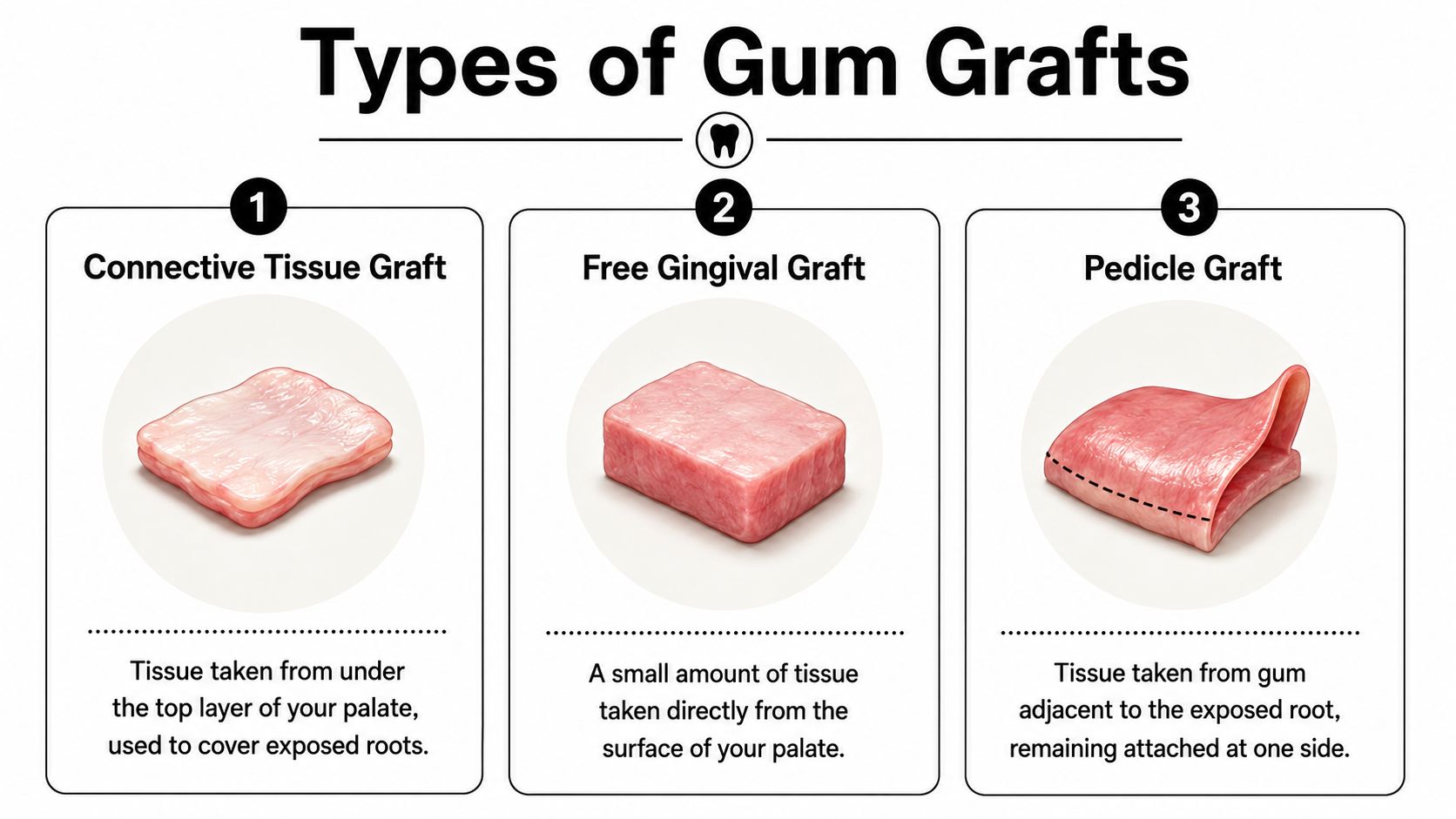
Connective tissue graft
This is the most common choice for root coverage. Tissue is taken from under the top layer of the palate and placed where the recession is present. It's useful when the goal is to cover exposed root surfaces and improve tissue quality.
Free gingival graft
This option is often used when the gums are especially thin and need more thickness. Tissue is taken directly from the surface of the palate. It may be selected when the priority is reinforcement rather than cosmetic blending alone.
Pedicle graft
This approach uses gum tissue next to the recession site and repositions it over the exposed root. Because the tissue stays attached at one side, it keeps its own blood supply. It only works when there's enough healthy tissue nearby.
A less invasive option for select patients
For the right candidate, a tunnel-based approach can reduce tissue trauma. These methods are designed to preserve blood flow around the treatment area, which can support smoother healing than some traditional flap designs. A periodontics source describing the gum grafting process notes that technique choice depends on the recession pattern, that treatment typically takes about 45–90 minutes or 1–2 hours depending on complexity, and that modern tunnel-based approaches can improve blood flow to the grafted area, supporting better and faster healing than some traditional flap designs, as explained in this overview of gum graft techniques and treatment timing.
One minimally invasive option in this category is the Pinhole Surgical Technique. Instead of taking tissue from the palate in the traditional way, the gum tissue is repositioned through a very small access point. That can make the experience feel less intimidating for patients who are anxious about graft harvesting.
Gum Grafting Techniques at a Glance
| Technique | Best For | Invasiveness | Key Feature |
|---|---|---|---|
| Connective Tissue Graft | Root coverage when exposed roots need reliable coverage | Moderate | Uses tissue from beneath the top layer of the palate |
| Free Gingival Graft | Thin gums that need more thickness | Moderate | Focuses on increasing tissue thickness |
| Pedicle Graft | Localized recession with enough nearby gum | Moderate | Nearby tissue stays attached to its blood supply |
| Pinhole Surgical Technique | Select recession cases where a less invasive approach is appropriate | Lower | Repositions tissue through a small entry point |
What works well and what doesn't
What works well is matching the technique to the defect. Thin tissue often needs thickness, not just coverage. A tooth with plenty of neighboring gum may be a good pedicle case. A patient with multiple recession areas and anxiety about donor tissue may be better suited for a minimally invasive approach.
What doesn't work is choosing treatment based only on what sounds easiest online. Good results come from diagnosis first, then procedure selection.
Cali Family Dental offers gum recession treatment that includes the Pinhole Surgical Technique, along with broader family and restorative care for patients who also need cleanings, crowns, dental implants, or follow-up maintenance.
Your Gum Grafting Appointment Step by Step
The part patients usually fear most is the unknown. Once they know what the visit looks like, anxiety tends to drop.
The consultation
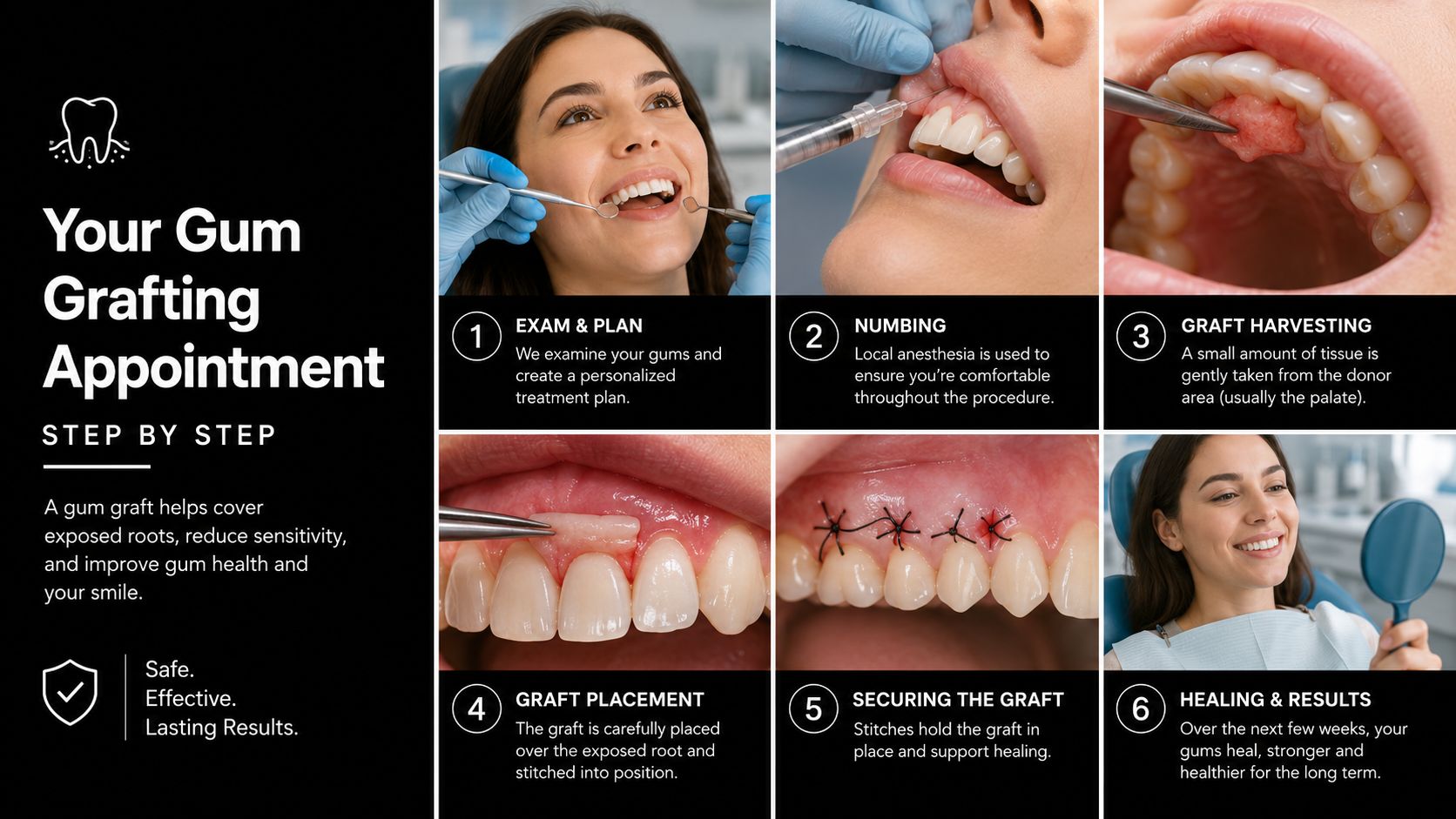
The first visit is about clarity. We examine the recession, check whether the root is exposed in one area or several, and determine whether the tissue is thin, inflamed, or stable. An intraoral camera can be especially helpful because patients can see exactly what we're talking about instead of trying to picture it from a verbal explanation.
This is also where we talk through options in plain language. If you're a candidate for a traditional graft, I'll explain why. If a less invasive approach makes sense, I'll explain that too. The point is to make the choice understandable.
The day of treatment
On procedure day, we numb the area with local anesthesia. Patients are often surprised by how manageable this part is because the goal is complete comfort before anything starts. Once you're numb, the treatment area is cleaned carefully and the selected technique is performed.
If we're doing a traditional graft, that may involve preparing the site and placing donor tissue. If we're using a minimally invasive method, the steps look different, but the objective stays the same. Protect the root and improve the gumline with as little trauma as the case allows.
Most patients do better when they stop bracing for the worst and focus on the sequence. Numbing, treating the site, placing the tissue, then protecting it while it heals.
A short visual overview can help if you like seeing the process first.
Before you leave
You'll go home with specific instructions on eating, cleaning, and protecting the area. That guidance matters as much as the procedure itself. A graft that heals undisturbed has a much better chance of settling in properly than one that gets bumped, brushed, or chewed on too soon.
Most appointments feel far less dramatic than patients expect. From the chair, it's a carefully planned dental procedure, not an ordeal.
What to Expect During Your Gum Graft Recovery
The first evening after treatment is usually the part patients worry about most. In practice, recovery is often steadier than expected when the area is left alone and the instructions are followed closely.
The first 24 hours
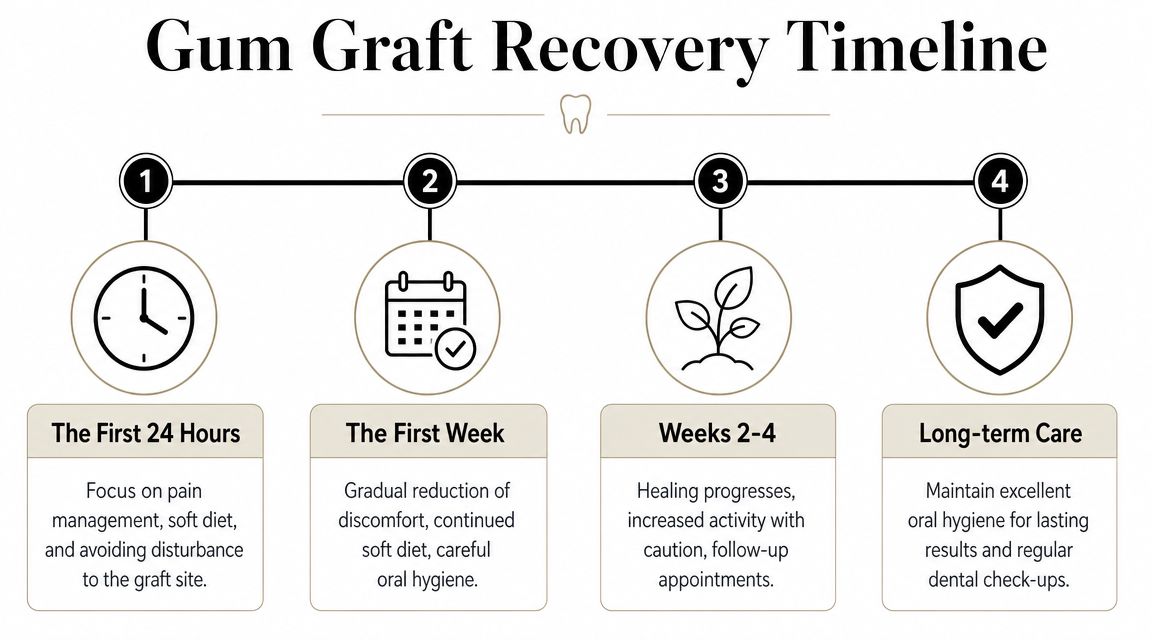
Plan for a quiet day. Eat soft foods, chew on the opposite side, and take any prescribed or recommended medication exactly as directed. Mild soreness, slight swelling, and a small amount of spotting can be normal early on.
What helps most is protecting the site from movement. Do not pull your lip to inspect it. Do not touch it with a finger or keep testing it with your tongue. A graft heals better when it stays stable.
If you had the Pinhole Surgical Technique, recovery can feel easier because there is less tissue manipulation. If you had a traditional graft, especially one that used donor tissue from the roof of the mouth, expect a little more tenderness at first. Both can heal very well. The difference is usually in how much soreness you feel during the first several days.
The first week
This is the period where patience pays off. I tell patients at Cali Family Dental to treat the graft like fresh skin. Keep it clean the way we instruct you, but do not brush or floss directly over the treated area until we say it is safe. Even careful brushing can irritate a new graft before it has attached firmly.
Food choices matter more than patients expect. Scrambled eggs, yogurt, oatmeal, mashed vegetables, pasta, and smoothies eaten with a spoon are usually comfortable options. Chips, crusty bread, nuts, and spicy foods can scrape or inflame the site, so it is better to avoid them for now.
A simple recovery checklist
- Keep meals soft: Choose foods that do not require hard chewing.
- Avoid direct brushing at the graft site: Clean the rest of your mouth gently and leave the surgical area undisturbed.
- Use rinses only as instructed: Too much swishing can be as irritating as brushing.
- Sleep with your head slightly raised the first night: This can help limit swelling.
- Call us if bleeding continues, swelling worsens, or a protective dressing comes loose: Small concerns are easier to handle early.
Most setbacks during healing come from friction, not from the procedure itself.
Weeks after the procedure
As the tissue matures, the area usually looks more natural and feels less tender. Follow-up visits let us check color, contour, and how well the graft is blending with the surrounding gumline. Those visits also help us decide when normal brushing can start again and whether your brushing technique needs to change.
Long-term success depends on what caused the recession in the first place. Aggressive brushing, clenching, gum inflammation, and missed cleanings can all shorten the life of a good result. Once healing is far enough along, we show patients the safest way to clean the area so the new tissue stays healthy and the root stays protected.
Benefits Risks and Financing Your Gum Graft
A gum graft can do two jobs at once. It can improve the appearance of a receded gumline, and it can also protect a root surface that has become harder to defend. For many patients, that combination makes the procedure easier to justify because it addresses both comfort and long-term tooth support.
Benefits that matter in daily life
The biggest practical benefit is often less sensitivity. When the root is covered or the tissue is thickened, brushing and temperature changes usually become easier to tolerate. Patients also like that the smile looks more balanced afterward.
This kind of treatment can also support other parts of dental care. If a patient is considering cosmetic dentistry, restorative dentistry, or even future dental implants in nearby areas of the mouth, stable gum tissue becomes part of the foundation for keeping everything healthy.
Risks and trade-offs
No surgery is completely risk-free, and it's better to say that plainly. The main concerns are healing problems, irritation from trauma during recovery, and results that may vary based on the original anatomy and the technique chosen. Smoking, inconsistent oral hygiene, and brushing the area too soon can work against healing.
That said, gum grafting is generally a predictable procedure when the diagnosis is sound and aftercare is followed closely. Across dental sources, gum grafting success is typically reported as over 90%, with some sources giving a range of 85% to 95% depending on factors like technique, oral hygiene, smoking, systemic health, and follow-up care, according to this summary of gum grafting success rates and cost ranges.
Cost and payment planning
Cost is one of the first questions patients ask, and understandably so. The same source notes that gum grafting can range from $600 to $3,000 per tooth, depending on complexity, technique, and location. A simpler case is different from a more advanced one, and a minimally invasive option may not be priced the same way as a traditional graft.
A consultation is the only way to give a meaningful estimate because the procedure has to match the defect. Insurance can also change the out-of-pocket picture.
For patients in Pico Rivera, payment planning matters just as much as clinical planning. This office accepts Denti-Cal, Medi-Cal, and most PPO plans, and financing options are available. That doesn't make every case identical in cost, but it does make treatment more accessible for families who need to balance care with a budget.
Gum Grafting FAQs from Our Pico Rivera Patients
Is the gum grafting procedure painful
During treatment, the area is numbed thoroughly with local anesthesia, so patients shouldn't feel sharp pain while we're working. Afterward, some soreness is normal, especially with traditional grafts, but most patients tell us the anticipation was worse than the actual recovery.
How long do results last
Results can last for many years when the cause of recession is addressed and the area is maintained properly. The biggest factors are home care, professional cleanings, and avoiding habits that keep traumatizing the gumline.
Is Pinhole surgery better than a traditional graft
Not automatically. It's less invasive for the right case, and that appeals to many patients, but it isn't a universal replacement for every traditional graft. The better option is the one that fits your tissue type, recession pattern, and long-term goal.
Are there alternatives if I'm not ready for surgery
If recession is mild, we may focus first on controlling inflammation, changing brushing technique, and monitoring the area. Those steps can help prevent progression, but they don't rebuild lost tissue. When roots are exposed and the tissue is too thin, surgery is often the treatment that restores protection.
When should I schedule an evaluation
Schedule one when you notice sensitivity, exposed roots, teeth that look longer, or a gumline that seems to be shifting. If you've been searching for a dentist in Pico Rivera, CA, an emergency dentist, or even help with related care like a tooth extraction, cosmetic dentist near me, or dental implants near me, it's worth having the gums examined too. Recession often affects how we plan other treatments.
If you're noticing gum recession, tooth sensitivity, or a changing gumline, schedule a consultation with Cali Family Dental. Dr. Rafaat and the team provide same-day care, clear treatment planning, and options that include traditional grafting and minimally invasive Pinhole treatment for eligible patients in Pico Rivera.