Invisalign usually works within 12 to 18 months for most adult cases, and many people start noticing visible changes in 4 to 6 weeks. If your case is mild, treatment may finish in 6 to 9 months, which means some patients see their full results in under a year.
If you're reading this, you're probably doing what many people in Pico Rivera do before starting treatment. You're checking the mirror, wondering whether your teeth will move fast enough to feel worth it, and trying to picture how Invisalign will fit into work, school, meals, and weekends out. That question is reasonable. A straighter smile matters, but so does your time.
The part that often confuses patients is this. Invisalign speed isn't just about what your teeth need. It's also about what you do every day. The average timeline gives you a starting point, but your habits, especially the easy-to-overlook weekend habits, can push treatment forward or slow it down.
Your Invisalign Timeline Guide from a Dentist in Pico Rivera
A common question comes up initially. How fast does Invisalign work if I stay on track?
For most adults, the typical answer is a year to a year and a half. Some mild alignment cases wrap up sooner, while more involved bite or crowding problems take longer. What matters most is that your timeline should be based on your smile, not on a friend's experience or a social media post.
Why timelines vary from person to person
Two people can both say they want straighter teeth and still need very different treatment plans. One person may have slight spacing in the front teeth. Another may have crowding plus a bite issue that affects how the upper and lower teeth meet. Those aren't the same kind of movement, so they won't move at the same pace.
A good Invisalign plan looks at more than appearance. It also considers function, comfort, and long-term stability. That's why an estimate should feel personal, not generic.
Practical rule: The best timeline is the one built from your scan, your bite, and your daily habits.
What patients in Pico Rivera usually want to know
Most local patients aren't only comparing clear aligners to braces. They're also asking practical questions:
- Will I see change early: Many people want to know whether the first month feels encouraging.
- Can I still work and socialize normally: Since aligners are removable, lifestyle matters.
- Will treatment drag on if I miss time: This is one of the biggest causes of delay.
That last question deserves special attention. People often assume missed hours only matter if they happen often. In reality, short lapses can affect how well each aligner fits and how smoothly the next one works.
What a realistic Invisalign plan should give you
A clear treatment plan should help you understand:
| What you should know | Why it matters |
|---|---|
| Your likely treatment range | It sets expectations early |
| Whether your case is mild, moderate, or complex | It explains the length of treatment |
| What daily wear is required | It determines whether trays can keep moving teeth |
| When check-ins happen | It helps catch delays before they grow |
If you're looking for a dentist near me or a cosmetic dentist near me in Pico Rivera, CA, this is the kind of guidance that makes treatment feel manageable. Good dental care should make the process less stressful, not more confusing.
Understanding How Invisalign Gradually Creates Your New Smile
Invisalign works through a series of custom clear aligners. Each set is shaped a little differently from the one before it, and that difference is what guides your teeth into new positions over time.
The process is similar to walking up a staircase. You don't jump to the top in one move. You take one step, then another, then another. Invisalign does the same thing with tooth movement. Each tray makes a small change, and those small changes add up.
What the aligners are actually doing
When you wear an aligner as directed, it applies gentle, steady pressure to selected teeth. That pressure tells the body to remodel the bone around those teeth so they can shift gradually. The movement is controlled, planned, and sequenced.
This is why consistency matters so much. The trays aren't passive. They only work while they're in your mouth.
Why digital planning helps
Modern Invisalign treatment starts with a digital scan instead of old-style putty impressions. For patients, that means a cleaner, more comfortable visit. For treatment planning, it means greater precision.
A digital scanner creates a detailed model of your teeth and bite. From there, the dentist can map the planned movement from the starting point to the final result. That doesn't just improve comfort. It also helps patients understand what they're committing to and why each stage matters.
The clearer the plan is at the beginning, the easier it is to stay confident during the middle of treatment.
Where patients usually get confused
A lot of people expect every tooth to move at the same speed. That usually doesn't happen. Front teeth may look different early, while bite changes can take longer to feel. Some stages are more visible than others.
Here's an easy way to understand:
- Early stage: You may notice subtle cosmetic changes first.
- Middle stage: More alignment happens across multiple teeth.
- Later stage: Fine adjustments improve fit, contact, and balance.
That doesn't mean treatment has stalled if progress feels less obvious for a while. It usually means the work has shifted from easy-to-see front teeth to movements that are just as important but less noticeable day to day.
Patients who are also interested in broader dental care, such as cleaning and exams, dental x-rays, new patient exams, or teeth whitening, often appreciate how well digital tools improve communication across the whole visit, not just Invisalign.
Comparing Treatment Speeds Invisalign vs Traditional Braces
A common question in my Pico Rivera office sounds like this: "If I start Invisalign now, will I finish sooner than I would with braces?" That is a fair question, because the answer affects school, work, photos, weddings, and all the small routines that make up your week.
According to Hello Tend's overview of Invisalign timelines, Invisalign treatment typically completes within 12 to 18 months for most adult cases, with noticeable visible changes appearing as early as 4 to 6 weeks after starting; mild cases may finish in 6 to 9 months, while complex corrections can extend to 18 to 24 months. The same source also states that Invisalign works up to 50% faster than traditional metal braces in some cases.
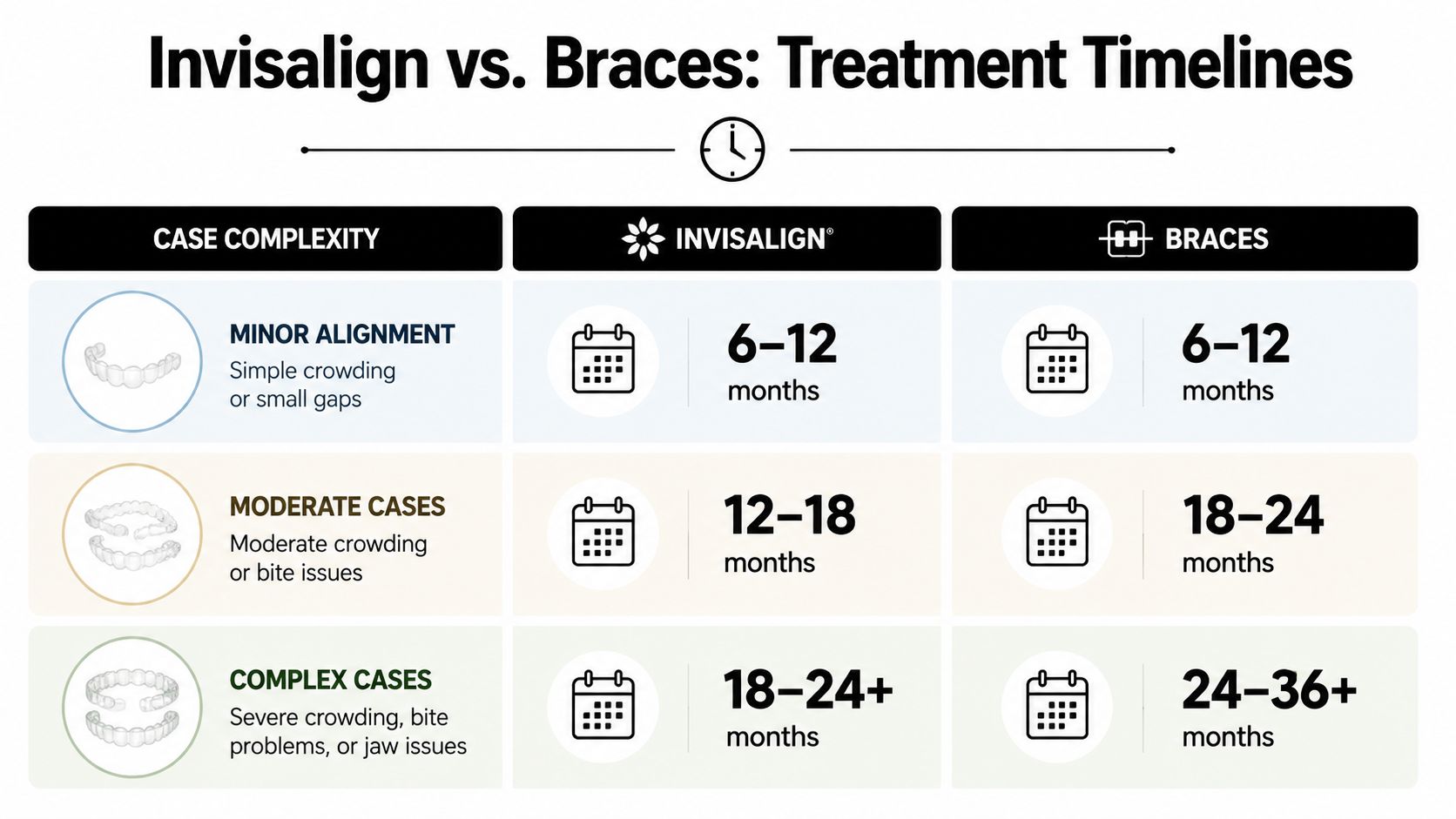
A side by side view of treatment timelines
Here is the practical comparison many patients want first:
| Case type | Invisalign | Traditional braces |
|---|---|---|
| Mild alignment needs | 6 to 9 months in many cases | Often longer for similar mild cases |
| Most adult cases | 12 to 18 months | Often 18 to 36 months for comparable results |
| Complex corrections | 18 to 24 months or longer | Often on the longer end of treatment |
Those ranges are useful, but they do not tell the whole story. Braces are fixed to the teeth, so they keep working whether it is Monday morning or Saturday night. Invisalign trays only work while they are in your mouth. That makes your daily habits part of the treatment system itself.
A good comparison is a cast versus a removable splint. A cast keeps doing its job around the clock because you cannot take it off. A removable splint can work very well too, but only if you wear it as directed. Invisalign follows that same pattern.
Why one person finishes faster than another
For the right case, Invisalign can be very efficient because each aligner is built for a planned stage of tooth movement. You switch trays in sequence, and each one picks up where the last one left off.
But weekends often decide whether that plan stays on schedule.
Patients usually do well Monday through Thursday. Then Friday dinner runs long, trays stay out during social events, Saturday coffee turns into a late lunch, and Sunday becomes a "catch up tomorrow" day. Losing a few hours here and there may not feel like much, but teeth respond to steady pressure. If the pressure keeps stopping, movement can slow down and aligners may stop fitting as neatly as they should.
That is why Invisalign versus braces is not only a question of speed on paper. It is also a question of consistency at home.
How to make the comparison more realistic for your life
If you are organized, wear aligners the recommended number of hours, and put them back in after meals, Invisalign may fit your life very well. If you travel often, snack throughout the day, or know that weekends throw off your routines, braces may be more predictable even if they are less discreet.
Both options can create excellent results. The better choice depends on the kind of structure you need.
Ask yourself:
- Will I actually wear trays as directed every day, including weekends?
- Do I want the freedom to remove my appliance for meals and brushing?
- Am I choosing based on appearance, convenience, or the shortest realistic timeline for my habits?
- Would fixed braces help me stay on track better than a removable system?
Some patients also weigh appearance and smile goals alongside other treatments such as cosmetic dentistry. That is reasonable. Just remember that the fastest plan is usually the one you can follow consistently, not the one with the most appealing average timeline.
Key Factors That Determine How Fast Your Teeth Will Move
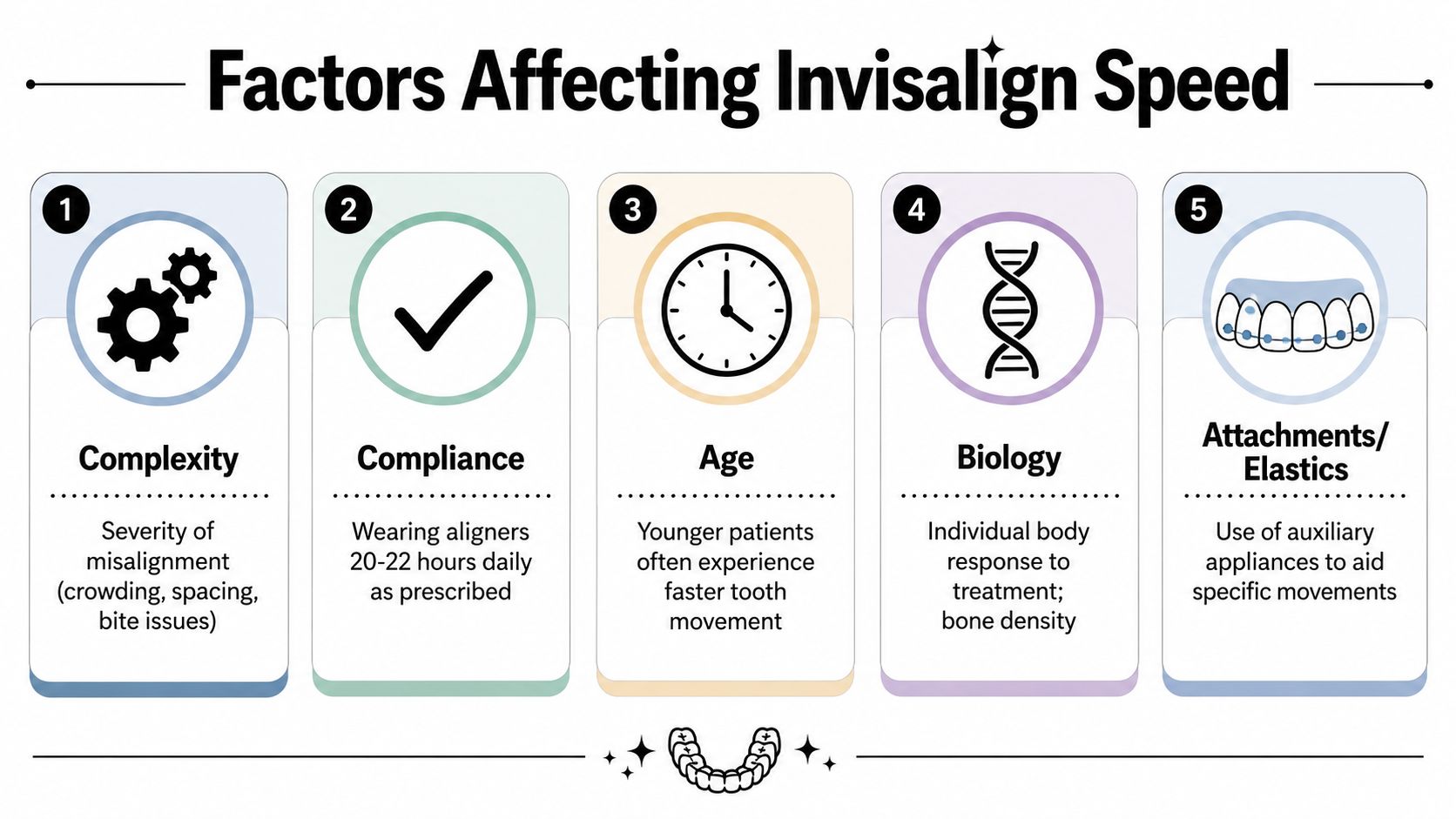
Two patients can start Invisalign in the same month, wear trays that look almost identical, and still finish on different schedules. That usually comes down to a mix of treatment complexity, biology, and daily habits. In my Pico Rivera office, the habit piece is often the one patients can influence most, especially on weekends when routines loosen.
Case complexity sets the starting pace
Some smiles need a few straightforward corrections. Others need several teeth to rotate, shift, level, and fit together better at the same time. Mild spacing or minor crowding often moves faster because there are fewer steps involved. More involved bite problems and severe crowding usually take longer because each tray has to guide a series of small, controlled changes.
A longer timeline does not mean treatment is off course. It often means your plan is correcting more.
Your body's response affects how smoothly teeth track
Teeth move because the bone around them remodels under gentle, steady pressure. A good comparison is reshaping a path in soil. If the pressure is regular, the path forms predictably. If the pressure keeps stopping, the soil settles back and progress slows.
Bone density, gum health, inflammation, and healing response all matter here. Younger patients sometimes move faster, but age is only one part of the picture. I have many adult patients who do very well because their trays fit well and they wear them consistently.
Attachments and other tools improve control
Small tooth-colored attachments, elastics, or other bite tools can make certain movements more precise. Patients sometimes see these as a sign their case is harder than expected. In reality, they usually help us move teeth more accurately and reduce guesswork.
You can think of them as handles for the aligners. They give the plastic a better grip so it can guide more difficult movements.
Weekend wear habits often decide whether you stay on schedule
This is the factor patients underestimate most. Monday through Friday tends to be structured. Breakfast, work, school, dinner, and bedtime happen in a familiar order. Then Saturday arrives. Brunch lasts longer, coffee turns into errands, dinner runs late, and aligners stay out for stretches that feel harmless in the moment.
According to Palo Alto Orthodontics on Invisalign wear consistency, a single day of 16-hour wear can reset the biological clock, potentially adding 2 to 4 weeks to a 12-month case. The same source notes that weekend lapses are a common reason treatment drifts beyond the original estimate.
One loose day can affect several trays after it.
That is why I encourage patients to treat weekends like weekdays. Teeth respond best to steady pressure, not occasional bursts of perfect wear.
Small interruptions can create bigger delays than people expect
The trays may still fit after a long meal or a late night without them. That can be misleading. What often changes first is how fully the aligner seats around the teeth. Then the next tray feels unusually tight, attachments stop lining up as cleanly, or we need extra time before switching sets.
Common slowdown points include:
- Meals that turn into long breaks: The tray comes out for lunch and does not go back in promptly.
- Coffee, drinks, or frequent snacking: Short removals add up over a full day.
- Falling asleep without aligners: A late evening can erase hours of wear time.
- Missed appointments: Small tracking problems are easier to correct early.
If you are also juggling family routines, shift work, sports, or other dental care such as tooth extraction, emergency dentist visits, or restorative dentistry, building a repeatable routine matters. The patients who stay closest to their projected Invisalign timeline are usually not the ones with perfect lives. They are the ones with habits that make good wear time automatic.
How to Keep Your Invisalign Treatment on the Fast Track
Friday night is where many Invisalign timelines start to drift.
A patient does well all week, then leaves the aligners out through dinner, a movie, late-night snacks, and sleep. By Monday, the trays may still seem close enough to fit, but the teeth have lost hours of steady guidance. Invisalign works more like a train staying on its tracks than a car making sharp turns. Small departures can add time later.
The good news is that daily habits have a real effect on how smoothly treatment moves. Biology matters, but routine matters too. In my Pico Rivera office, the patients who stay closest to their original estimate are usually the ones who protect the ordinary parts of the day, especially weekends.
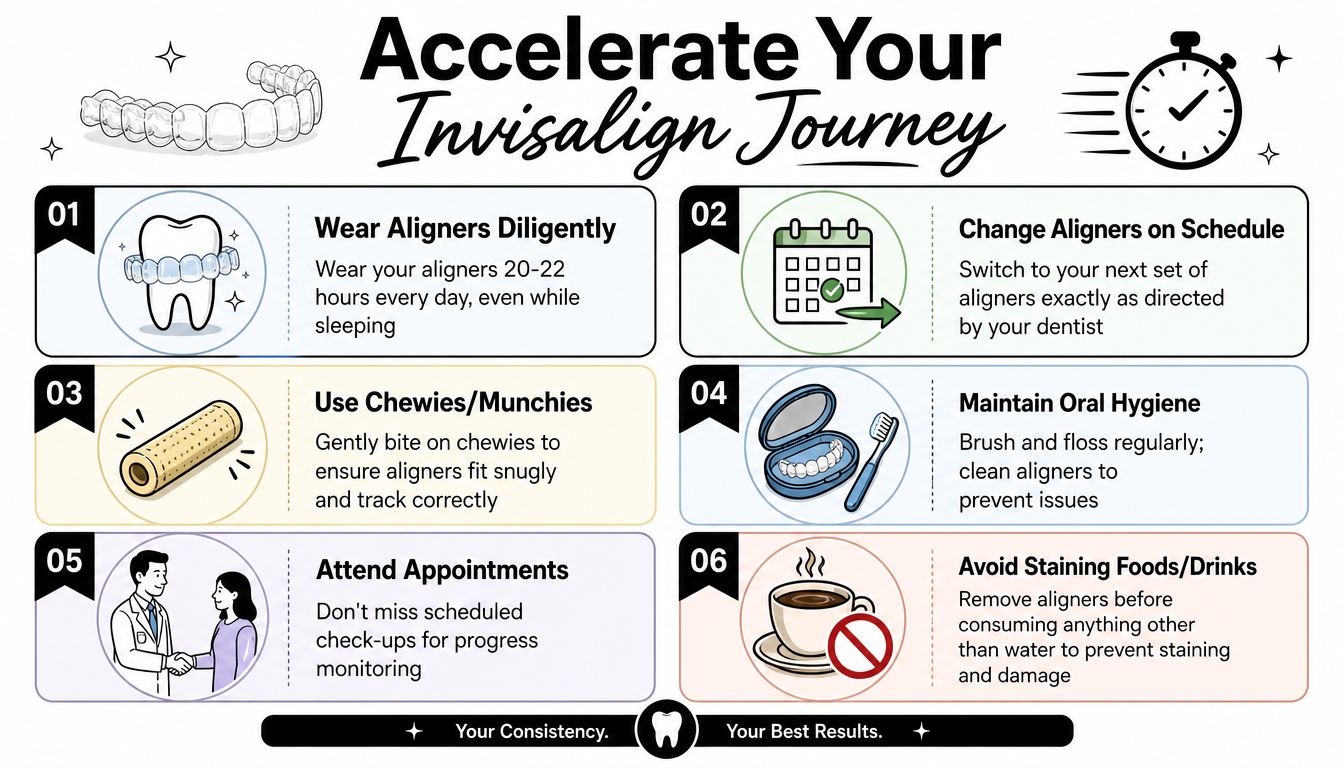
Early in treatment, it helps to see what good habits look like in action:
The habit that matters more than any other
According to Enjoy Orthodontics on clear aligner wear time, patients must wear Invisalign aligners for a minimum of 20 to 22 hours per day for the fastest and most effective results.
That number can feel demanding at first, so here is the practical way to read it. Your aligners should be in for nearly the whole day, coming out mainly for meals, brushing, and flossing. The trays only guide teeth while they are on your teeth.
Daily reminder: If the aligners are out, the teeth are on break too.
A practical checklist that keeps treatment moving
- Build your wear time during routine hours: Work, school, errands, and sleep usually give you the easiest consistent hours.
- Reinsert aligners right after eating: A 10-minute delay here and a 20-minute delay there can gradually shrink your total wear time.
- Follow your tray-change schedule closely: Switching too early or too late can slow tracking.
- Keep the trays clean and comfortable: Clean aligners are easier to wear for the full day.
- Keep your check-ins: Small tracking problems are simpler to correct when we catch them early.
- Plan weekends instead of winging them: If you know you have a party, long dinner, or sports event, decide in advance when the trays will come out and when they will go back in.
This short video gives a helpful visual overview of what consistent progress looks like in clear aligner treatment.
Small routines beat good intentions
Patients often assume faster progress comes from motivation alone. In real life, treatment stays on schedule when the routine is simple enough to repeat on busy days, tired days, and social weekends. Keep your case with you. Brush soon after meals. Put the trays back in before the next distraction arrives.
If you're the kind of person searching for dentist near me because you want clear advice you can use at home, here is the takeaway. Invisalign usually moves fastest when weekdays and weekends follow the same basic pattern. Consistency is what keeps your smile plan on time.
Your Invisalign Journey at Cali Family Dental
Starting Invisalign tends to feel much easier once you know what the first visit is like. Most patients arrive with a mix of excitement and uncertainty. They want straighter teeth, but they also want to know whether the process will be comfortable, realistic, and clearly explained.
At the first visit, Dr. Rafaat begins by listening. Some patients are focused on crowding in the front teeth. Others are more concerned with bite comfort, past shifting after braces, or how a straighter smile fits with other goals like teeth whitening or broader cosmetic treatment later on.

What the first steps usually feel like
The office uses digital scanners, so patients don't have to deal with messy traditional impressions. That scan creates a clear picture of the teeth and bite, and it helps shape a treatment plan that's easier to understand from the beginning.
Many patients say this is the moment Invisalign starts to feel real. The process becomes less abstract because they can see where they are starting and what the plan is meant to improve.
The experience through treatment
Once aligners are delivered, the next phase is about rhythm. You wear each set as directed, keep up with home care, and return for periodic check-ins so Dr. Rafaat can confirm that everything is tracking properly.
Those visits are also a good time to ask practical questions. If something feels tight, if a tray isn't seating well, or if your schedule has made consistency harder than expected, the team can help you correct course before a small issue becomes a delay.
Patients who come in for Invisalign often appreciate that the same office can also help with other needs under one roof, including cleaning and exams, dental x-rays, restorative dentistry, and services for urgent problems when an emergency dentist is needed.
The finish line matters too
When active treatment ends, retention begins. Retainers help preserve the smile you've worked for and reduce the chance of shifting over time.
That final stage shouldn't feel like an afterthought. It's part of protecting the comfort, appearance, and function created during treatment.
Frequently Asked Questions About Invisalign Speed
Do refinements add a lot of time
Sometimes they can add time, but not always a dramatic amount. Refinements are extra aligners used when small details still need improvement at the end of the initial plan. They don't mean treatment failed. They usually mean your dentist wants a more precise finish.
Is Invisalign faster for teens than adults
Teens may respond differently than adults, but age isn't the only thing that matters. Daily wear habits, case complexity, and how the teeth are tracking often matter more in practice. An adult who wears aligners exactly as directed may stay more on schedule than a teen who doesn't.
Will my teeth move back after treatment is done
They can if retainers aren't worn as directed. Teeth naturally tend to shift over time, especially right after active movement ends. Retainers help maintain the result and protect the investment you've made in treatment.
The end of Invisalign is not the end of maintenance. It's the start of protecting your result.
Can Invisalign help if I also need other dental treatment
Often, yes. Some patients begin Invisalign as part of a broader care plan that may include restorative or cosmetic work. In other cases, certain dental problems need attention first. A full exam helps determine the right order of treatment so everything supports a healthy, stable smile.
If you're in Pico Rivera, CA and want a clearer answer for your own case, the best next step is a consultation with a dentist who can evaluate your bite, explain your options, and map out a timeline that fits your real life.
If you're ready to find out how fast Invisalign can work for your smile, schedule a visit with Cali Family Dental. Dr. Rafaat and the team provide patient-focused care in Pico Rivera, CA with digital scanners, a full range of dental services, and a welcoming approach that helps you feel informed from day one. Whether you're looking for a dentist in Pico Rivera, CA, a cosmetic dentist near me, help with routine dental care, or guidance on Invisalign for yourself or your teen, this is a practical place to start.