A toothache rarely waits for a convenient time. You may be trying to find an emergency dentist, booking a new patient exam, or finally scheduling the cleaning and exam you've been putting off, and the first question that hits is usually the same. “Is this covered?”
That question matters even more when you're in Pico Rivera and trying to sort through Denti-Cal, Medi-Cal, or PPO dental benefits while you're already worried about pain, time off work, or the cost of treatment. Insurance language can feel vague on purpose. Patients hear words like deductible, annual maximum, frequency limitation, waiting period, and pre-authorization, then still don't get a simple answer about what they'll owe.
Knowing how to verify insurance coverage before your visit can remove a lot of that stress. It helps you avoid surprises, ask better questions, and walk into your appointment focused on your teeth instead of paperwork. If you've been searching for a dentist near me or a dentist in Pico Rivera, CA, this is the process that gives you clarity before treatment starts.
Navigating Dental Insurance in Pico Rivera
A common same-day call goes like this. Someone wakes up with swelling, a cracked tooth, or pain when chewing. They need care quickly, maybe a tooth extraction, maybe X-rays, maybe a crown, and they're trying to figure out whether their plan will help pay for it.
That's where dental insurance gets confusing. A plan can be active and still not cover the service you need the way you expect. A patient may assume a cleaning is covered because the policy is active, then learn the plan only allows it on a certain schedule. Another patient may have coverage for restorative dentistry but not for a cosmetic service such as teeth whitening or clear aligner treatment.
Why dental verification feels harder than medical verification
Dental coverage has more procedure-specific rules. Patients often need to confirm not just whether the plan is active, but also whether there are benefit caps, frequency limits, annual maximums, exclusions, and plan-type rules that affect a specific service.
Dental insurance isn't just “yes or no” coverage. It's usually a series of smaller rules that change depending on the procedure.
That matters in urgent situations. If you need an emergency exam, digital X-rays, a filling, root canal, or crown, you don't want to guess. You want a practical answer about what the insurer recognizes, whether your dentist is in network, and whether the treatment needs any advance review.
What local patients usually need to know first
For Pico Rivera families, three plan types come up often:
- Denti-Cal often requires close attention to procedure-specific rules and eligibility details.
- Medi-Cal can add another layer of confusion when patients aren't sure which dental benefits apply.
- PPO plans may offer flexibility, but out-of-pocket costs can change a lot depending on network status and plan structure.
Patients looking for a cosmetic dentist near me, dental implants near me, or help with restorative dentistry also need to know that insurance may treat those services very differently from preventive care.
If you start with the right questions and the right documents, the process becomes much easier. That's true whether you're booking a routine cleaning, a same-day emergency visit, or a more involved treatment plan.
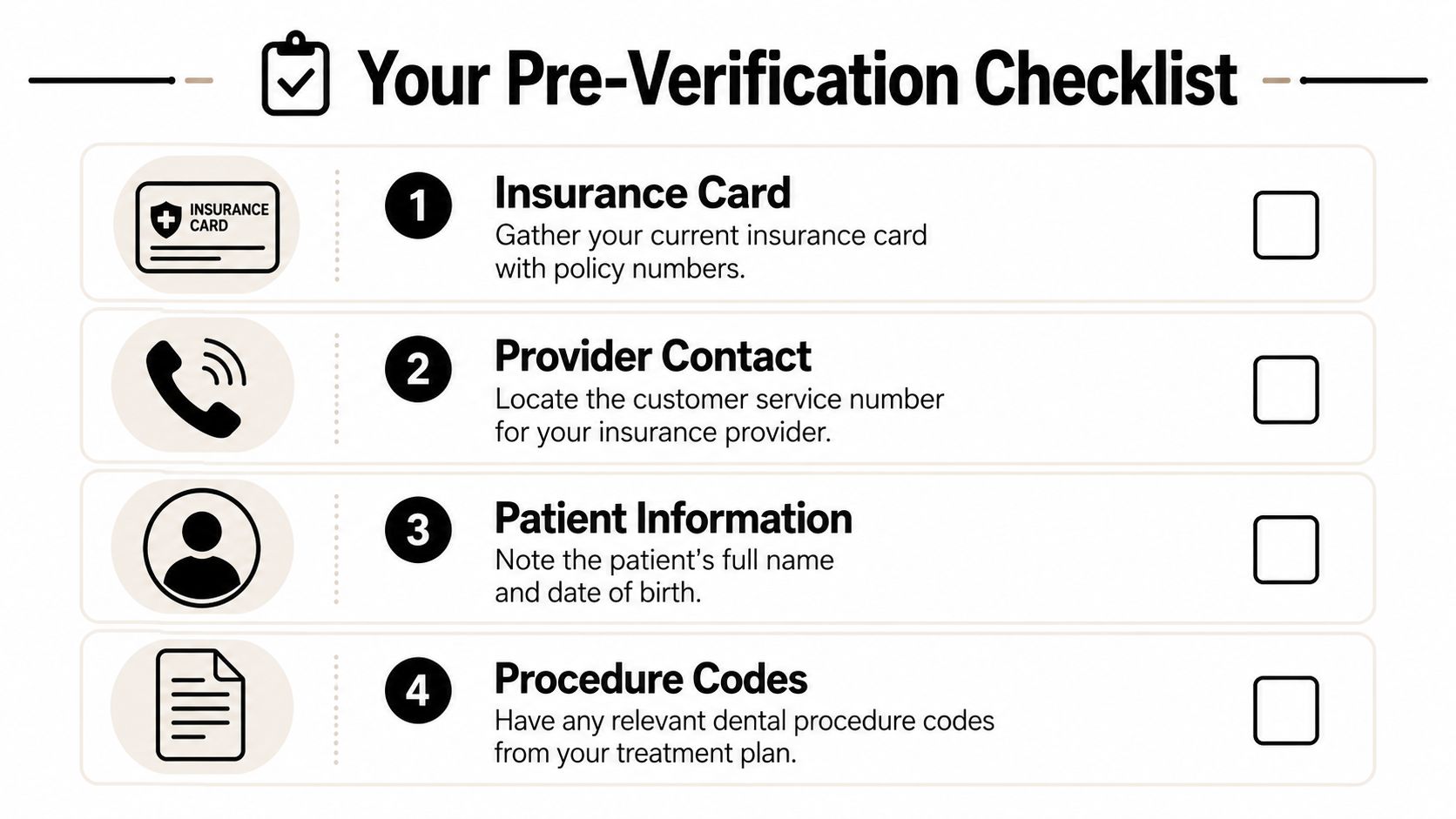
Your Pre-Verification Checklist What to Gather First
Before you call your insurance company or ask a front desk team to check benefits, get your information together. This saves time and helps prevent the most frustrating outcome, which is getting halfway through the call and realizing you're missing a member ID, group number, or the card itself.
According to Wisdom's guide to verifying dental insurance, practices must collect the patient's full name, date of birth, insurance company, member ID, group number, employer name, and a copy of the insurance card front and back.
What to have in front of you
- Insurance card front and back. This usually shows the plan name, member ID, group number, customer service number, and claims address.
- Patient full legal name. Use the name that appears on the policy, not a nickname.
- Date of birth. Insurers often use this to confirm identity before they discuss benefits.
- Member ID. This is the number tied to the covered person.
- Group number. This helps identify the employer-sponsored plan or benefit package.
- Employer name. Some plans still ask for it during verification.
- Customer service phone number. It's usually on the back of the card.
- Any treatment details you already have. If a dentist has given you a treatment plan, it helps to have the procedure name or code ready.
What those numbers actually mean
The member ID identifies you in the insurer's system. The group number identifies the plan your employer or sponsoring organization purchased. If two family members are on the same policy, they may share a group number but have different member details.
The phone number on the card matters because insurers often have separate lines for medical, dental, pharmacy, and providers. Calling the wrong line can waste time and lead to incomplete answers.
Practical rule: If you have a treatment estimate, keep it next to your insurance card during the call. Asking about “a crown on a back tooth” gets better answers than asking vaguely about “dental work.”
What about Social Security Numbers
Many patients still think they must provide an SSN to verify benefits. In practice, that's often no longer necessary. Modern healthcare verification platforms can identify active coverage using demographic information like name, address, and date of birth, and Experian's healthcare overview explains how probabilistic matching can help find coverage without relying on SSNs.
That matters in a diverse community where some patients don't want to share an SSN, don't have one available, or are trying to verify benefits quickly from a phone. If an office asks for it, it's reasonable to ask whether they can verify using other identifiers first.
Questions to Ask Your Dental Insurance Provider
Once you have your documents ready, the next step is asking the right questions. At this stage, many patients lose money without realizing it. They ask, “Am I covered?” and the insurer says yes, but that answer leaves out the details that affect the bill.
For dental plans, that gap is important. Data from the American Dental Association (2024) shows that 32% of dental claim denials stem from unverified benefit caps or frequency rules, yet only 12% of eligible verification guides include dental-specific checklists. That's why your call should focus on the exact service, not just general eligibility.
Phone call or portal
A phone call is often better when you need a same-day answer for an urgent issue, an emergency exam, or a treatment recommendation such as a crown, root canal, or extraction. A member portal can be useful for checking plan basics, but it may not spell out every exception or limitation clearly.
If you call, keep a pen ready and write down the representative's name, the date, and what they tell you. If you use a portal, save screenshots of the benefit summary.
A simple script that works
You can say:
“I have a dental appointment coming up and I'd like to verify my benefits for specific services. Can you confirm whether my plan is active, whether my dentist is in network, and what my coverage looks like for preventive, basic, and major services?”
Then move into narrower questions.
Key Questions for Your Insurer
| Category | Question to Ask |
|---|---|
| Active coverage | Is my dental plan active right now, and what is the effective date? |
| Network | Is this dental office in network for my specific PPO or dental plan? |
| Preventive care | Are routine cleanings, exams, and dental X-rays covered, and are there any frequency limits? |
| Basic services | How are fillings or deep cleanings covered under my plan? |
| Major services | How are crowns, bridges, dentures, or dental implants handled under my plan? |
| Deductible | Do I have a deductible, and has any of it already been met? |
| Annual maximum | What is my annual maximum, and how much of it has already been used? |
| Waiting periods | Is there a waiting period for major or restorative services? |
| Exclusions | Are any recommended services considered cosmetic or otherwise excluded? |
| Pre-treatment review | Do I need a pre-authorization or pre-determination for this procedure? |
| Specialist rules | If I need referral-based care, does my plan require anything in advance? |
| Patient share | What part of the cost is typically my responsibility for this category of care? |
For many dental plans, Dental ClaimSupport's checklist explains that coverage often follows a common structure of 100% for preventive, 80% for basic, and 50% for major services. That doesn't mean every plan follows it exactly, but it gives you a useful framework for asking sharper questions.
Ask about limits, not just percentages
A plan may say it covers preventive care, but you still need to ask whether there's a frequency rule. A plan may say it covers major services, but you still need to ask whether there's a waiting period, annual maximum, or missing tooth clause.
If you're considering dental implants near me, cosmetic dentistry, or same-day treatment after an urgent exam, ask the insurer to explain the category they place that service in. That one detail often changes the cost more than patients expect.
Confirming In-Network Status and Pre-Authorizations
The phrase “we accept your insurance” can sound reassuring, but it doesn't always mean what patients think it means. The question that matters most is whether the office is in network for your exact plan, not just willing to bill it.
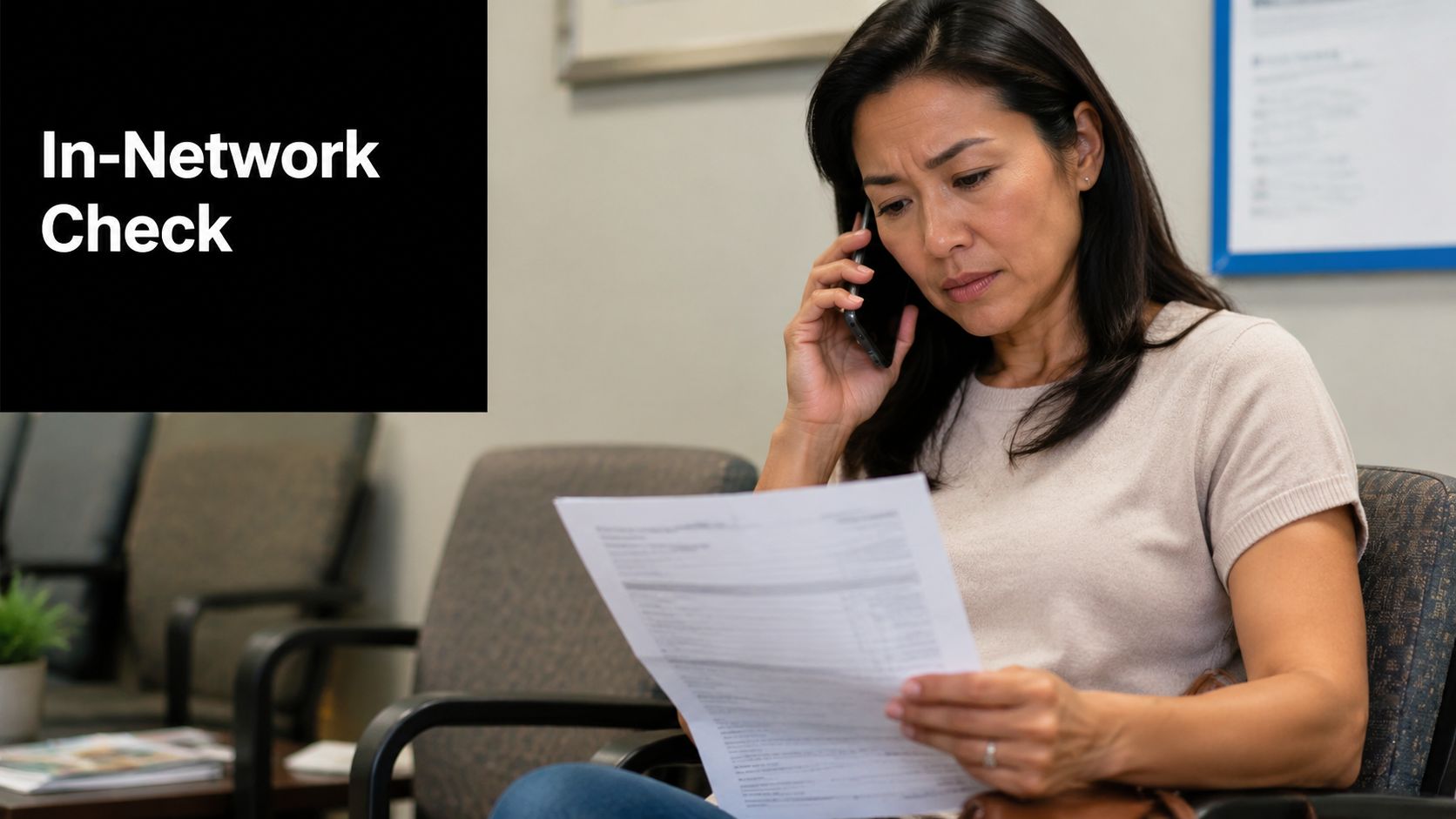
For PPO patients, this distinction can change your share of the cost significantly. In-network offices work within the insurer's contracted fee schedule. Out-of-network benefits may still exist, but reimbursements can differ, and your out-of-pocket amount may be higher.
What to confirm about network status
When you call the insurer, ask for the office's network status under your exact plan name, not just the insurance company name. A dentist may participate with one PPO product and not another.
For local patients searching for a dentist in Pico Rivera, CA, this is especially important when booking same-day care. You don't want to arrive for an emergency visit and find out later that the office was out of network for the plan variation you carry.
Why pre-authorizations matter
Large treatment plans bring another risk. If a service needs pre-authorization or a pre-determination and nobody checks, the claim can be denied even when the patient assumed they had benefits.
According to Outsource Strategies' insurance verification guidance, failing to confirm pre-authorization requirements for specific procedures leads to 35% of denied claims in dental and medical settings, and 22% of those denials are irreversible even after appeal.
That's why pre-authorizations are not optional for services that may trigger extra review. Think crowns, bridges, oral surgery, implant-related care, or treatment plans with several steps.
Here's a quick explainer that helps many patients understand the difference between benefits and approval before treatment:
A useful phrase during the call
Ask this directly:
“For this procedure, does my plan require a pre-authorization or pre-determination before treatment, and if so, what information does the office need to send?”
That wording gets you closer to a real answer. It tells the insurer you're not asking only about active coverage. You're asking whether there is an advance review step that could affect payment.
If you're dealing with Denti-Cal, Medi-Cal, or a PPO in an urgent scenario, this is one of the few questions that can prevent a very expensive misunderstanding.
How Our Pico Rivera Dental Team Helps You Verify
A common same-day call sounds like this: a patient in Pico Rivera has a cracked tooth, the pain started overnight, and they need to know whether Denti-Cal, Medi-Cal, or a PPO will help before they come in. In that moment, vague answers are not helpful. Patients need clear next steps and a realistic estimate of what still may need to be confirmed at the visit.
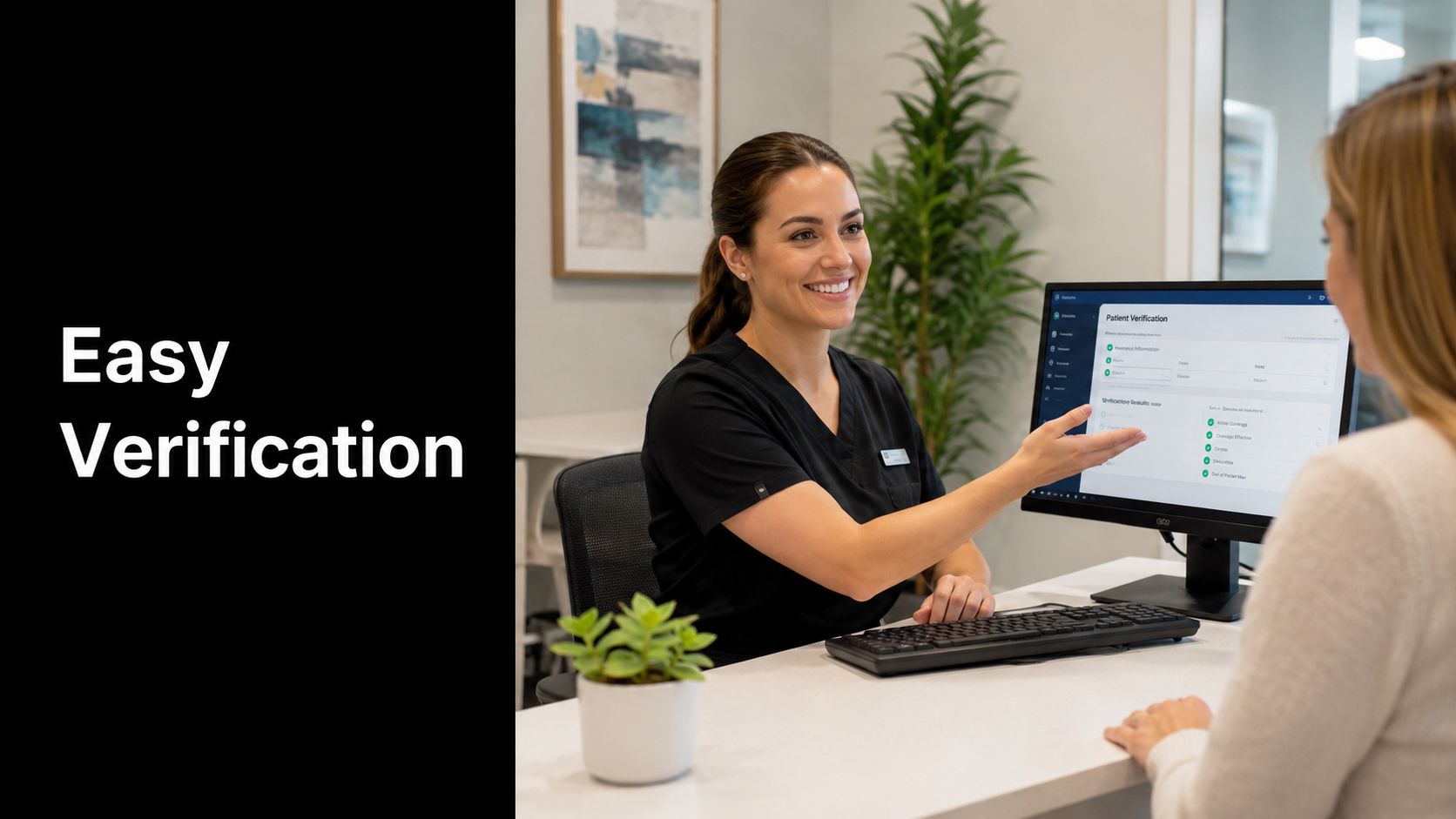
Our front desk process is built for that kind of call. We collect the member ID, patient name, date of birth, and the plan details exactly as they appear on the card. Then we verify eligibility, check the plan type, and look for the details that often cause confusion in dental care, such as frequency limits, waiting periods, missing tooth clauses, annual maximums, and whether the visit is being routed through a medical or dental benefit.
That office review matters because urgent dental visits can change quickly. A patient may book for an exam and X-rays, then need a same-day extraction, pulpal treatment, or antibiotics after the doctor evaluates the tooth. For Denti-Cal and Medi-Cal patients, one of the first questions is whether the service fits the covered dental benefit and whether any program rules limit timing or place of service. For PPO patients, we also check network status and whether the plan uses a reduced fee schedule, coinsurance, or a deductible that still applies.
We also help patients ask better questions. If someone has already called their insurance and got a partial answer, we compare what they were told against the information on file and flag mismatches before treatment starts. That saves time at check-in and reduces the chance of a billing surprise later.
At Cali Family Dental, patients can send insurance information while scheduling so our team can start the verification process before the appointment. For same-day visits, we do as much as we can with the information available, then tell patients what is confirmed, what is estimated, and what may still depend on the clinical exam or insurer response.
A few practical steps help the process go faster:
- Send a photo of the front and back of the insurance card.
- Use the subscriber's full name if the patient is covered under a parent or spouse.
- Share any referral, authorization number, or recent plan change.
- Tell the team if the visit is urgent and what treatment you think you may need.
- Bring the current card to the office, even if you already uploaded it.
I always tell patients the same thing. Verification helps us give better cost guidance, but it is not the same as a final guarantee of payment from the insurance company. The goal is clarity before care, especially when someone is in pain and trying to make a decision quickly.
Schedule Your Appointment with Confidence
A common same-day call in our Pico Rivera office goes like this: a patient has a broken tooth, pain that started overnight, and an insurance card in hand, but no clear idea what the plan will help pay for. In that moment, the goal is not to know every final dollar before the exam. The goal is to get enough verified information to decide whether to come in now, what to bring, and which costs may still depend on the diagnosis.
That is especially true with dental coverage. Denti-Cal, Medi-Cal-linked benefits, and PPO plans do not answer questions in the same way, and urgent visits add time pressure. A cleaning, a limited emergency exam, X-rays, a filling, or an extraction can each be handled differently by the plan.
Clear answers before the chair helps people say yes to care
Patients usually feel calmer once they know three things: whether the office can bill the plan, whether the visit itself is likely covered, and whether any part of treatment may still need approval. That clarity helps families make faster decisions, especially when someone is in pain or trying to fit a same-day visit into work and school schedules.
According to eClaimStatus on insurance verification checklists, practices that use standardized verification checklists reduce claim denials by up to 30%, improve first-pass payment acceptance to 92%, and see 95% fewer financial disputes when coverage is verified before treatment.
What the appointment usually looks like
Once the insurance questions are narrowed down, the visit is easier to follow. The team can focus on the tooth, the gums, the swelling, the broken filling, or the treatment question that brought you in.
You should expect:
- A front-desk review of your plan details and any recent insurance changes
- An exam that matches the reason for the visit, especially for pain, swelling, trauma, or a same-day concern
- A plain-language treatment discussion that separates what needs attention now from what can wait
- A cost estimate when enough information is confirmed, with any remaining unknowns clearly pointed out
I tell patients this often. Verification gives you a better map, not a promise from the insurance company. That distinction matters with dental plans because coverage can still depend on frequency limits, missing tooth clauses, downgrades, waiting periods, or what the doctor finds during the exam.
If you have been putting off treatment because insurance feels confusing, start with the call anyway. A short verification step often turns a stressful unknown into a practical plan for the visit.
If you are ready to book with Cali Family Dental, our Pico Rivera team can review Denti-Cal, Medi-Cal-related dental information, or PPO details before the appointment and tell you what is confirmed, what is estimated, and what may still need follow-up. Patients coming in for urgent care, a first exam, restorative treatment, or cosmetic services can also ask about the $69 New Patient Special that includes an exam, digital X-rays, and a routine cleaning. Contact the office to schedule.