You run your tongue along a tooth and it feels different. The edge near the gumline seems more exposed. Maybe cold water has started to sting, or your teeth look a little longer in the mirror than they used to. That moment catches people off guard. Gum recession often creeps in slowly, then suddenly becomes impossible to ignore.
For patients searching for a dentist near me in Pico Rivera, CA because of sensitivity, an uneven gumline, or concern about losing support around a tooth, the good news is that treatment has come a long way. Today, two advanced options often come up in the same conversation: the traditional gum graft and the Pinhole Surgical Technique. Both aim to protect exposed roots and improve the appearance of the gumline, but the patient experience can feel very different depending on which path fits your case.
Your Trusted Pico Rivera Dentist for Gum Recession
A common visit starts with a simple concern. A patient notices one front tooth looks longer than the one beside it. Another says brushing has become uncomfortable near the gumline. Someone else found the problem after searching “dentist in Pico Rivera, CA” or “emergency dentist” because a sharp sensitivity made them worry something was seriously wrong.
Those concerns are valid. Receding gums can affect comfort, appearance, and long-term tooth support. In practice, patients usually want the same answers right away. Is this fixable? Will treatment hurt? How long will recovery take? Will my smile look natural afterward?
Dr. Amirreza Rafaat approaches those questions with the kind of calm explanation patients need when they already feel anxious. With more than 24 years of experience, he focuses on making complex treatment choices easy to understand. That matters because gum recession isn't a one-size-fits-all problem, and the best recommendation depends on the shape of the recession, the thickness of the tissue, your brushing habits, and your goals.
Two treatment paths patients usually compare
The comparison often comes down to these two options:
- Traditional gum graft involves moving tissue, often from the roof of the mouth, to cover an exposed root.
- Pinhole Surgical Technique uses a tiny access point to gently reposition your existing gum tissue over the recessed area without scalpels or sutures.
Both are established ways to treat recession. The difference is usually less about whether treatment works and more about how the experience feels for the patient.
Many patients don't ask first, “Which procedure is older?” They ask, “Which one lets me heal more comfortably and smile with confidence sooner?”
That's the right question. People considering cosmetic dentist near me, restorative dentistry, or even broader dental care often discover that gum health affects all of it. A healthy gumline supports not just comfort, but the look and stability of your smile.
Why local expertise matters
If you live in Pico Rivera or nearby communities, it helps to work with a dentist who can evaluate both function and appearance in the same visit. Gum recession sometimes exists alongside other needs such as cleaning and exams, dental x-rays, crowns, implants, or cosmetic improvements.
A careful local evaluation helps answer the question that matters most. Not “Which treatment sounds newer?” but which treatment makes sense for your mouth.
Understanding Gum Recession and Why Treatment Is Important
Gum recession means the gum tissue has moved away from the tooth, exposing more of the tooth surface and sometimes part of the root. It can happen slowly enough that people miss it at first. They may only notice when cold drinks sting, floss catches in a new way, or the smile starts to look uneven.
What causes recession
Several things can contribute, and more than one factor is often involved.
- Brushing too hard can wear away tissue over time, especially with a stiff brush or scrubbing motion.
- Periodontal disease can weaken the supporting tissues around teeth.
- Genetics can leave some patients with naturally thinner gum tissue.
- Bite pressure or clenching may add stress around certain teeth.
- Tooth position can make some roots more vulnerable if they sit closer to the outer bone.
One reason patients are surprised by this diagnosis is that it's very common. Studies show that nearly 50% of the population has some degree of gum recession, making it one of the most common dental issues patients face, though many don't realize treatment options are available (NCBI review on gingival recession).
What happens if you ignore it
Recession isn't only about appearance. The root surface isn't protected the same way the crown of the tooth is. Once that area is exposed, problems can build.
- Sensitivity often becomes the first daily annoyance.
- Root decay becomes easier to develop in the exposed area.
- Plaque control gets harder when the shape of the gumline changes.
- The smile can look uneven if some teeth appear longer than others.
- Tooth support can worsen if the underlying cause continues without treatment.
Practical rule: If your tooth looks longer, feels more sensitive, or has a notch near the gumline, don't assume it's only cosmetic.
Patients who come in for new patient exams, dental care, or even unrelated treatment sometimes learn that early gum treatment can prevent bigger restorative problems later. That's where a dentist who also provides broader services like fillings, crowns, tooth extraction, and dental implants near me can help connect the dots. If recession progresses too far, the conversation may eventually shift from preserving a tooth to replacing one. Protecting the gumline early is often the better road.
Why treatment matters beyond the gums
Healthy gums support nearly every part of dentistry. They affect how a crown fits, how a smile looks after teeth whitening, and how stable a tooth remains over time. In that sense, recession treatment sits at the intersection of prevention, cosmetics, and restorative dentistry.
The Traditional Gum Graft Procedure
For many years, the traditional gum graft has been the standard treatment for exposed roots. It's still a strong option in the right case, and patients shouldn't think of it as outdated. It's a time-tested procedure designed to rebuild coverage where the gumline has pulled back.
How the procedure is done
The most common version is a connective-tissue graft. A small section of tissue is typically taken from the roof of the mouth, then placed over the recessed area and secured so it can heal into position.
From the patient's perspective, the visit usually starts with numbing the area thoroughly. Once you're comfortable, the dentist prepares the recession site, places the grafted tissue, and stabilizes it with sutures. Because tissue is often taken from the palate, there are usually two healing areas to think about after treatment.
What recovery often feels like
When comparing Pinhole Surgical Technique vs gum graft, many patients pause. A graft can be very effective, but the donor site on the roof of the mouth is often what people remember most during recovery.
Common patient concerns include:
- Tenderness while eating because the palate can feel sore
- More awareness after the numbing wears off
- A need for softer foods while the area heals
- Extra care with brushing and flossing near the treated site
That doesn't mean the experience is unmanageable. It means patients should understand it clearly before choosing it.
A gum graft asks your mouth to heal in more than one place. For some patients, that trade-off is worth it. For others, it's the main reason they ask about less invasive options.
When a gum graft makes sense
Traditional grafting can be a very good choice when the tissue quality, recession pattern, or anatomy calls for added thickness or a more conventional surgical approach. It can also be appropriate when the dentist wants direct control over tissue placement in a very specific area.
Patients looking for long-term protection often do well with this treatment when they're prepared for the healing process and follow instructions carefully. In a consultation, the key question isn't whether grafting works. It does. The primary concern is whether it's the best fit for your recession pattern and your comfort goals.
The Minimally Invasive Pinhole Surgical Technique
The Pinhole Surgical Technique, often called PST, was developed for patients who want root coverage without the traditional experience of cutting, stitching, and taking tissue from the roof of the mouth. It's one of the most appealing options for patients who value a gentler recovery and a more natural-looking transition at the gumline.
How PST works
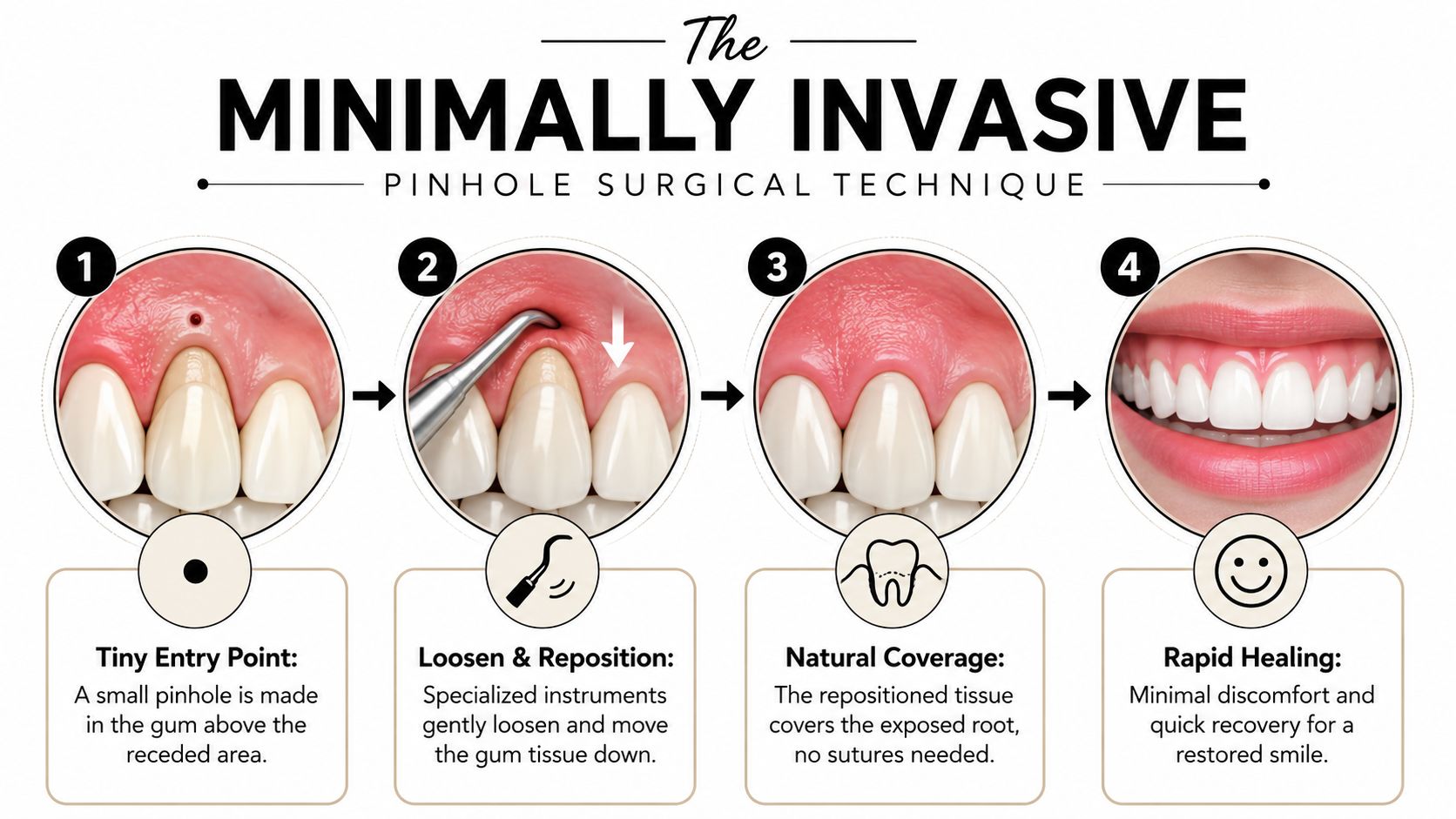
Instead of making incisions, the dentist creates a very small entry point in the gum tissue above the recessed area. Through that opening, specialized instruments gently loosen the existing tissue and guide it down over the exposed root.
Because the technique repositions tissue that's already there, there's no second surgical site on the palate. There are also no sutures holding grafted tissue in place.
That difference changes the whole feel of treatment for many patients.
What patients often like about it
Individuals considering pinhole surgical technique vs gum graft are usually focused on the lived experience, not the terminology. PST tends to stand out for a few practical reasons.
- No scalpel-based cutting of the gumline
- No sutures
- No donor tissue taken from the roof of the mouth
- A more natural visual blend because the original gum tissue is repositioned
- The ability to address more than one tooth area efficiently, depending on the case
For patients who are nervous about oral surgery, those points can significantly reduce the mental barrier to treatment.
A quick visual can help clarify the process:
Why technique and training matter
PST is not “easier gum treatment.” It requires precision, good case selection, and a careful understanding of soft tissue behavior. The dentist has to know when the tissue can be predictably repositioned and when a traditional graft may still be the better answer.
The best minimally invasive procedure is the one that's used in the right patient, for the right recession pattern, by a dentist who knows when not to force it.
That's why a proper exam matters. Some recession cases are excellent candidates for PST. Others need the structure and tissue augmentation that a graft can provide. The value of this modern option is real, but so is the need for an honest recommendation.
Comparing Gum Graft and Pinhole Surgery Side by Side
Patients usually don't need a lecture here. They need a clear side-by-side look at what each option means in real life. The patient experience thus becomes the deciding factor for many families looking for a dentist near me in Pico Rivera.
| Factor | Traditional Gum Graft | Pinhole Surgical Technique (PST) |
|---|---|---|
| Procedure approach | Uses grafted tissue placed over recession | Repositions existing gum tissue through a tiny opening |
| Incisions | Typically involved | Avoided |
| Sutures | Usually required | Not required |
| Donor site | Often from the roof of the mouth | No donor site |
| Recovery experience | More involved because more than one area may heal | Usually easier for patients who want a less invasive experience |
| Appearance after treatment | Effective root coverage, with healing changes over time | Often appealing to patients seeking a natural gumline look |
| Multiple teeth | Depends on the case and surgical plan | Can be efficient for broader areas in selected cases |
| Best fit | Cases that need a traditional surgical approach or added tissue support | Cases suited for minimally invasive repositioning |
Comfort and pain level
This is often the biggest issue in Pinhole Surgical Technique vs gum graft. A traditional graft can leave patients sore both where the recession was treated and where tissue was taken. PST avoids that second surgical site, which is a major advantage for comfort-focused patients.
That said, “minimally invasive” doesn't mean “zero sensation.” Patients can still expect tenderness and need to protect the area while it stabilizes. The difference is usually in the overall intensity and complexity of recovery.
The palate donor site is often the deciding factor for patients who want to avoid a more uncomfortable healing experience.
Recovery and daily routine
Recovery isn't just about pain. It's about eating, brushing, sleeping, and returning to normal habits. Gum graft patients usually need to be more mindful of both sites during healing. They may need a modified diet for longer and often feel more restricted early on.
PST patients typically appreciate that there's no palate wound to protect. For busy adults, parents, and anyone who doesn't want a drawn-out postoperative routine, that can be a meaningful difference.
Visual result
Both treatments aim to restore a healthier gumline and cover exposed root surfaces. A graft can produce excellent protection and appearance, especially in experienced hands. PST often appeals to patients because the tissue being repositioned is their own existing gum tissue, which can create a smooth, natural transition.
Some patients are mostly concerned about sensitivity. Others are equally focused on how the smile looks in photos or conversation. In those cases, the cosmetic feel of the result matters just as much as the functional protection.
What works and what doesn't
Here's the balanced answer patients deserve.
What works well with gum grafting
- Predictable treatment in many established surgical cases
- Useful when added tissue support is needed
- Strong choice when recession anatomy favors a graft
What works well with PST
- Patients who want less invasive care
- People who strongly want to avoid donor tissue from the palate
- Cases where multiple areas may be managed efficiently
What doesn't work with either approach
- Ignoring the cause of recession after treatment
- Continuing aggressive brushing
- Skipping follow-up care and home care instructions
The real decision point
The best choice usually comes down to anatomy, goals, and tolerance for recovery. If you want the broadest rule of thumb, it's this:
If your case qualifies for PST and your top priorities are comfort, faster recovery, and a natural-looking gumline, it often becomes the preferred recommendation. If your tissue needs more structural reinforcement, a graft may still be the smarter choice.
Costs Insurance and Long-Term Success Rates
Cost is part of the decision, but it shouldn't be the only one. The more useful question is whether the treatment recommended for your mouth is also workable with your insurance and budget.
What affects cost
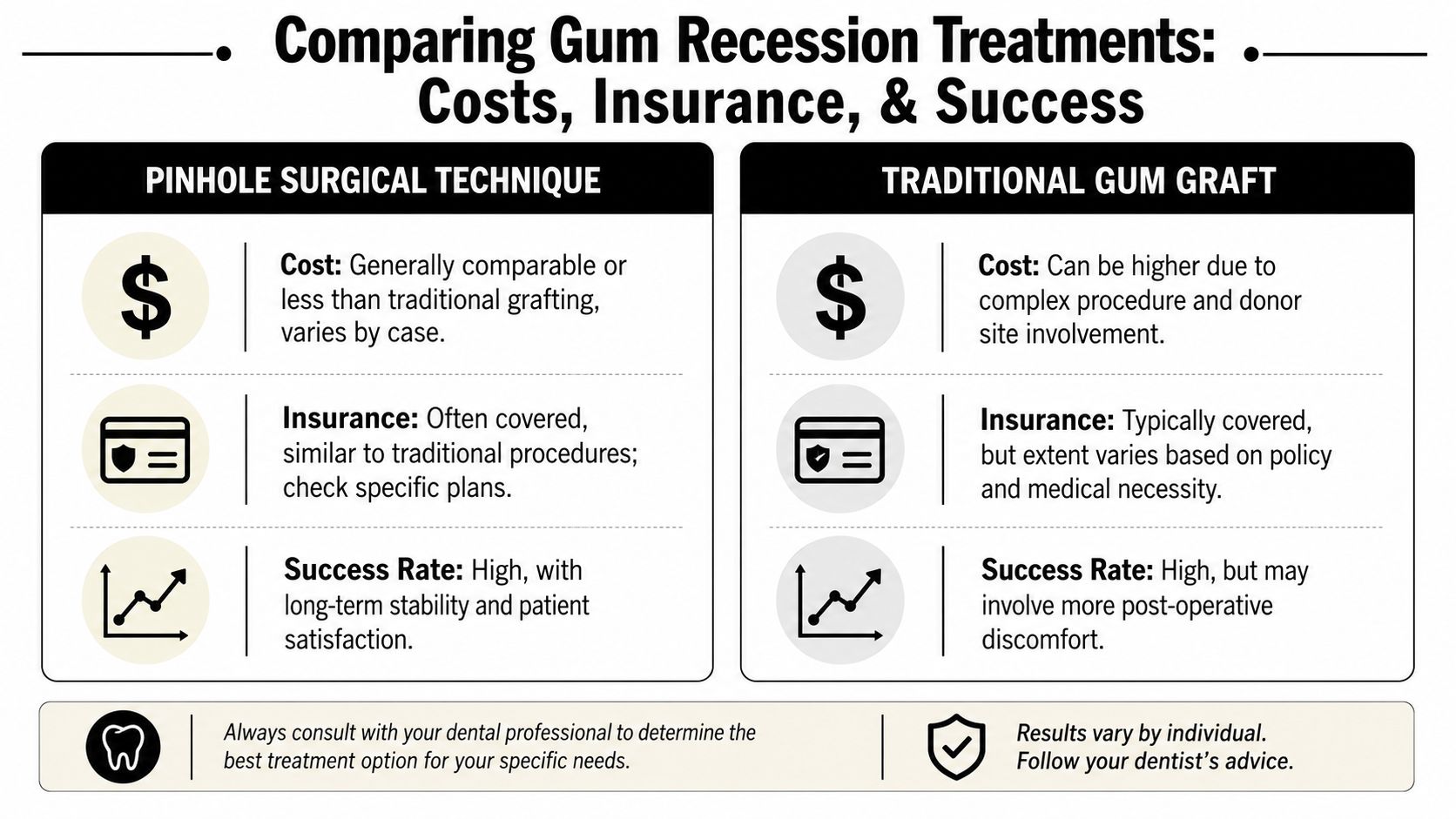
The final fee can vary based on the number of teeth involved, the complexity of the recession, whether additional periodontal care is needed, and which procedure best fits the case. Because of that, it's better to think in terms of case-specific treatment planning rather than expecting one flat price.
In many offices, both gum grafting and PST may be covered in a similar way when the treatment is considered medically necessary. Coverage depends on the details of the plan, not just the name of the procedure.
For patients in Pico Rivera, access matters. A practice that accepts Denti-Cal, Medi-Cal, and most PPO insurance plans, and also offers financing, removes a major barrier to getting care before recession worsens.
Long-term success depends on more than the procedure
Patients often ask which treatment “lasts longer.” The practical answer is that both can be successful long term when the case is chosen well and the patient maintains the result.
Long-term stability depends on factors like:
- Home care habits including gentler brushing technique
- Managing periodontal disease if it contributed to recession
- Routine maintenance visits for exams and cleanings
- Bite and grinding evaluation when excess force is part of the problem
A beautifully performed procedure can still fail if the original cause keeps damaging the tissue.
Value is bigger than the fee
If recession treatment prevents root decay, ongoing sensitivity, or the future need for more involved restorative care, it can protect much more than appearance. It may also help preserve options for future treatment if a tooth later needs a crown or other restorative dentistry.
For some patients, the higher value is the comfort and convenience of a less invasive experience. For others, it's the confidence of a traditional graft that fits a difficult anatomy. The best recommendation is the one that balances biology, comfort, and affordability without forcing a technique that doesn't match the case.
Schedule Your Gum Health Consultation in Pico Rivera
Reading about treatment is helpful, but it won't tell you which option your gums can support. That takes an exam. A consultation lets the dentist check the depth and pattern of recession, evaluate tissue thickness, review sensitivity, and look for the reason the recession started in the first place.
What to expect at the visit
Patients in Pico Rivera should expect a consultation that feels informative, not rushed. Modern diagnostics can include digital X-rays, intraoral cameras, and digital scanners that replace messy impressions. Those tools help patients see what the dentist sees, which makes treatment decisions easier to trust.
A strong consultation should also cover more than the procedure itself. It should answer:
- Why the recession happened
- Whether you're a candidate for PST
- Whether a traditional graft would give a more reliable result
- How to protect the result after treatment
- How insurance and financing may apply
That kind of visit is especially valuable if you've also been searching terms like cosmetic dentist near me, dental implants near me, or tooth extraction, because gum health can shape the order and timing of other treatment decisions.
Why early evaluation pays off
The earlier recession is evaluated, the more conservative the discussion can often be. Patients sometimes wait because they assume the issue is minor or purely cosmetic. Then sensitivity worsens, the root becomes harder to protect, or a more involved restorative plan becomes necessary.
An appointment now can give you clarity before the problem expands. It can also give you peace of mind if the recession is mild and only needs monitoring, hygiene changes, or a less invasive plan.
If you're new to the office, a limited-time $69 new patient special that includes an exam, digital X-rays, and a routine cleaning can be an easy first step toward understanding your gum health and deciding what comes next.
If you're noticing longer-looking teeth, root sensitivity, or an uneven gumline, schedule a consultation with Cali Family Dental. Dr. Amirreza Rafaat and the team provide patient-focused gum recession care in Pico Rivera, including minimally invasive Pinhole Surgical Technique, along with a complete range of dental care, emergency dentist visits, restorative dentistry, cosmetic services, and new patient exams.