A mother stands in a kitchen at midnight, phone in hand, trying to decide whether to call 988, the police, or no one at all. Her adult son hasn't slept in days, insists nothing is wrong, and refuses medication he once agreed helped him.
That scene sits underneath much of the debate around the Treatment Advocacy Center. For some families, the question isn't whether the mental health system needs reform. It's what happens when someone is clearly unraveling and still says no to treatment.
A System in Crisis A Family's Search for Help
At 2 a.m., the argument in many homes is no longer about medication. It is about what counts as help. A father wants to call a crisis team. His daughter says that will only make his wife more afraid. The person at the center of the crisis may be hearing voices, refusing care, and still nowhere near the legal threshold for involuntary intervention.
That gap between visible deterioration and legal action shapes the family experience more than any policy paper does.
When refusal isn't simple refusal
Clinicians and family advocates often point to anosognosia, a condition in which a person does not recognize that they are ill. The concept is widely discussed in schizophrenia research and by the National Institute of Mental Health's overview of schizophrenia. In practical terms, a person can reject treatment not because they have weighed the options and declined, but because the illness itself has altered insight.
For relatives, that distinction matters. It can mean watching unpaid bills, lost housing, job loss, or repeated emergency room visits while being told that an adult has the right to refuse care. It can also mean fearing police contact, jail, or street homelessness long before a judge would consider the situation an emergency.
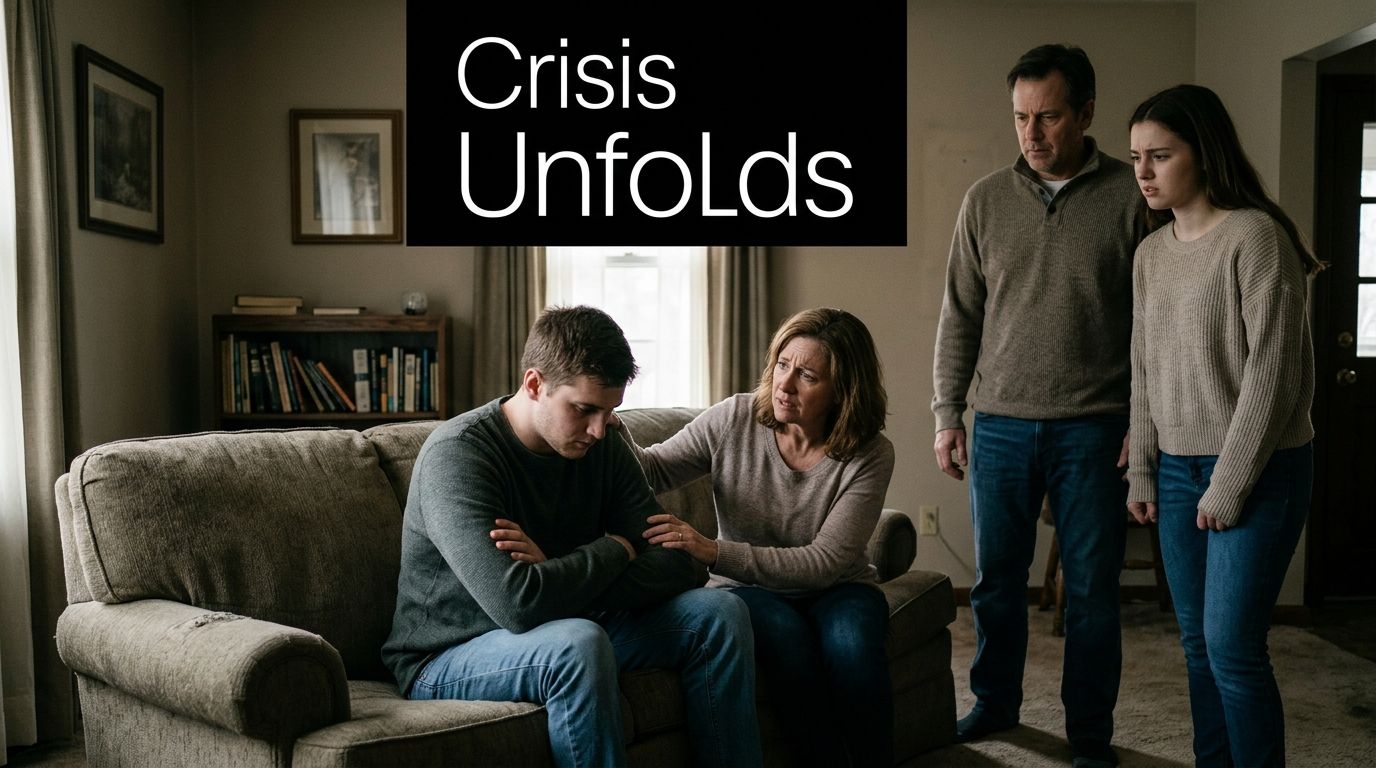
Families usually aren't looking for a legal theory. They're looking for a way to keep someone alive, housed, and connected to care.
The scale of serious mental illness is large. The federal government's 2023 NSDUH detailed tables from SAMHSA estimate that millions of U.S. adults live with serious mental illness in a given year. Research and public agencies have also documented higher rates of homelessness and justice-system contact among people with untreated psychiatric disorders, though estimates vary sharply depending on definitions, settings, and whether substance use is measured separately.
That uncertainty matters too. Advocacy groups such as TAC cite those failures as evidence that the system intervenes too late. Disability rights advocates and many peer-led organizations argue that crisis statistics can be used too broadly, especially when they blur the difference between people who need housing and community care, and people who meet a legal standard for coercion.
The question families keep asking
For some caregivers, support for the Treatment Advocacy Center begins with a practical question. If someone is getting sicker, rejecting treatment, and cycling through short hospital stays, what is left besides court involvement?
The choices can feel narrow:
- Wait and hope: symptoms may settle, or the crisis may deepen.
- Call crisis services: help may come, but the response can be unpredictable.
- Ask a court to intervene: treatment may become possible, and trust may suffer.
Those options help explain TAC's appeal. The organization speaks to families who believe the current system mistakes psychiatric deterioration for ordinary refusal until the consequences become severe.
But the same moment produces a different conclusion for critics. They argue that desperation can make coercion look like the only serious option, even when voluntary models, peer support, housing, and sustained outreach may work better for some people and do less harm. That tension sits at the center of the debate, and it starts long before any court order is filed.
What Is the Treatment Advocacy Center
The Treatment Advocacy Center, often called TAC, doesn't run clinics or offer direct psychiatric treatment. Its role is policy, law, and public argument.
Where TAC came from
The organization was originally announced as the NAMI Treatment Advocacy Center in 1997 and is based in Alexandria, Virginia, with a mission centered on removing barriers to treatment for people with severe mental illness. That mission includes schizophrenia spectrum disorders, severe bipolar disorder, and major depression with psychotic features, according to the Treatment Advocacy Center overview.
Its identity has long been tied to one issue above all others: support for legally compelled outpatient services, commonly called assisted outpatient treatment, or AOT.
What TAC is trying to change
TAC's public stance starts from a simple claim. A subset of people with severe mental illness don't reliably engage in care because the illness itself disrupts judgment, insight, or both. In that view, mental health policy fails when it treats every refusal as fully informed and fully voluntary.
That outlook shapes the group's work across several areas:
| Focus area | How TAC approaches it |
|---|---|
| Treatment access | Pushes for policies that reduce barriers to psychiatric care |
| Mental health law | Supports statutes that allow court-ordered outpatient treatment |
| Public education | Publishes explainers and family-oriented materials on severe mental illness |
| System reform | Argues for stronger continuity between crisis care, hospitalization, and community treatment |
TAC is also known for supporting research and policy development around psychiatric care delivery. Its broader framework focuses on improving treatment access for severe mental illness in the United States while engaging with issues that have relevance beyond any single state.
Why the organization remains influential
TAC occupies a distinctive space in the mental health field. Many advocacy groups emphasize rights, peer support, stigma reduction, and voluntary services. TAC puts greater weight on untreated illness, impaired insight, and the harms that can follow when systems wait too long.
Key distinction: TAC is best understood as a policy advocacy organization, not a treatment provider.
That difference matters. When families find TAC, they're usually not finding a place to book an appointment. They're finding arguments, legal frameworks, state-by-state information, and a vocabulary for saying that severe illness can sometimes block a person's ability to seek help.
Supporters see that as realism. Critics see it as a model that can overvalue compulsion and undervalue patient autonomy.
Both readings contain part of the truth. TAC's influence comes from how clearly it answers a painful question many institutions answer poorly: what should happen when a person is sick enough to deteriorate, but not willing enough to participate in care?
Understanding Assisted Outpatient Treatment
A judge signs an order. The person at the center of it is not being sent to a locked ward. They are being told they can stay in the community, but only under court-supervised treatment.
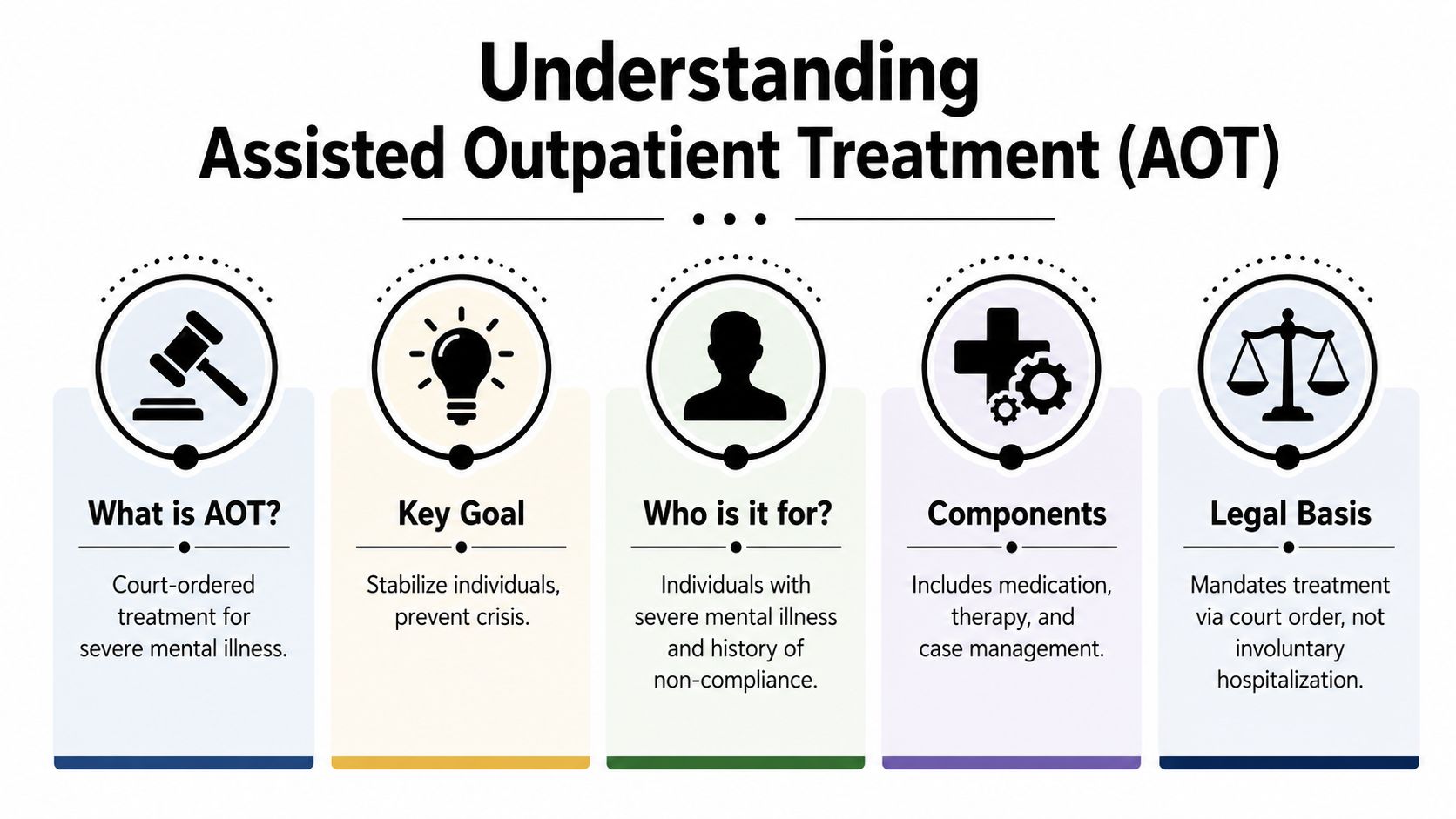
That is the basic structure of assisted outpatient treatment, or AOT, the policy tool most closely tied to the Treatment Advocacy Center's work. In general, AOT allows courts to require a person with serious mental illness to follow a treatment plan while living outside a hospital. Depending on state law, that plan can include medication, therapy, case management, substance use treatment, or scheduled clinical appointments.
What AOT is and isn't
AOT sits in the space between voluntary outpatient care and inpatient commitment. It uses legal authority, but it is designed for community living. Supporters often describe it as an earlier intervention, one meant to respond before another psychiatric emergency, arrest, eviction, or hospitalization.
The details differ by state. So do the criteria. In many places, eligibility turns on a documented pattern of relapse, repeated hospitalization, arrest, violence, or inability to follow treatment that clinicians believe is tied to serious mental illness.
TAC has made that pattern central to its case for reform. Its argument is that some people cycle through short hospital stays and unstable housing because the system offers help only after a crisis becomes acute, then fails to hold treatment together once the immediate danger passes.
Why TAC pushes for it
For TAC, AOT is less a medical innovation than a legal answer to a service gap. The organization argues that families and clinicians are often left with two bad options: wait for visible danger, or watch someone deteriorate while refusing care. In that view, a court order gives the treatment system a way to intervene before the next collapse.
That argument also reflects a larger shortage in psychiatric care capacity, as noted earlier in the article. TAC uses that shortage to make a broader policy point. If inpatient beds are limited and crisis care is episodic, policymakers will keep looking for ways to enforce continuity in the community.
Critics read the same situation differently. They argue that a fractured system does not justify coercion. If people cannot reliably get housing, peer support, trauma-informed care, transportation, and regular outpatient appointments, they say, a court order may compel compliance on paper without solving the conditions that make treatment hard to sustain.
How supporters describe its purpose
Supporters usually present AOT as a preventive tool, not a punishment. Their case tends to rest on three claims:
- It can create continuity. A court order may keep a person connected to services longer than a voluntary referral would.
- It aims to reduce repeat crises. The goal is to intervene before another emergency room visit, arrest, or involuntary hospitalization.
- It gives families and clinicians a mechanism they often lack. In systems with high thresholds for inpatient care, AOT can function as a middle option.
That helps explain why some relatives see AOT as humane. They are often responding to a specific history of relapse, fear, and failed handoffs between hospitals and community care.
Still, the core tension is hard to avoid. AOT is built on the idea that some people need treatment they would not choose on their own. That is precisely why supporters consider it necessary, and why opponents consider it dangerous. The unresolved question is not whether court oversight can produce adherence. It is whether enforced adherence leads to meaningful recovery, especially as patient-led and voluntary models gain stronger evidence and broader support.
The AOT Debate Efficacy vs Ethics
For parents, spouses, and siblings who have watched someone cycle from psychosis to the emergency room to a brief discharge and back again, the argument for court-ordered outpatient care can feel less theoretical than urgent. For psychiatric survivors, disability rights advocates, and many clinicians focused on recovery, the same policy can look like a familiar expansion of state control into one of the most intimate parts of life: whether to accept treatment.
The case for AOT
Support for AOT usually starts with a narrow question. What should the system do when a person repeatedly deteriorates, refuses care, and does not meet the threshold for long-term inpatient commitment until a crisis has already become dangerous?
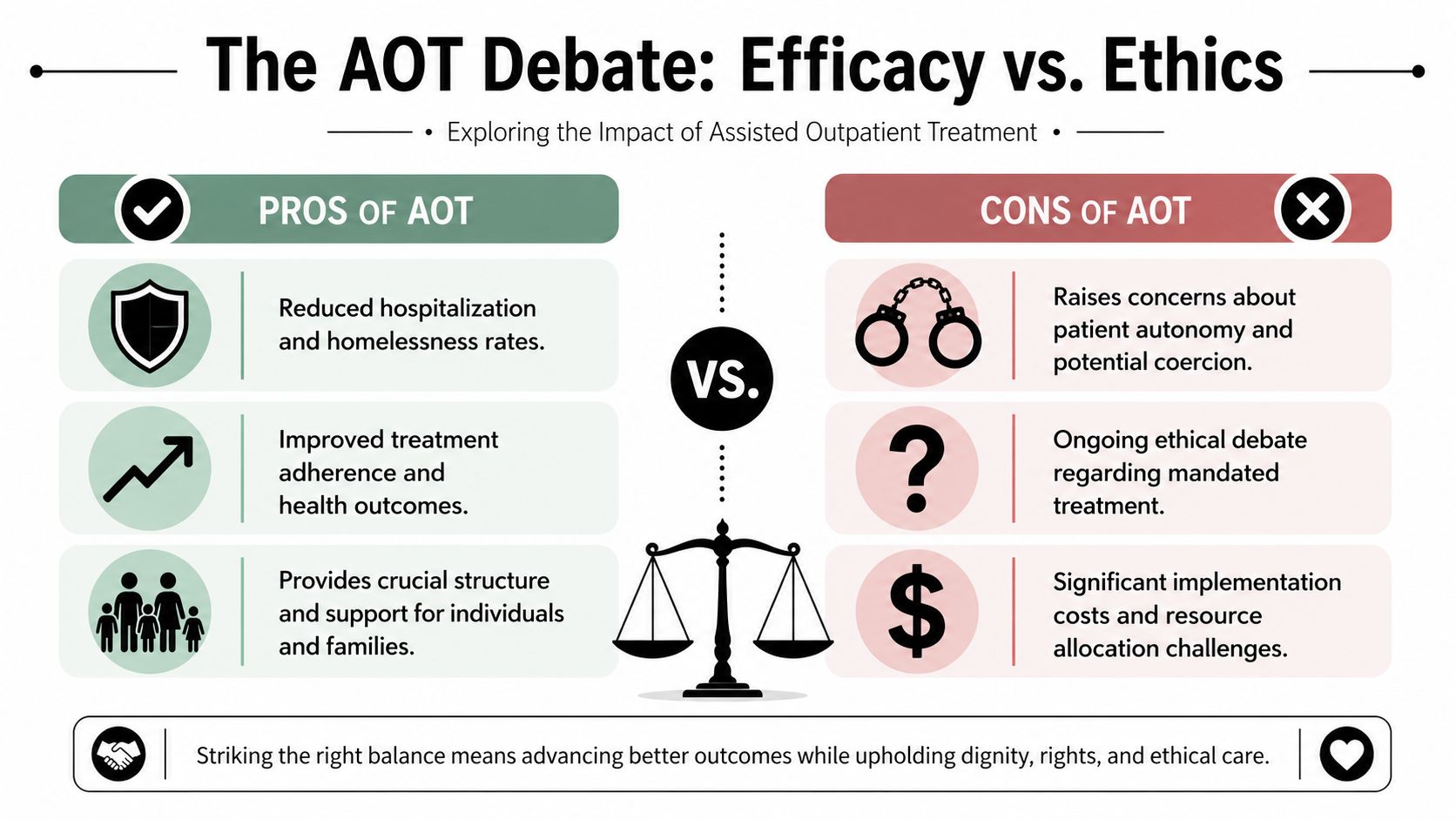
TAC and other AOT supporters argue that court oversight can interrupt that cycle. A summary cited earlier describes pilot program outcomes in which participants had fewer hospitalizations and fewer involuntary commitment petitions. For families who have run out of voluntary options, those results help explain why AOT is often framed as a practical intervention rather than an ideological one.
Supporters also make a harder claim, one that sits at the center of TAC's work. In some serious mental illnesses, they argue, refusal of treatment may reflect impaired insight rather than a stable, informed choice. Under that view, waiting for full voluntary consent can mean waiting through preventable losses of housing, health, and safety.
The ethical challenge
Critics accept that AOT may create short-term stability for some people. Their concern is what kind of treatment system gets built when legal pressure becomes an accepted answer to psychiatric crisis.
A court order changes the relationship before the first appointment begins. The person is living in the community, but the treatment plan is no longer fully voluntary. Civil liberties groups, disability advocates, and many people with lived experience argue that this matters not only as a legal issue, but as a clinical one. Trust is hard to build under coercion.
The same summary cited earlier notes a core criticism of AOT: compelled treatment can weaken trust in mental health services and may discourage future help-seeking. That tension often gets flattened in public debate. A person can comply with treatment and still feel alienated by how that compliance was obtained.
Some opponents go further. They argue that AOT can normalize a system that responds to suffering with surveillance and court involvement before it provides stable housing, peer support, transportation, culturally responsive care, or trauma-informed services.
Ethical tension: A policy can reduce visible crises and still raise serious questions about autonomy, dignity, and long-term recovery.
What the evidence does and does not settle
The evidence base around AOT is often presented more cleanly than the policy reality deserves. Supporters point to reduced hospitalization, fewer acute episodes, and relief for families. Critics respond that these outcomes can be difficult to separate from the quality and intensity of services attached to the court order.
That distinction matters. If people do better under AOT, is the court mandate driving the change, or is improvement coming from better access to treatment, follow-up, and case management that should have been available without a judge's order?
This is the part of the debate TAC's critics say is too often overlooked. The policy argument is not only about whether compulsion can produce adherence. It is also about whether the same public investment, directed into voluntary and patient-led models, could produce similar or better outcomes without the civil liberties costs.
Side by side concerns
| Supporters of AOT emphasize | Critics of AOT emphasize |
|---|---|
| Fewer repeated crises and hospital returns | Reduced autonomy and legal pressure |
| A response to impaired insight in severe illness | The risk of redefining disagreement as incapacity |
| A tool families can use before danger escalates | Damage to trust that may undermine later engagement |
| Structured follow-up in fragmented systems | The possibility that courts substitute for better voluntary care |
The disagreement becomes especially sharp around anosognosia, the symptom TAC and allied advocates frequently cite to explain why some people reject treatment. Supporters see it as a medical reality that policy has to confront. Opponents warn that, in practice, systems can apply that concept too broadly and give clinicians and courts too much authority over contested judgments about insight, risk, and choice.
Why the dispute persists
The divide is not between compassion and indifference. It is a conflict between two theories of care.
One theory holds that some people with severe psychiatric illness cannot reliably choose treatment during periods of decompensation, and that limited coercion may prevent much greater harm. The other holds that durable recovery is more likely when treatment begins with consent, material support, and relationships the patient helps shape.
That second view has gained traction as recovery-oriented and peer-led approaches have accumulated support. It does not erase the cases families describe, or the crisis conditions that make AOT politically persuasive. But it does sharpen the central question around TAC's agenda: whether compulsory treatment is the least harmful response to system failure, or whether it has too often become the response systems choose instead of building stronger voluntary care.
Alternative Paths Voluntary Recovery Models
The most important challenge to TAC's framework is not that severe mental illness is manageable without support. It's that support doesn't always have to begin with a court order.
A growing body of advocacy and program design favors voluntary, community-led recovery models. These approaches usually emphasize peer connection, stable housing, practical support, and treatment relationships built through consent rather than legal compulsion.

What these models do differently
Voluntary recovery programs typically start from a different assumption than AOT. Instead of asking how to compel adherence, they ask how to make engagement possible.
That can mean peer-led support, trauma-informed care, help with daily stability, and a treatment culture that gives the person a stronger sense of ownership. The goal isn't less seriousness about illness. It's a different theory of what produces durable participation.
In public debate, these programs are sometimes dismissed as too idealistic for people with the most disabling symptoms. But the available comparison included in the material around TAC complicates that assumption.
The comparison that matters
According to a discussion citing recent National Institute of Mental Health data, 72% of individuals in voluntary, community-led recovery programs maintained stable housing and medication adherence without court oversight, compared to 58% in AOT programs with similar severity levels, as reported in the Philanthropy Roundtable discussion of the Treatment Advocacy Center.
That finding doesn't prove AOT never works. It does suggest the policy conversation is often too narrow. If voluntary models can outperform compelled outpatient treatment on stability and adherence in comparable populations, then AOT can't be treated as the obvious gold standard.
The real policy question may not be AOT or nothing. It may be whether systems have underbuilt the voluntary options that many people would choose if they were accessible, consistent, and trustworthy.
Why this angle changes the TAC conversation
Many overviews of the Treatment Advocacy Center fall short, explaining TAC's legal agenda but skipping the competing recovery philosophy gaining traction in practice and policy discussions.
A balanced view has to hold both possibilities at once. Some people may need court-ordered intervention at certain points in illness. Others may do better when they aren't pulled into treatment through legal force. The harder task for policymakers is figuring out whether AOT is being used as a carefully limited tool or as a substitute for stronger voluntary systems.
That distinction matters because funding, political attention, and institutional habits don't spread evenly. When compulsory treatment dominates the conversation, voluntary care can end up looking optional even when it may be more sustainable for many patients.
Resources for Families Navigating the System
Families facing severe mental illness rarely need one more slogan. They need usable information, fast. That includes legal information, crisis contacts, and support from organizations that don't all share the same philosophy.
How to use TAC without treating it as the only voice
The Treatment Advocacy Center can be useful even for readers who don't agree with all of its positions. Its materials are especially relevant for families trying to understand how severe mental illness law works in their state, what AOT means locally, and how systems interact when treatment, housing, benefits, or the criminal legal system overlap.
A practical starting point is TAC's community resource center for schizophrenia, psychosis, and family support. That hub includes family-facing materials on topics such as anosognosia, psychiatric decompensation, medication management, emergency planning, and state-by-state treatment law navigation. TAC also notes there that it isn't a direct service provider, doesn't offer medical advice or legal services, and encourages independent judgment when evaluating outside resources.
Other places families may want to consult
No single organization captures the whole debate over mental health care. If you're trying to make decisions that fit your family's values, it's worth reading across viewpoints.
Consider looking at:
- NAMI: Offers education, family support, and local affiliate connections.
- Mental Health America: Often emphasizes early intervention, rights, and voluntary care.
- SAMHSA: Provides federal mental health resources, treatment locators, and general guidance.
- 988 Suicide & Crisis Lifeline: A crisis option when someone may be at immediate risk.
If there is immediate danger or a psychiatric emergency, use emergency services or 988 rather than waiting for a policy answer to solve a crisis in real time.
A practical way to move forward
When families are overwhelmed, broad research can feel impossible. A narrower checklist helps.
- Write down the pattern. Track symptoms, hospital visits, medication history, and changes in functioning.
- Learn your state rules. Treatment law differs widely, especially around civil commitment and outpatient orders.
- Talk to more than one organization. Compare perspectives on AOT, family rights, and voluntary care.
- Ask what support exists before crisis. Housing, case management, peer support, and outpatient follow-up can matter as much as legal tools.
- Keep crisis numbers accessible. Severe mental illness often worsens unevenly, and timing matters.
The Treatment Advocacy Center has become prominent because it answers a question many families can't avoid. But the best next step for any household depends on more than one organization's answer. It depends on the person's symptoms, the local system, the available services, and the values a family wants to protect while seeking safety.
If you're also taking care of your family's everyday health needs, Cali Family Dental offers patient-focused care in Pico Rivera with same-day appointments, complete family dentistry, and clear treatment guidance. Whether you're looking for a trusted dentist near me, an emergency dentist, tooth extraction, cosmetic dentistry, or dental implants near me, the team provides preventive, restorative, cosmetic, and surgical services in one welcoming office. Their technology includes digital X-rays that can reduce radiation exposure by up to 90% compared with traditional film X-rays, according to Cali Family Dental, and patients exploring implants can learn more about long-term replacement options supported by a reported 95% 10-year success rate when placed by experienced providers at the practice contact page. If you're in Pico Rivera, California and want a local dental office that emphasizes comfort, explanation, and prompt care, contact Cali Family Dental to schedule an appointment or consultation.